Melt-in-Your-Mouth Chinese Pineapple Tart Recipe
Buttery, crumbly pastry wrapped around homemade spiced pineapple jam. The Chinese pineapple tart is the classic Lunar New Year cookie from Singapore and Malaysia.
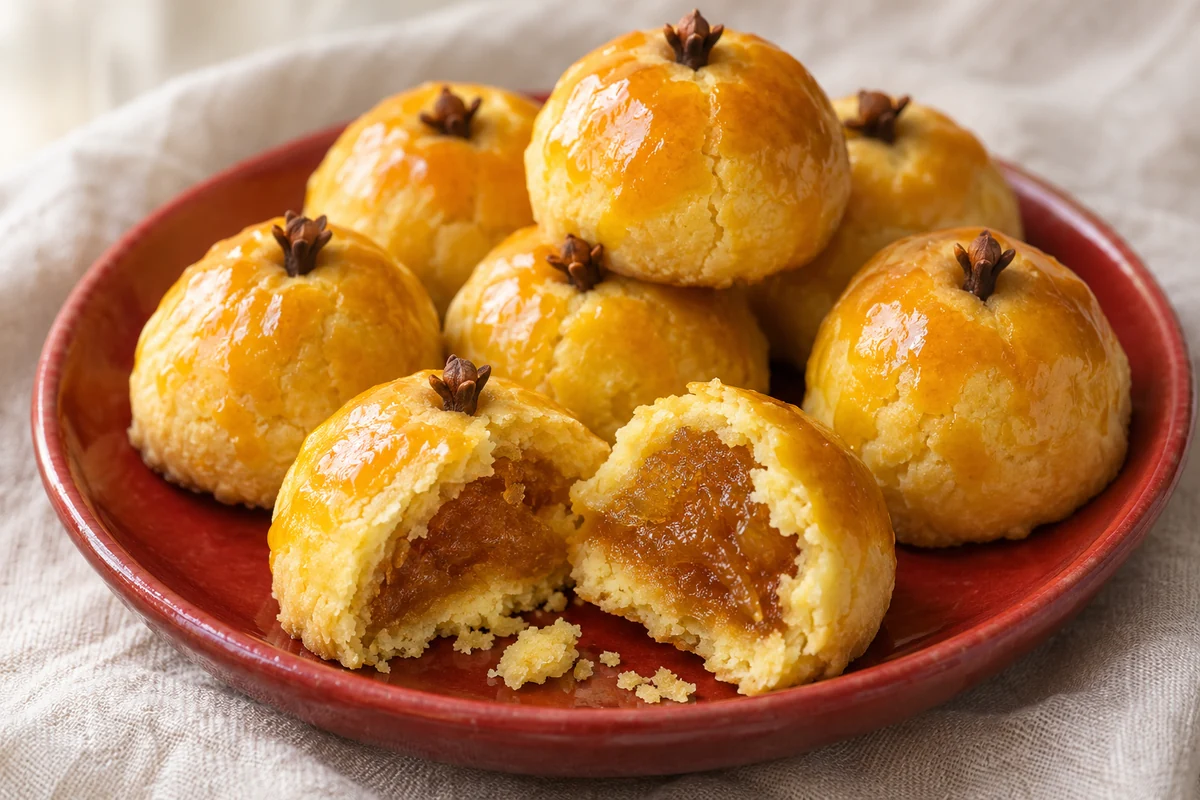
A Chinese pineapple tart is a two-bite cookie: buttery pastry that crumbles the second you bite it, wrapped around a sticky jam cooked down from fresh pineapple with cinnamon, clove and star anise. In Hokkien, the word for pineapple, "ong lai," sounds like "fortune comes," which is why tins of these appear on coffee tables across Singapore and Malaysia before Lunar New Year. Plan on just over five hours start to finish, and most of that is the jam simmering while you do something else.
Why You'll Love These Chinese Pineapple Tarts
- The pastry melts instead of snapping. Yolks, cornstarch and milk powder keep it short and tender, so it breaks apart on your tongue.
- The jam tastes like fruit, not just sugar. It's homemade from fresh pineapple and gently spiced, and you control the sweetness.
- They're built to be made ahead. Baked tarts keep for two weeks in an airtight tin and taste better on day two than day one.
- One dough gives you three shapes: enclosed balls, open-faced flowers, or little rolls.
Keep the pineapple juice, but don't cook it with the pulp. Drain the grated fruit, boil the juice by itself over high heat until it turns syrupy, then add the pulp back.
Juice on its own can take a hard boil without catching, so you keep its flavor and its caramel color without spending extra time evaporating that liquid at the gentler heat the pulp needs.
Read Before You Start
Chinese pineapple tarts reward patience more than skill, and two habits make the biggest difference.
Use the widest pan you own for the jam. Water leaves the jam from its surface, so a 12-inch skillet or a wok reduces grated pineapple much faster than a deep saucepan. A tall pot holds the same fruit in a thicker layer, which means slower cooking and more scorched patches on the bottom.
Weigh the dough and the jam. Around 12 g of dough to 9 g of jam bakes into a thin, even shell. Push the jam much higher and the filling expands in the oven faster than the pastry can stretch, which is where most cracks come from. A digital scale also makes every tart the same size, and same-size tarts finish baking at the same time.
Ingredient Notes
The jam and the pastry for Chinese pineapple tarts each use a short list, and every item is there for a reason.
Fresh pineapple: Ripe fruit brings the sweetness and the acidity that keeps the jam from tasting flat. Pick one that smells sweet at the base and has a mostly golden rind. Canned crushed pineapple works too (see the FAQs), though the jam tastes milder.
Granulated sugar: One cup is a starting point. Taste once it dissolves and add up to 1/4 cup more if the fruit was tart. Sugar also does structural work here: it's what lets the jam hold a rolled ball and keep for weeks.
Cinnamon stick, cloves and star anise: Use them whole and pull them out at the end. Ground spices turn the jam a muddy brown.
Unsalted butter: It should be softened until a finger leaves a dent while the block still holds its shape, around 65°F (18°C). Butter that has gone soft and greasy makes a dough that slumps in the oven. Keep the creaming short for the same reason I do in my No-Spread Christmas Sugar Cookies: air beaten into butter expands in the heat and pushes the shape out of line.
Powdered sugar: It melts into the butter without grit, and the little bit of cornstarch it contains keeps the crumb tender. It's the same reason my Classic Butter Cookies use it instead of granulated.
Egg yolks: Two go into the dough and one into the glaze. Yolks add fat, richness and color. Don't substitute whole eggs for the yolks: the whites add water and protein that set firm, which turns a crumbly crust cakey.
All-purpose flour and cornstarch: Cornstarch has no gluten-forming protein, so it dilutes the flour and keeps the pastry from turning chewy.
Milk powder: Adds a rounder, milky flavor and helps the pastry brown gently. Full-cream or nonfat both work. If you can't find it, replace it with an equal weight of cornstarch.
Salt: A quarter teaspoon sharpens the butter against a very sweet filling.
No vanilla, no cheese: Plenty of versions add vanilla extract or grated cheese to the pastry. I leave both out: vanilla extract is alcohol-based, cheese rennet varies by brand, and next to a spiced jam neither one adds much.
Equipment Needed
- Digital kitchen scale that reads in grams.
- 12-inch nonstick skillet or a wok: For the jam.
- Box grater or food processor: Pulse it, don't purée.
- Fine-mesh sieve: To drain the juice.
- Soft-bristled pastry brush: Since a stiff one drags the soft dough.
- Light-colored aluminum baking sheets: Because dark pans brown the bottoms before the tops color.
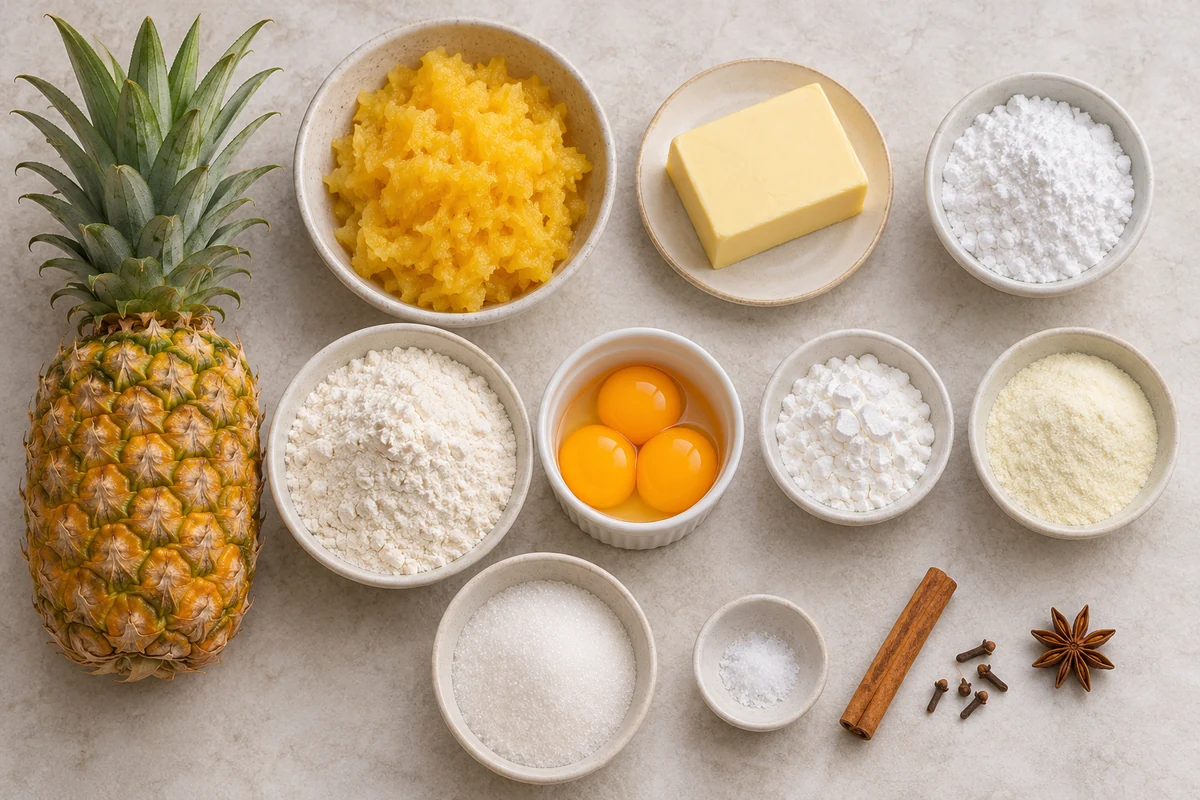
Ingredients for Chinese pineapple tarts laid out: fresh pineapple, butter, egg yolks, flour, milk powder, sugar and whole spices
Step-by-Step: How to Make Chinese Pineapple Tarts
Grate the Pineapple and Drain the Juice
Chinese pineapple tarts come together in two stages, jam first and pastry second. Before you start, separate 3 eggs: two yolks for the dough, one for the glaze. The whites can go into an omelet. Set the butter out on the counter when the jam goes on the stove so it softens while you cook.
Peel the pineapples, cut out the eyes, quarter them lengthwise and slice away the hard core. Grate the flesh on the large holes of a box grater, or pulse chunks in a food processor in short bursts until finely chopped but not liquid. Fine shreds give the jam its slightly fibrous bite; a purée cooks into something closer to fruit leather.
Tip the grated fruit into a sieve set over a bowl and press gently with a spoon. You should collect about 2 cups of juice.
Reduce the Juice, Then Cook the Pulp
Pour the juice into the skillet with the cinnamon stick, cloves and star anise. Boil it hard over high heat for 15 to 20 minutes, until it's down to about 1/2 cup and the bubbles turn large, slow and glossy.
Add the drained pulp and lower the heat to medium. Cook for about 40 minutes, stirring every few minutes, until the pan looks mostly dry and the pulp starts to cling to the bottom.
Add the Sugar and Cook to an Amber Paste
Stir in the sugar. The mixture will turn wet again at first, because sugar pulls liquid out of the fruit. Lower the heat to medium-low and keep stirring often now, since sugared fruit catches fast. After 25 to 35 minutes the jam should be a deep golden amber, and a spatula dragged through it should leave a clean trail that doesn't flood back.
Then do the plate test: cool a teaspoon on a plate for 2 minutes and try to roll it between your palms. If it forms a ball without smearing, it's done. Hot jam always looks looser than it will be once cool, so judging by eye goes wrong in both directions. Pulled too early, the jam is too soft to roll and leaks in the oven. Cooked past amber, it sets chewy and hard after baking. Taste, add more sugar while it's hot if needed, and fish out the whole spices.
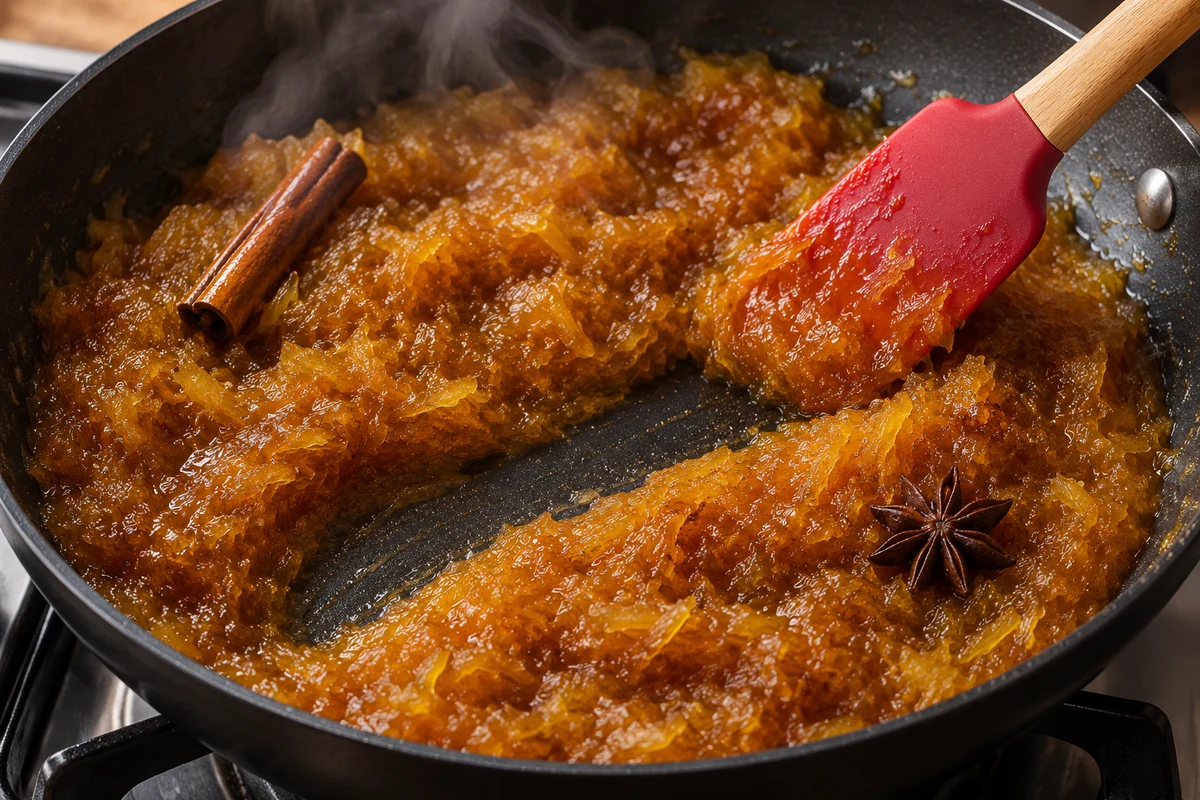
Thick amber pineapple jam for Chinese pineapple tarts in a wide skillet, with a spatula trail that holds its shape
Cool and Portion the Jam
Spread the jam over a plate or tray and let it cool to room temperature, about 1 hour.
Now the step most people skip: weighing. Pinch off 9 g portions and roll them into balls with lightly greased hands. You'll get about 55, with a few spoonfuls left over. Set them on a parchment-lined plate and refrigerate while you make the dough. Cold, firm jam is far easier to wrap than room-temperature jam.
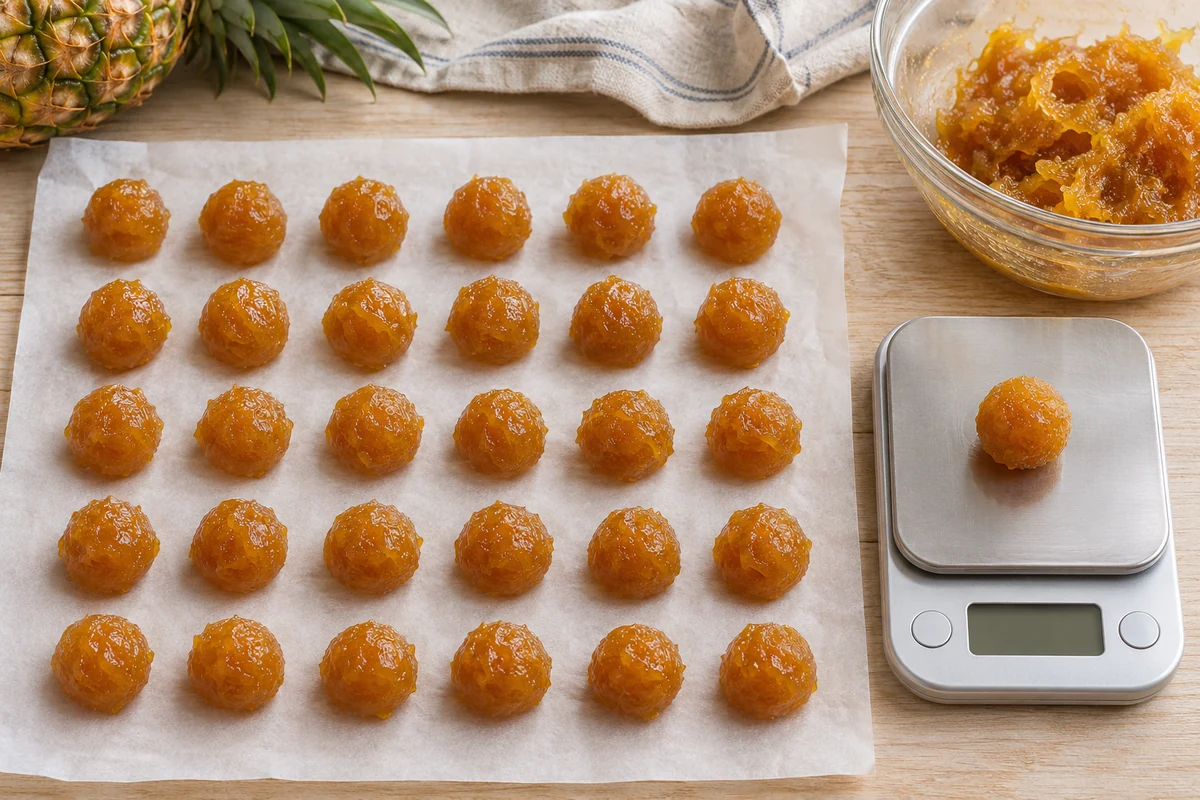
Rows of rolled pineapple jam balls on parchment beside a kitchen scale, portioned for Chinese pineapple tarts
Make the Melt-in-the-Mouth Dough
Whisk the flour, cornstarch, milk powder and salt in a bowl. In a second bowl, beat the butter and powdered sugar on medium-low speed for about 1 minute, just until smooth. Beat in the 2 yolks one at a time, stopping as soon as each one disappears.
Add the dry ingredients in two additions on the lowest speed (or fold them in with a spatula) and stop the moment no dry streaks remain. The dough should feel like soft play dough: it holds together when squeezed and doesn't stick to your palm. If it sticks, work in more flour 1 tablespoon at a time, up to 2 tablespoons. In a warm kitchen, keep half the dough in the fridge while you shape the other half.
Wrap, Shape and Glaze
Heat the oven to 340°F (170°C) with a rack in the middle, and line two light-colored baking sheets with parchment.
Weigh 12 g of dough and flatten it into a 2-inch disc in your palm. Set a jam ball in the center and ease the dough up and around it with your thumbs until it meets at the top. Pinch the seam closed, then roll the ball smooth between your palms. If the dough tears, patch it with a pinch of extra dough and roll again. Place the tarts seam side down, 1 inch apart. For the traditional pineapple-crown look, press a whole clove into each top, bud end up.
Beat the glaze yolk with the milk and brush a thin coat over every tart. By the time you reach the end of the second tray, the first tarts are dry enough for a second thin coat, so go back and give them all another layer. Keep the glaze off the base, since yolk that pools around the bottom browns long before the tart is baked. Put the second tray in the fridge while the first one bakes.
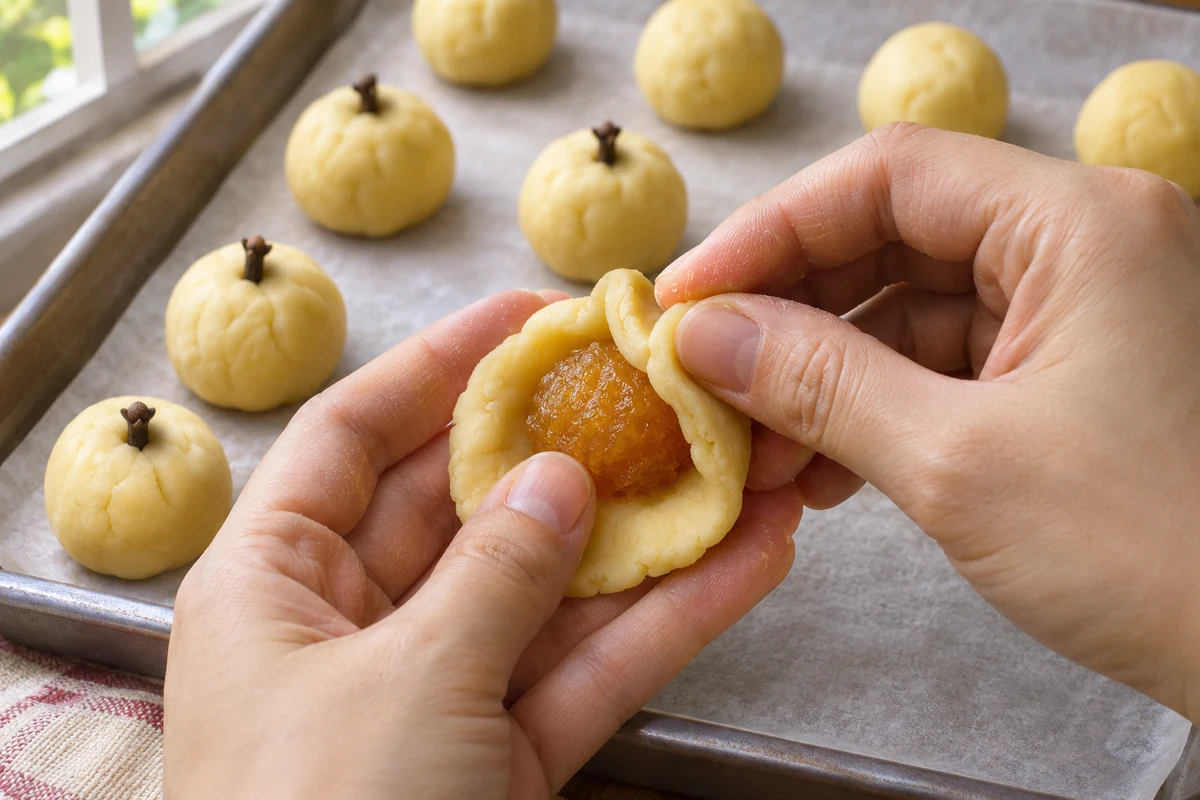
Hands wrapping butter pastry around a jam ball to shape Chinese pineapple tarts, with shaped tarts on a tray behind
Bake and Cool
Bake one tray at a time for 18 to 22 minutes, until the tops are a glossy deep golden yellow and the underside of a lifted tart is pale gold, not brown. The chilled second tray may need an extra 1 to 2 minutes. A few hairline cracks may open as the jam expands, and they narrow as the tarts cool.
Leave the tarts on the tray for 10 minutes, since they're fragile while hot, then move them to a rack until completely cool, about 20 minutes more. They'll taste slightly crisp today. By tomorrow the pastry softens into the crumbly, melting texture that makes Chinese pineapple tarts worth the effort.
Getting the Texture Right
Most problems with Chinese pineapple tarts trace back to the jam's moisture, the butter's temperature, or the dough-to-jam ratio.
A few hairline cracks are normal on enclosed tarts. Wide splits mean too much jam for the pastry or a dough that's too dry. Go back to 12 g dough and 9 g jam, and if the dough cracks while you shape it, work in a teaspoon of softened butter.
The jam was undercooked (it would have failed the plate test) or the seam wasn't pinched shut. You can return cooled jam to the pan and cook it further before the next batch.
The butter was too warm or creamed too long. Chill the shaped tarts for 15 minutes before baking.
Too much flour, or too much mixing after the flour went in. Taste one the next day before deciding, since freshly baked pastry always reads crisper.
A dark pan or a low rack. Switch to a light aluminum sheet on the middle rack, or slide a second sheet underneath for insulation.
It was cooked past amber into caramel. Next time, stop as soon as the plate test passes.
Whole egg instead of yolk, or only one coat of glaze.
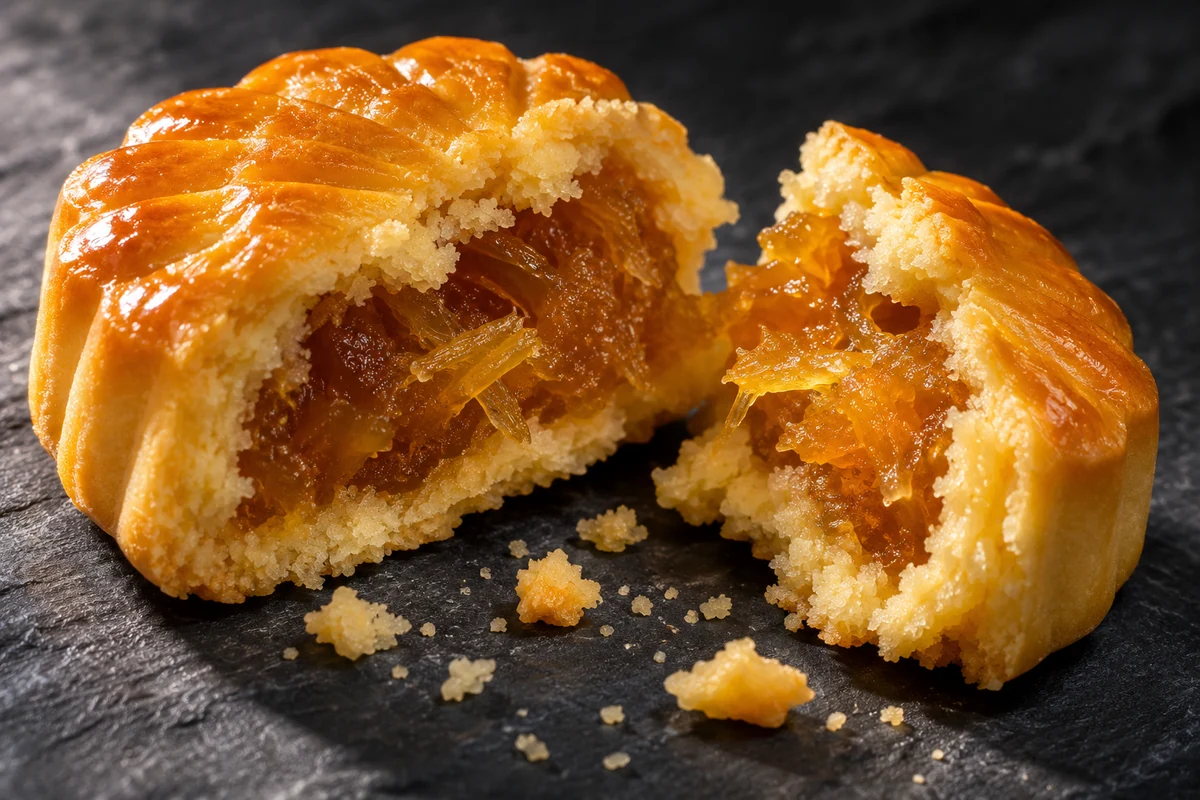
A Chinese pineapple tart broken in half showing crumbly melt-in-your-mouth pastry around dense amber pineapple jam
Two Other Ways to Shape Chinese Pineapple Tarts
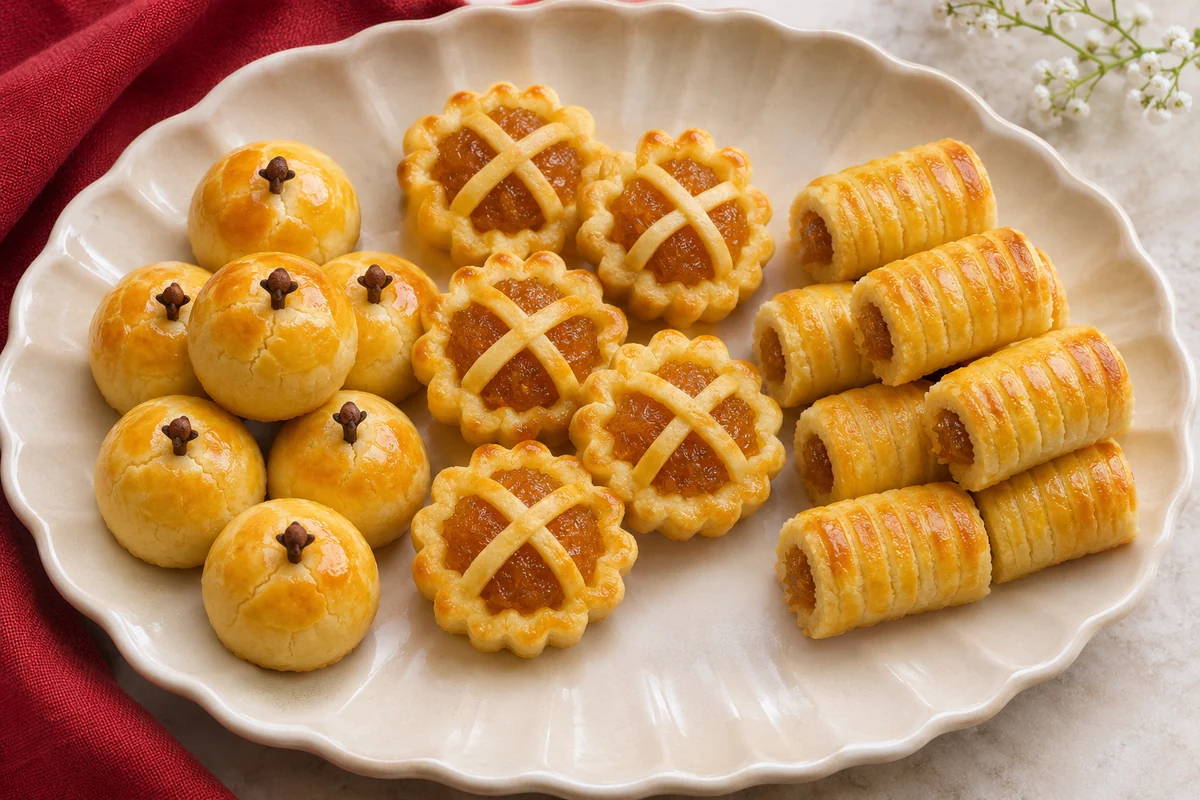
Three shapes of Chinese pineapple tarts on a platter: enclosed balls, open-faced flower tarts and scored pineapple rolls
How to Serve, Store and Reheat Chinese Pineapple Tarts
Serve Chinese pineapple tarts at room temperature, ideally from the day after baking. A pot of hot tea (jasmine or oolong) balances the sweetness. For a Lunar New Year spread, set them out with Cabbage Dumplings and Chinese Peanut Cookies. Pick out the decorative clove before eating.
Yes. Keep baked Chinese pineapple tarts in an airtight container at room temperature for up to 2 weeks, away from the stove and direct sun. Let them cool completely before closing the lid, because trapped warmth turns into condensation that softens the pastry. In a hot, humid kitchen, refrigerate them airtight for up to 3 weeks and let the container come to room temperature before opening it. Leftover jam keeps in a sealed jar in the fridge for up to 2 weeks.
They don't need it. If humidity has softened them, spread them on a tray and warm at 300°F (150°C) for 5 minutes, then cool completely before eating or storing.
Yes, and Chinese pineapple tarts freeze two ways. Unbaked: freeze the shaped, unglazed tarts on a tray until solid, then bag them for up to 2 months. Glaze straight from the freezer and bake at 340°F (170°C), adding 3 to 5 minutes. Baked: freeze in an airtight container for up to 2 months and thaw with the lid on, so condensation forms on the container instead of the pastry. The jam alone freezes for up to 3 months.
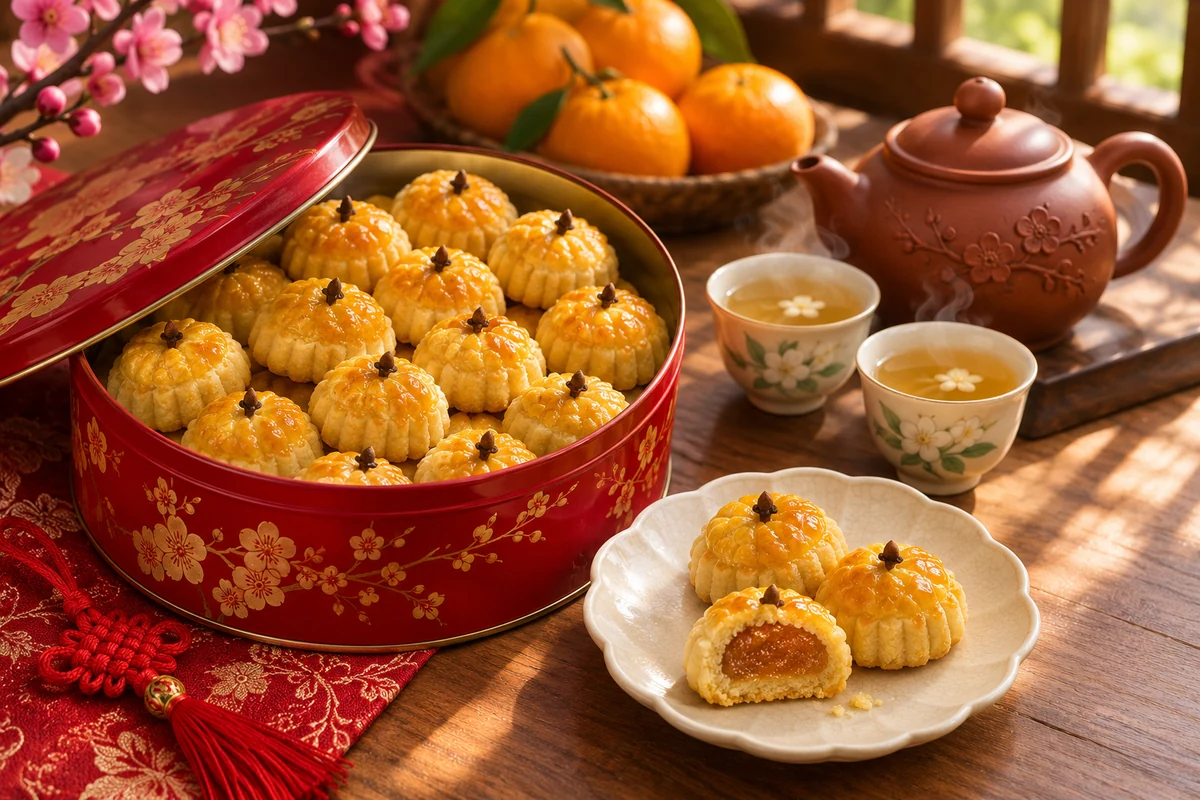
Chinese pineapple tarts in an open red cookie tin served with jasmine tea and tangerines for Lunar New Year
How to Use This Pineapple Jam
Dietary Variations
Each swap below keeps the shaping and baking of Chinese pineapple tarts exactly the same. Replace the 2 dough yolks with 3 tablespoons sweetened condensed milk and cut the powdered sugar to 2 tablespoons. For the glaze, thin 1 tablespoon condensed milk with 1 teaspoon milk. The tops come out glossy but less yellow.
Swap the all-purpose flour for a 1:1 gluten-free baking blend that contains xanthan gum and keep the cornstarch. Cover the dough and let it rest for 20 minutes at room temperature before shaping, so the blend hydrates and stops tearing.
Use firm plant-based butter sticks (tub spreads hold too much water) and replace the milk powder with an equal weight of cornstarch. Glaze with the egg yolk alone.
The "melt-in-the-mouth" pastry of a good Chinese pineapple tart is a gluten problem, and this dough solves it three ways at once. Gluten forms when flour proteins meet water and get worked.
Here the water stays low (yolks only, no whites, no milk), cornstarch and milk powder dilute the flour with ingredients that can't form gluten, and roughly two parts butter to three parts dry ingredients coats what protein is left.
That's also why mixing stops the moment the dry streaks disappear: every extra turn builds the structure you're trying to avoid.
Allergen Notice: This Chinese pineapple tart recipe contains wheat (gluten), eggs and milk (butter and milk powder). For wheat, use the gluten-free swap above. For eggs, use the condensed milk swap (which still contains dairy). For milk, use the plant butter and cornstarch swap. The recipe contains no nuts as written. Labels and manufacturing practices vary, so if you're baking for someone with a food allergy, check every label and confirm the swap with them. These changes remove the listed ingredient, but I can't promise the result is safe for a specific allergy.
Chinese Pineapple Tart FAQs
If this is your first batch of Chinese pineapple tarts, make the jam a day early and save the shaping for a calm afternoon with the scale close by. Keep the first slightly lopsided ones for yourself and fill the tin with the neat ones for guests.
Recipe Visual Gallery (8 Full Photos)
Recipe Card & Steps
Ingredients Checklist
Click an item to check it off as you prep
Pineapple Jam
- 2 medium ripe pineapples (about 3 lb / 1.4 kg each, whole)
- 1 cup (200 g) granulated sugar, plus up to 1/4 cup (50 g) more to taste
- 1 cinnamon stick (about 3 inches)
- 4 whole cloves
- 1 star anise
Pastry
- 1 cup plus 2 tablespoons (250 g) unsalted butter, softened but cool
- 1/3 cup (40 g) powdered sugar
- 2 large egg yolks
- 2 1/2 cups (320 g) all-purpose flour, plus up to 2 tablespoons more if needed
- 1/4 cup (30 g) cornstarch
- 3 tablespoons (20 g) milk powder
- 1/4 teaspoon fine salt
Glaze
- 1 large egg yolk
- 1 teaspoon milk
- Whole cloves, for decorating (optional)
Step-by-Step Instructions
Follow along and mark each step complete as you cook
Peel the pineapples, cut out the eyes, quarter lengthwise and remove the core. Grate on the large holes of a box grater or pulse in a food processor until finely chopped but not puréed. You should have about 6 cups (1.5 kg).
Set a sieve over a bowl, add the grated pineapple and press gently to collect about 2 cups of juice.
Pour the juice into a 12-inch nonstick skillet or wok, add the cinnamon stick, cloves and star anise, and boil over high heat for 15 to 20 minutes, until reduced to about 1/2 cup of glossy syrup.
Add the drained pulp, lower the heat to medium and cook for about 40 minutes, stirring every few minutes, until the pan looks mostly dry and the pulp starts to cling to the bottom.
Stir in the sugar. Lower the heat to medium-low and cook, stirring often, for 25 to 35 minutes, until the jam is deep golden amber and a spatula dragged through it leaves a trail that doesn't fill back in. A teaspoon cooled on a plate for 2 minutes should roll into a ball. Taste and add more sugar while hot if needed. Remove the whole spices.
Spread the jam on a plate or tray and cool to room temperature, about 1 hour.
With lightly greased hands, roll the jam into 9 g balls (about 55). Refrigerate them on a parchment-lined plate while you make the dough.
Whisk the flour, cornstarch, milk powder and salt in a bowl.
Beat the butter and powdered sugar on medium-low speed for about 1 minute, just until smooth. Beat in the 2 yolks one at a time, just until combined.
Add the dry ingredients in two additions on the lowest speed, stopping as soon as no dry streaks remain. If the dough sticks to your palm, work in up to 2 tablespoons more flour, 1 tablespoon at a time.
Heat the oven to 340°F (170°C) with a rack in the middle. Line two light-colored baking sheets with parchment.
Flatten 12 g of dough into a 2-inch disc, set a jam ball in the center and push the dough up and around it. Pinch the seam closed and roll smooth. Place seam side down, 1 inch apart. Press a clove into each top if using.
Beat the glaze yolk with the milk. Brush a thin coat over every tart, then go back to the first tarts and brush a second thin coat over all of them, keeping glaze off the base. Refrigerate the second tray.
Bake one tray at a time for 18 to 22 minutes, until the tops are glossy deep golden and the bottoms are pale gold. Add 1 to 2 minutes for the chilled tray.
Cool on the tray for 10 minutes, then on a rack until completely cool, about 20 minutes more.
Recipe Card Notes & Tips
- Fresh from the oven the pastry tastes slightly crisp. It softens into its crumbly texture by the next day.
- The jam can be made up to 2 weeks ahead and refrigerated in a sealed jar.
- In a warm kitchen, keep half the dough in the fridge while you shape the other half.
- Canned crushed pineapple packed in juice (three 20-ounce cans) can replace fresh. Drain, reduce the juice first and continue the same way.
- Store baked tarts airtight at room temperature for up to 2 weeks.
- Remove the decorative clove before eating.
- Making the jam ahead splits Chinese pineapple tarts into two sessions. With jam ready in the fridge, baking day takes about 2 hours 20 minutes.
Ratings & Reviews
Leave a Review
Made this recipe? Share your thoughts, tweaks, and honest rating with other home cooks!
Community Reviews (0)
You Might Also Enjoy
More delicious recipes in Desserts.
Chewy Matcha Mochi Breads Recipe
Chewy Cranberry Chocolate Oatmeal Cookies Recipe