Baked Pumpkin Donuts Recipe
Soft, spiced pumpkin donuts baked in a donut pan and rolled in buttery cinnamon sugar while still warm. No frying and no mixer.
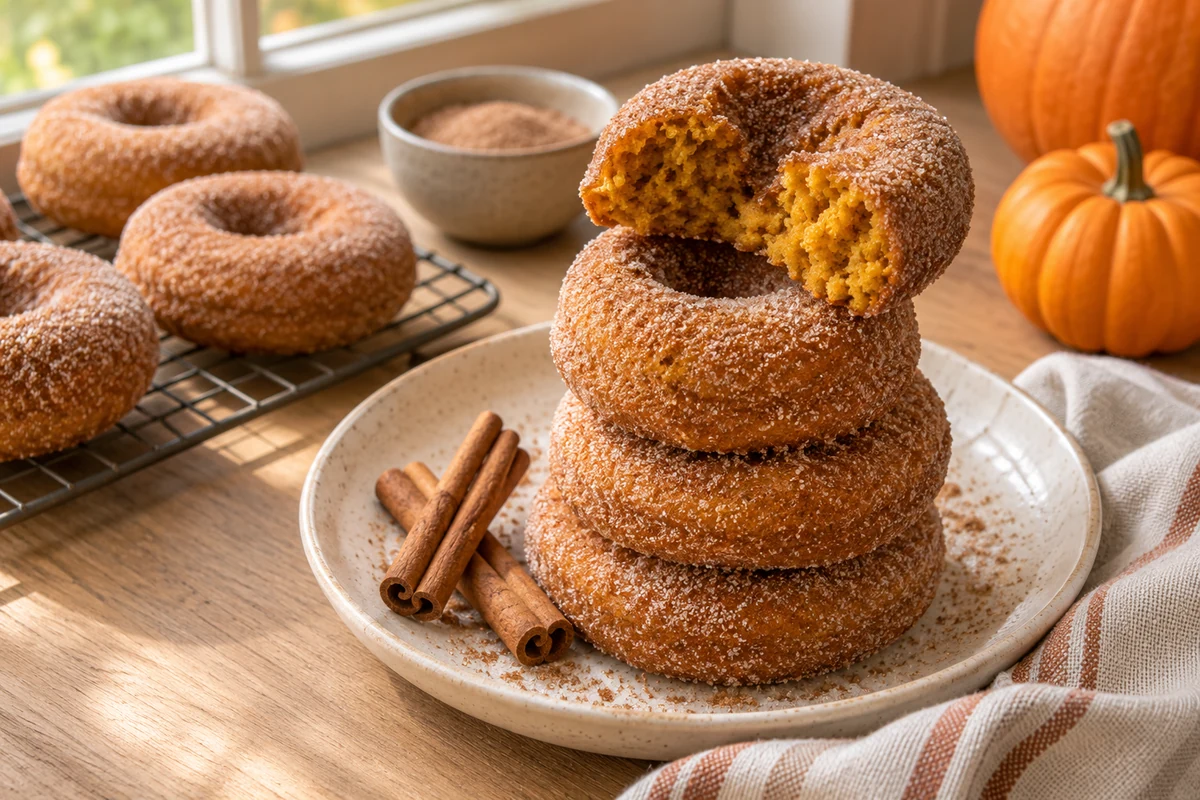
These pumpkin donuts bake in a donut pan, so there's no pot of hot oil and no dough to roll out. You whisk two bowls together by hand, pipe the batter into rings, and roll the warm donuts in buttery cinnamon sugar about an hour later (closer to 40 minutes if you own two pans).
Why You'll Love These Pumpkin Donuts
- No mixer, no frying. Two bowls, a whisk, and a spatula. The oven handles the rest.
- They stay soft into day two. The batter uses oil instead of butter, and oil stays liquid at room temperature, so the crumb doesn't firm up overnight.
- You can taste the pumpkin. Two and a half teaspoons of spice and a full 3/4 teaspoon of salt keep the flavor from going flat.
- Two finishes from one batter. Cinnamon sugar while they're warm, or a maple glaze once they've cooled.
Check the pumpkin puree before it goes in the bowl. Canned pumpkin isn't as consistent as the label makes it look. Some cans are thick enough to hold a peak on a spoon. Others slump and leave a wet ring on the plate.
If yours slumps, spread the measured cup on a double layer of paper towels, press another towel on top, and leave it for 5 minutes while you whisk the dry ingredients.
That loose water is what makes baked pumpkin donuts gummy around the inner ring, and the recipe already gets the liquid it needs from the milk, which measures the same every time.
Read Before You Start
The side that faces up in the oven is the back of the donut. Batter rises freely on top, so that side bakes domed and a little cracked. The side pressed against the pan comes out flat, smooth, and evenly browned, which is the shape you picture when you think of a cake donut. Turn them out pan side up and coat that side.
Grease the center posts too. Sticking almost always starts at the little column in the middle of each cavity, because batter climbs it and bakes on. Spray the posts as carefully as the cavities, even in a nonstick pan, and the donuts drop out whole.
Ingredient Notes
Canned pumpkin puree: Use plain puree, the kind with pumpkin as the only ingredient. Don't substitute pumpkin pie filling. It's already sweetened and spiced, so the batter comes out too sweet and too wet, and the spice measurement stops making sense. A 15-ounce can holds about 1 3/4 cups, which leaves roughly 3/4 cup over. Move it to a covered container (not the open can) and use it within 3 to 4 days, or freeze it for your next loaf of Pumpkin Bread.
All-purpose flour: 220 grams. If you're using cups, spoon the flour in and level it off. A cup scooped straight from the bag packs in noticeably more, and extra flour is a quick route to dense pumpkin donuts.
Brown and white sugar: Most of the sweetness comes from light brown sugar. Its molasses keeps the crumb moist and gives the baking soda something mildly acidic to react with. The quarter cup of granulated sugar helps the outside set into a thin, slightly firmer skin, which gives the cinnamon sugar something to cling to.
Neutral oil: Canola, sunflower, or vegetable oil. Butter is roughly 80 percent fat, with most of the rest water, and it firms up as it cools, so butter-based baked donuts tighten by the next morning. Oil stays liquid at room temperature. Butter still shows up in the coating, where you can actually taste it.
Eggs: Two large, at room temperature, so they whisk smoothly into the sugar and oil.
Pumpkin pie spice: Two and a half teaspoons can look like a lot for a dozen pumpkin donuts. Pumpkin is mild and a little earthy, and it mutes spice more than a plain vanilla batter would. No pumpkin pie spice in the cupboard? The recipe card notes have a homemade blend.
Baking powder and baking soda: You need both. The soda starts reacting with the brown sugar and pumpkin as soon as the batter is wet, and it helps the donuts brown. The baking powder gives a second push of rise from the oven's heat, which is why the second batch still rises well after waiting its turn. If either has been open a long time, test it: a pinch of soda should fizz in vinegar, and baking powder should bubble in hot water.
Alcohol-free vanilla: Pure vanilla extract sold in the US has to contain at least 35 percent alcohol. Alcohol-free vanilla, usually glycerin-based, is hard to tell apart in a spiced batter and keeps the recipe halal-friendly.
Milk: A quarter cup of any milk, dairy or plant-based.
The coating: Unsalted butter, granulated sugar, and cinnamon. It's the same flavor as the outside of my Snickerdoodle Cookies, except here melted butter is the glue instead of raw dough.
Equipment Needed
- Donut pan: A standard 6-cavity pan with rings about 3 to 3 1/2 inches across. One pan means two batches; two pans means everything bakes at once.
- Piping bag or zip-top bag: Spooning batter into a ring is slow and messy, and any batter that lands on the center post closes the hole.
- Paper towels: Only if your puree needs blotting.
- Instant-read thermometer (optional): The most reliable doneness check for a batter that's already orange before it bakes.
- Pastry brush (optional): Dipping in the butter works too, but a brush puts on a thinner, more even layer.
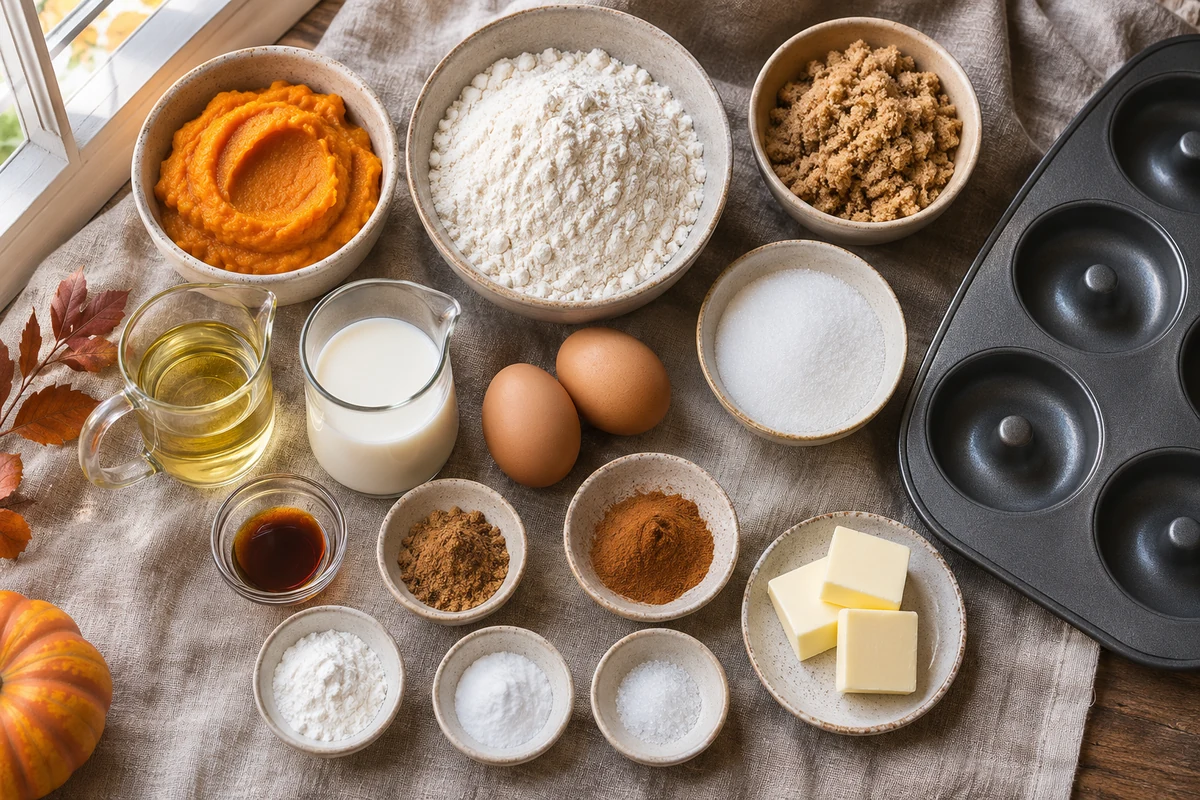
Ingredients for pumpkin donuts laid out overhead: pumpkin puree, flour, brown sugar, eggs, oil, milk, spices and a donut pan
How to Make Pumpkin Donuts Step by Step
Heat the Oven and Grease the Pan
Measure everything before you start mixing. Once the wet and dry ingredients meet, the baking soda gets to work, so the first batch should go straight from bowl to pan to oven.
Heat the oven to 350°F (175°C) with a rack in the center. Spray every cavity of the donut pan with nonstick spray, center posts included. If spray pools in the bottom of a ring, wipe the extra out with a paper towel.
Check the Pumpkin (the Step Most People Skip)
Measure 1 cup of pumpkin puree. Drop a spoonful on a plate. If it holds its shape, it's ready to use. If it slumps and leaves a wet halo, spread the full cup on a double layer of paper towels, lay another towel on top, and press gently. Leave it there while you do the next step (5 minutes is plenty), then peel it off the towel with a spatula.
Whisk the Dry Ingredients
In a medium bowl, whisk the flour, pumpkin pie spice, baking powder, baking soda, and salt for a good 30 seconds. Baking soda clumps easily, and a lump that never gets broken up leaves a bitter, soapy bite in one unlucky donut.
Whisk the Wet Ingredients
In a large bowl, whisk the brown sugar, granulated sugar, oil, and eggs for about a minute, until the mixture looks smooth and slightly thick with no brown sugar lumps left. Scrape in the pumpkin, add the milk and vanilla, and whisk until the color is even.
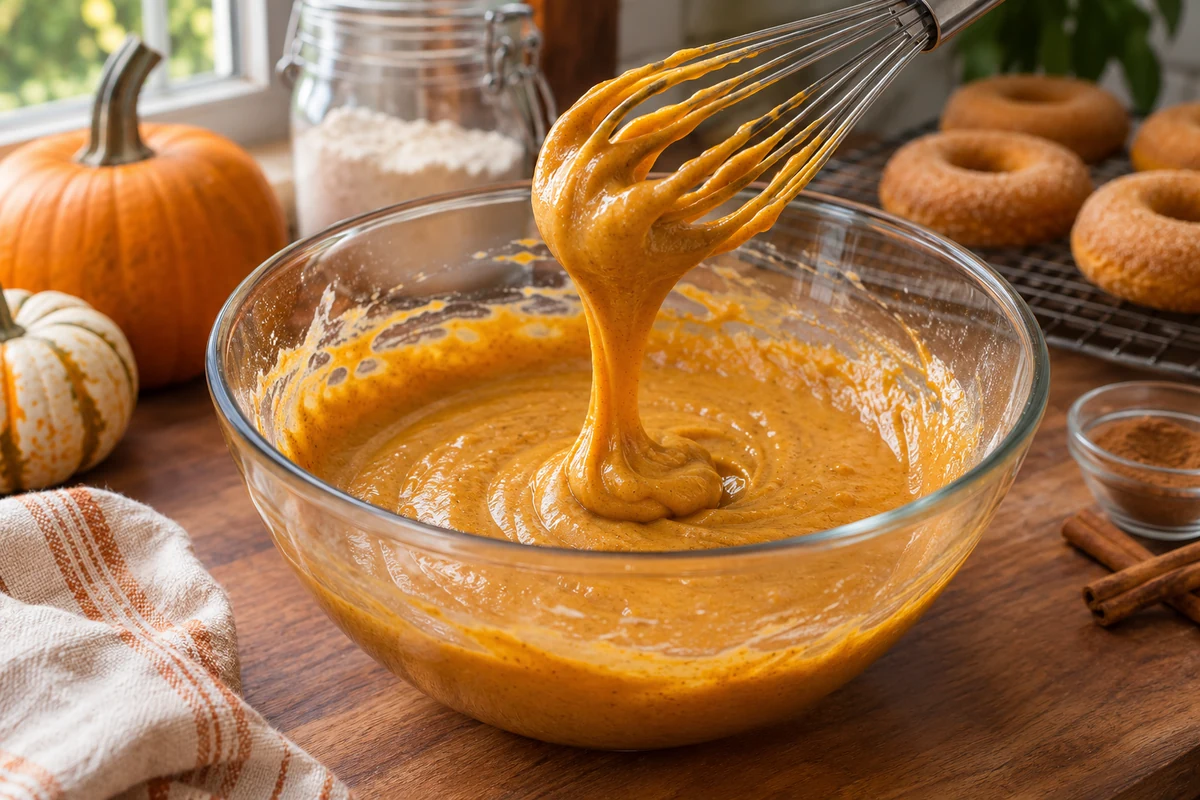
Whisking pumpkin puree, brown sugar, oil and eggs into a smooth orange base for pumpkin donuts in a large glass bowl
Fold the Dry Ingredients into the Wet
Add the dry ingredients to the large bowl and fold with a spatula, scraping the bottom, until you can't see any dry flour. That takes 15 to 20 strokes. A few small lumps are fine. Mixing past that point builds gluten, and the donuts bake up tough with long tunnels inside. The batter should be thick and scoopable, a little heavier than pancake batter.
Pipe and Bake
Spoon the batter into a piping bag or zip-top bag and snip off a 1/2-inch opening. Pipe a ring into each cavity, filling it about three-quarters full (roughly 1/4 cup). Overfill and the batter rises over the center post, which closes the hole and leaves you with a pumpkin muffin with a dent in it. Twist the bag shut to hold the rest of the batter.
Bake for 13 to 15 minutes. They're done when the tops spring back when you press them lightly, a toothpick pushed into the thickest part of the ring (halfway between the post and the outer edge) comes out clean or with a few dry crumbs, or an instant-read thermometer reads about 200°F (93°C). Don't wait for them to look browner. They won't change color much, and the Chef's Note below explains why.
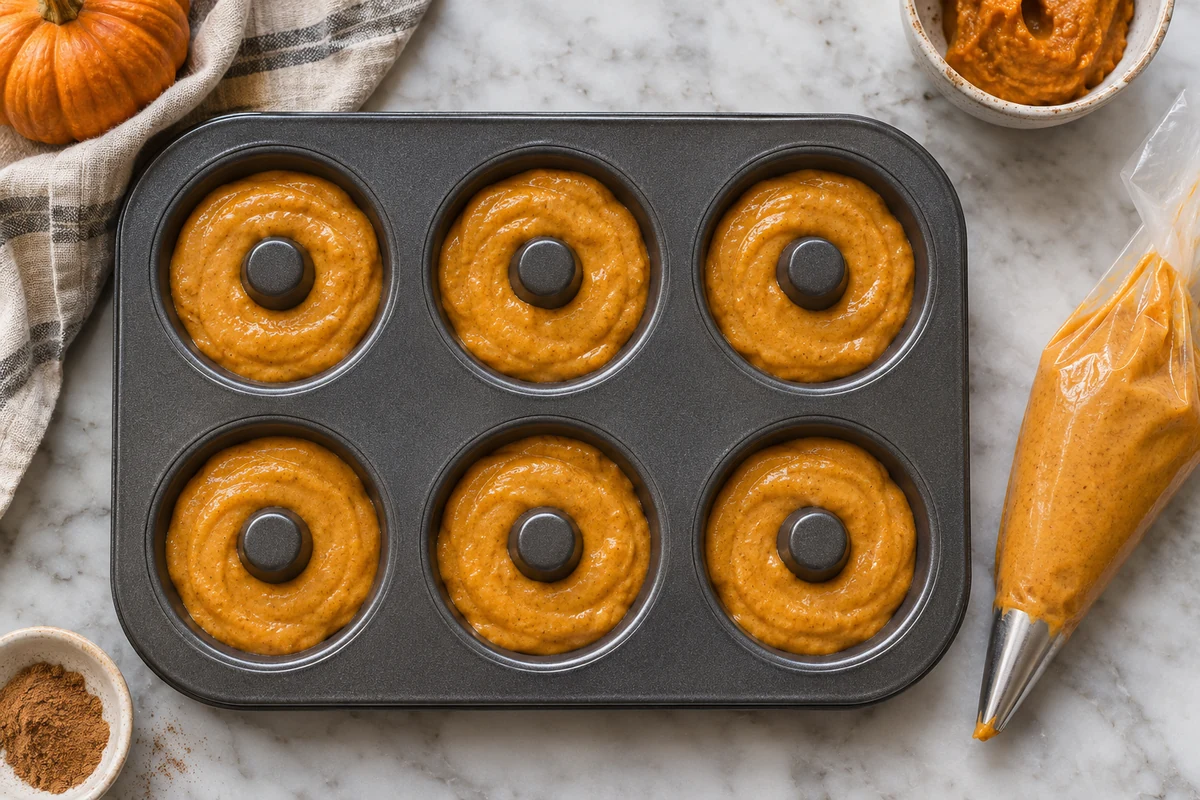
Unbaked pumpkin donut batter piped three-quarters full into a 6-cavity donut pan, with the piping bag resting beside it
Cool, Flip, and Coat
Leave the pumpkin donuts in the pan for 5 minutes. Straight out of the oven they're too soft to hold together. Then turn the pan over onto a wire rack so the smooth pan side faces up.
Once the pan is warm rather than hot, wipe out any crumbs, spray it again (posts included), pipe in the rest of the batter, and bake the second batch the same way.
While it bakes, coat the first six. Melt the butter, and stir the sugar and cinnamon together in a shallow bowl. Brush the warm donuts all over with butter (or dip the smooth side straight in), then press them into the cinnamon sugar and turn to coat. A warm donut soaks up a little of the butter, and that's what holds the sugar on. Coat the second batch the same way after its 5 minutes in the pan.
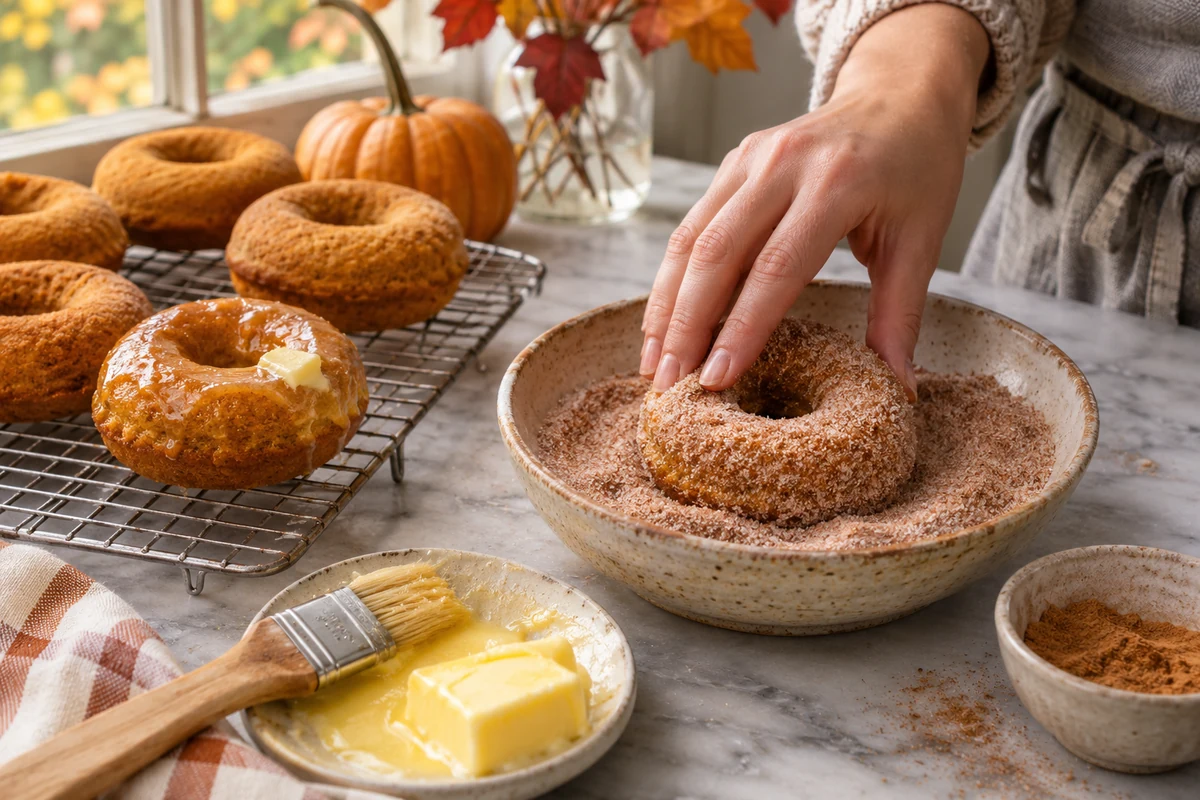
Pressing a warm, butter-brushed pumpkin donut into a shallow bowl of cinnamon sugar next to a wire rack of donuts
Getting the Texture Right
A good baked pumpkin donut is soft and springy, moist without being wet, and cakey enough to tear cleanly. When one misses, the cause is usually easy to trace.
Either the pumpkin was loose and went in unblotted, or the donuts came out a minute or two early. The thick middle of the ring is the last part to set, so that's where the toothpick goes.
Too much flour (usually from scooping) makes them heavy. Mixing past the last streak of flour makes them tough and tunneled.
The cavities were overfilled. Three-quarters full leaves room to rise without covering the post.
The center posts weren't greased, or the donuts were flipped out before their 5 minutes were up.
Make sure the salt went in, then check the date on your spices. Ground spices lose their aroma over time even when they look fine.
If it won't stick, the donuts cooled too long before coating, so brush on a bit more butter and try again. If it goes wet a few hours later, they were sealed in a container while still warm, and the trapped steam dissolved the sugar.
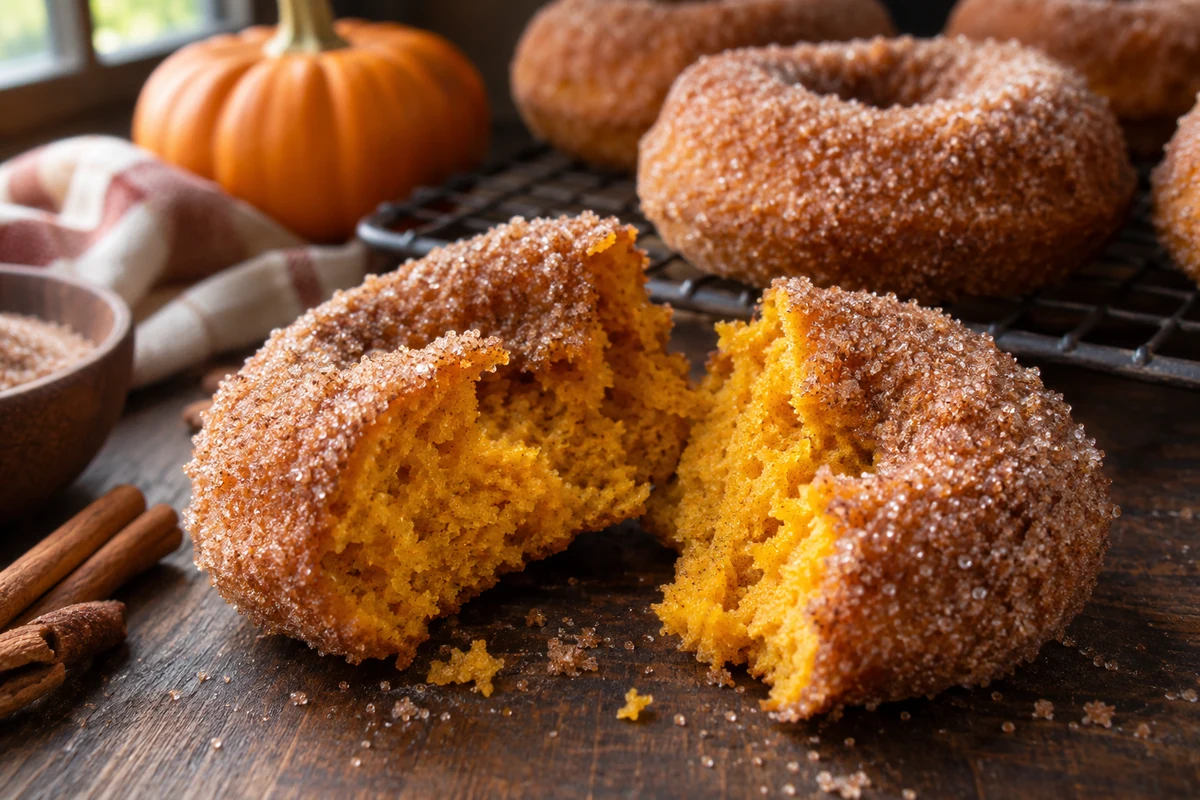
Close-up of a pumpkin donut torn in half, showing a soft, even orange crumb and a sparkling cinnamon sugar crust
Other Ways to Top Pumpkin Donuts
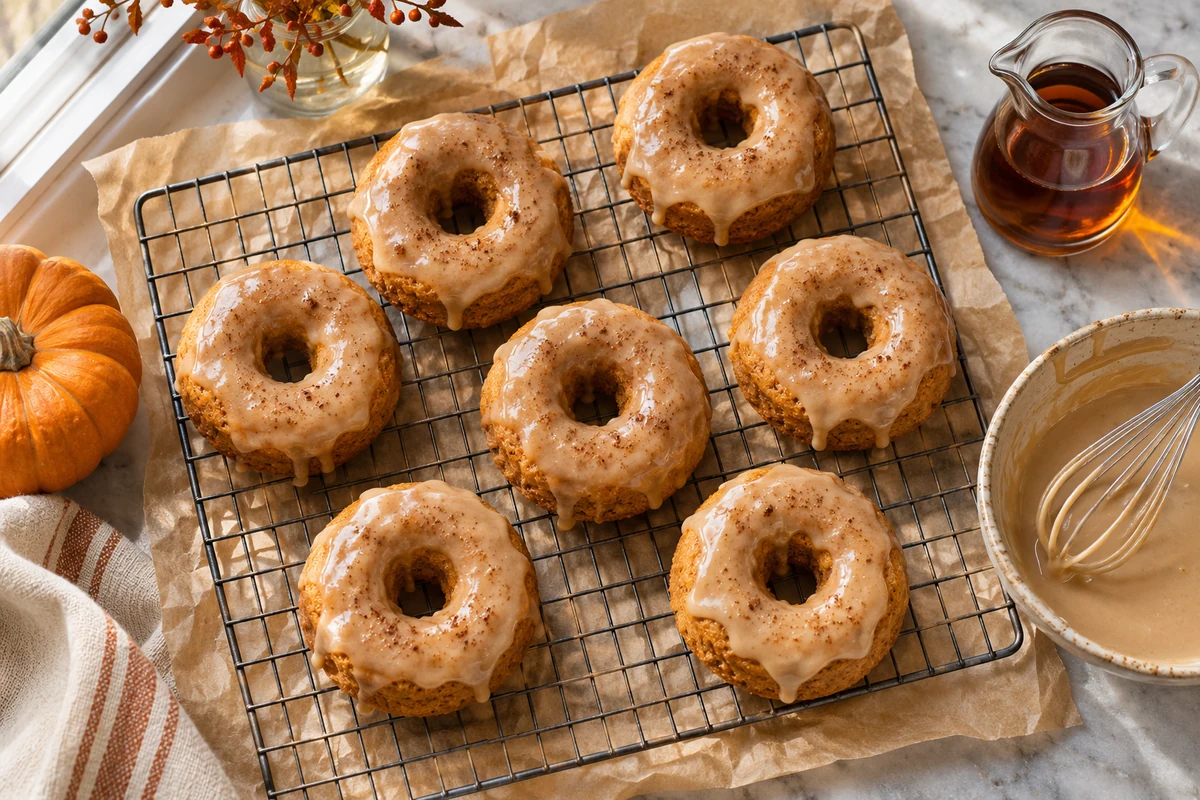
Baked pumpkin donuts dipped in a glossy maple glaze cooling on a wire rack, with a small pitcher of maple syrup nearby
How to Serve, Store, and Reheat Pumpkin Donuts
Pumpkin donuts are at their best the day they're baked, ideally within a few hours of coating, while the cinnamon sugar still crunches. Serve them with coffee, chai, or hot apple cider. For a fall brunch, pile them on a platter and let people help themselves.
Keep cinnamon sugar pumpkin donuts at room temperature for up to 2 days, in a container with the lid resting loosely on top or on a plate under a clean towel. An airtight seal traps moisture against the sugar and turns it damp. Maple-glazed donuts can go fully airtight once the glaze has set. Anything with cream cheese glaze goes in the fridge, covered, for up to 3 days. Skip the fridge for the rest, since cold air makes cake-style baked goods go stale faster than the counter does.
Warm a pumpkin donut in the microwave for 8 to 10 seconds, or heat a few on a baking sheet at 300°F for about 5 minutes. To bring back day-old cinnamon sugar, brush the warm donut with a little melted butter and roll it again.
Yes, pumpkin donuts freeze well, as long as you freeze them before coating. Cool them completely, wrap each one in plastic wrap, and freeze in a freezer bag for up to 3 months. Thaw at room temperature, still wrapped, for about an hour (condensation forms on the wrap instead of the donut), then warm for 10 seconds and coat with butter and cinnamon sugar. Glazed donuts don't freeze well; the glaze turns sticky and weeps as it thaws.
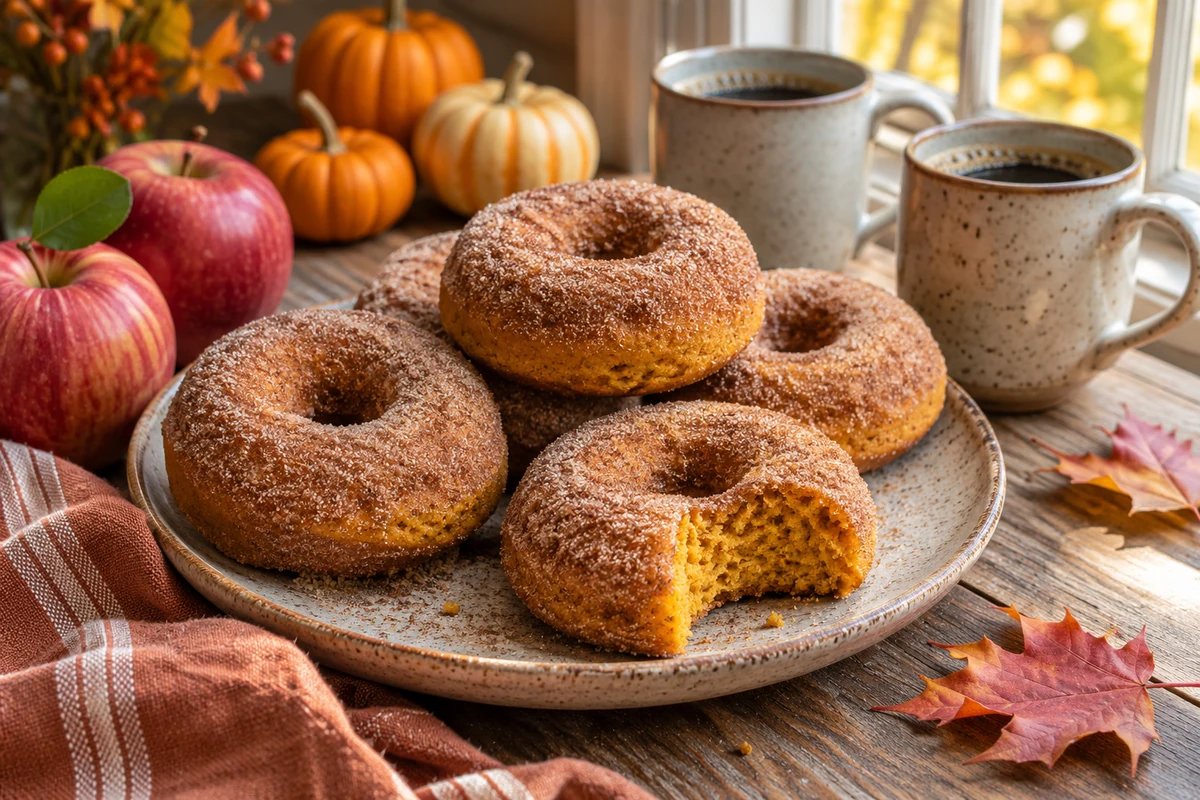
Platter of cinnamon sugar pumpkin donuts served with two mugs of coffee on a rustic wooden table set for a fall breakfast
Other Ways to Use This Batter
Dietary Variations
Swap in a 1:1 gluten-free baking blend that contains xanthan gum, by weight (220 g). Let the batter sit for 15 minutes before piping. Rice-based blends absorb liquid slowly, and skipping the rest can leave the crumb gritty. Bake time stays about the same.
Use any unsweetened plant milk in the batter, and brush with melted dairy-free butter before the cinnamon sugar. The batter has no butter in it, so nothing else changes.
Replace each egg with a flax egg (1 tablespoon ground flaxseed stirred into 3 tablespoons water, left 10 minutes to thicken). Expect denser, more muffin-like pumpkin donuts. The pumpkin helps hold them together, but the rise won't match the original.
Why color can't tell you they're done. Most cakes and quick breads tell you they're ready by browning.
This batter is orange-brown before it ever goes in the oven: pumpkin is loaded with beta-carotene, and brown sugar brings the dark color of molasses.
The Maillard browning still happens, but it's hard to see against that background, so it's easy to pull baked pumpkin donuts too early, or to leave them in "until they brown" and dry them out.
Go by touch and temperature instead: a top that springs back, a clean toothpick, about 200°F in the thick middle of the ring. The rings are thin, so the gap between underdone and dry is only a couple of minutes. Start checking at 13.
Allergen Notice: This recipe contains wheat, eggs, and milk (in the batter and the butter coating).
- Wheat: use the gluten-free blend above.
- Eggs: use flax eggs as above.
- Milk: use plant milk in the batter and dairy-free butter for the coating.
Read every label, including spices and baking blends, since some are packed in facilities that handle other allergens. These swaps change the ingredients, not the risk of cross-contact, and I can't promise this recipe is safe for anyone managing a food allergy.
Pumpkin Donuts FAQs
Pumpkin donuts are best in their first hour, still a little warm, with the cinnamon sugar crunching when you bite in. Make them on a slow weekend morning, and if you try the maple glaze or the donut holes, pin the version you made so it's easy to find next fall.
Recipe Visual Gallery (8 Full Photos)
Recipe Card & Steps
Ingredients Checklist
Click an item to check it off as you prep
For the donuts
- Nonstick cooking spray, for the pan
- 1 3/4 cups (220 g) all-purpose flour, spooned and leveled
- 2 1/2 tsp pumpkin pie spice
- 1 tsp baking powder
- 1/2 tsp baking soda
- 3/4 tsp fine sea salt or table salt
- 2/3 cup (135 g) packed light brown sugar
- 1/4 cup (50 g) granulated sugar
- 1/2 cup (120 ml) neutral oil, such as canola or sunflower
- 2 large eggs, at room temperature
- 1 cup (245 g) canned pumpkin puree (not pie filling), measured before blotting
- 1/4 cup (60 ml) milk
- 1 tsp alcohol-free vanilla
For the cinnamon sugar coating
- 1/2 cup (100 g) granulated sugar
- 1 Tbsp ground cinnamon
- 4 Tbsp (56 g) unsalted butter, melted
Step-by-Step Instructions
Follow along and mark each step complete as you cook
Heat the oven to 350°F (175°C) with a rack in the center. Spray a 6-cavity donut pan with nonstick spray, including the center posts.
Measure the pumpkin puree. If a spoonful slumps and leaves a wet ring on a plate, spread the cup on a double layer of paper towels, cover with another towel, press gently, and let it sit for 5 minutes.
In a medium bowl, whisk the flour, pumpkin pie spice, baking powder, baking soda, and salt for 30 seconds.
In a large bowl, whisk the brown sugar, granulated sugar, oil, and eggs for about 1 minute, until smooth and slightly thick. Add the pumpkin, milk, and vanilla and whisk until the color is even.
Add the dry ingredients to the wet and fold with a spatula just until no dry flour shows, 15 to 20 strokes.
Transfer the batter to a piping bag or zip-top bag and snip a 1/2-inch opening. Pipe into the cavities until each is about three-quarters full (roughly 1/4 cup). Twist the bag shut to hold the remaining batter.
Bake for 13 to 15 minutes, until the tops spring back when pressed and a toothpick inserted into the thickest part of the ring comes out clean, or the center reads about 200°F (93°C).
Cool in the pan for 5 minutes, then invert onto a wire rack so the smooth pan side faces up.
When the pan is warm rather than hot, wipe out any crumbs, spray it again, pipe in the remaining batter, and bake the second batch the same way.
While the second batch bakes, stir the sugar and cinnamon together in a shallow bowl. Brush the warm donuts all over with melted butter (or dip the smooth side), then press into the cinnamon sugar and turn to coat. Coat the second batch after its 5 minutes in the pan.
Recipe Card Notes & Tips
- Prep Time: 25 minutes (includes blotting the pumpkin, piping both batches, and coating). Cook Time: 30 minutes (two batches of 13 to 15 minutes in one 6-cavity pan). Rest Time: 10 minutes (5 minutes in the pan after each batch). With two pans, all 12 pumpkin donuts bake at once: about 20 minutes of prep, 15 minutes in the oven, and 5 minutes of rest, so roughly 40 minutes total.
- Homemade pumpkin pie spice: 1 1/2 tsp cinnamon, 1/2 tsp ground ginger, 1/4 tsp nutmeg, 1/8 tsp ground cloves, and a pinch of allspice.
- Two pans: Fill both and bake at once; total time drops to about 40 minutes.
- Maple glaze (instead of cinnamon sugar): Whisk 1 cup (120 g) powdered sugar, 3 Tbsp pure maple syrup, 1 Tbsp milk, and a pinch of salt, adding up to 1 Tbsp more milk if needed. Dip fully cooled donuts and let set for 20 minutes.
- Donut holes: Bake 1 Tbsp portions in a greased mini muffin tin at 350°F for 9 to 11 minutes.
- Storage: Room temperature, loosely covered, up to 2 days. Freeze uncoated for up to 3 months.
Ratings & Reviews
Leave a Review
Made this recipe? Share your thoughts, tweaks, and honest rating with other home cooks!
Community Reviews (0)
You Might Also Enjoy
More delicious recipes in Breakfast.