Creamy Christmas Cheesecake Recipe with Cranberry Topping
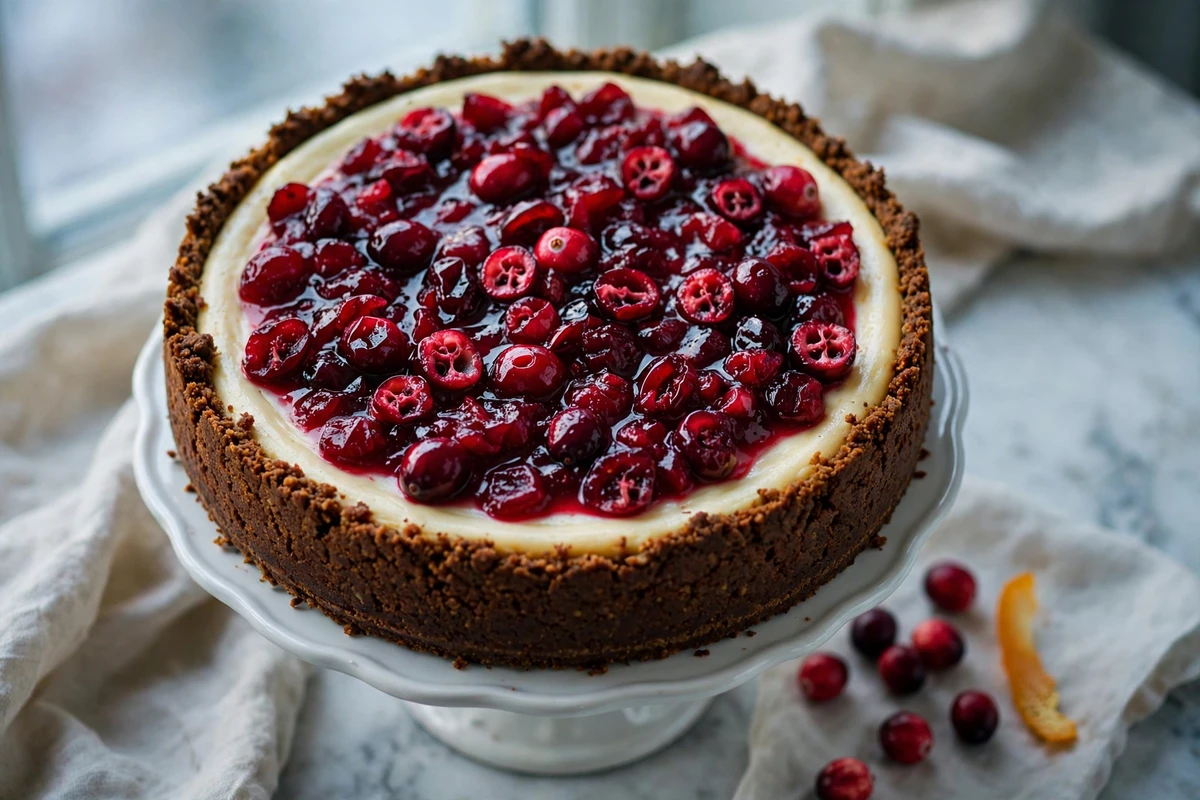
A dense baked cheesecake on a spiced gingersnap crust, finished with a sharp cranberry orange topping. No foil-wrapped water bath, and made a day or two ahead.
So the decision changes. You are no longer protecting a surface nobody will see. You are protecting texture and crust, which means a lower oven, a pan of water on the rack below rather than around the tin, and a slow cool-down.
Why You'll Love This Recipe
- Made two days ahead by design, so the oven is free on the day itself
- Gingersnap crust instead of plain graham, which gives it spice without any extra work
- No foil-wrapped water bath, so no risk of a soggy bottom
- The cranberry topping is sharp enough to cut through a very rich slice, which is the whole reason it works after a heavy dinner
Skip the water bath and put a roasting tin of boiling water on the rack below instead, then drop the oven to 300°F.
A traditional bain-marie means wrapping a springform tin in foil and sitting it in water, and foil seams leak more often than anyone admits.
The steam is what matters, not the water touching the tin, and steam rises perfectly well from a tray underneath.
The trade-off is a slightly higher chance of a hairline crack on the surface, which is exactly the risk worth taking on this cake, because the cranberry layer covers the top completely.
You are swapping a cosmetic risk you have hidden for a crust risk you cannot undo.
Read Before You Start
Everything cold must come out of the fridge two hours early. Cream cheese, eggs and sour cream all need to be at room temperature, and cream cheese is the one people rush. Cold cream cheese will not go smooth, and once sugar and eggs are in, the lumps are permanent. You cannot beat them out later, because by then more beating means more air, which means more cracking.
Cook the cranberry topping further than feels right. It should mound on a spoon rather than run off it. A loose topping looks fine in the pan and then weeps a thin red liquid across the cheesecake overnight, softening the surface and pooling at the edges of every slice.
Ingredient Deep Dive & Notes
Full-fat block cream cheese (32 oz / 900g). Four standard blocks. Not the spreadable tub kind, which contains more water and gums, and sets soft and slightly bouncy. Enzyme source varies between cream cheese brands, so check the label if that matters in your kitchen.
Gingersnap cookies (about 200g, roughly 40 small cookies). These bring ginger, cinnamon and molasses into the base with no extra ingredients. Packaged cookie fats vary by brand, which is worth a label check. If you would rather make the base yourself, the spiced dough from the Gingerbread House recipe bakes and crushes into an excellent crumb.
Sour cream (1 cup), full fat. It loosens the batter slightly and adds a tang that stops 900g of cream cheese tasting flat and heavy.
Cornstarch (2 Tbsp). A small insurance policy. It stabilises the custard so the centre sets more forgivingly and is less likely to sink as it cools. Two tablespoons is not enough to make the texture starchy.
Orange zest (1 Tbsp in the filling, 1 Tbsp in the topping). The zest does far more than juice would. Orange oil is fat-soluble, so it disperses through a cream cheese batter and carries flavour in a way that adding liquid juice to the filling never does.
Fresh or frozen cranberries (12 oz / 340g). Frozen work identically and need no thawing. Do not use jarred cranberry sauce, which is already thickened with its own set and turns gluey when reheated.
Don't substitute: low-fat cream cheese or light sour cream. The fat is structural in a baked cheesecake, not a richness choice. Reduced-fat versions give a rubbery slice with a grainy edge, and no technique fixes it.
Equipment Needed
- 9 inch springform tin, and a flat plate or small saucer to press the crust
- A roasting tin large enough to hold water, for the rack below
- An instant-read thermometer. The centre should read about 150°F, which removes all guesswork from the hardest judgement call in the recipe
- A stand mixer with a paddle, or a hand mixer. Not a whisk attachment, which drives air into the batter
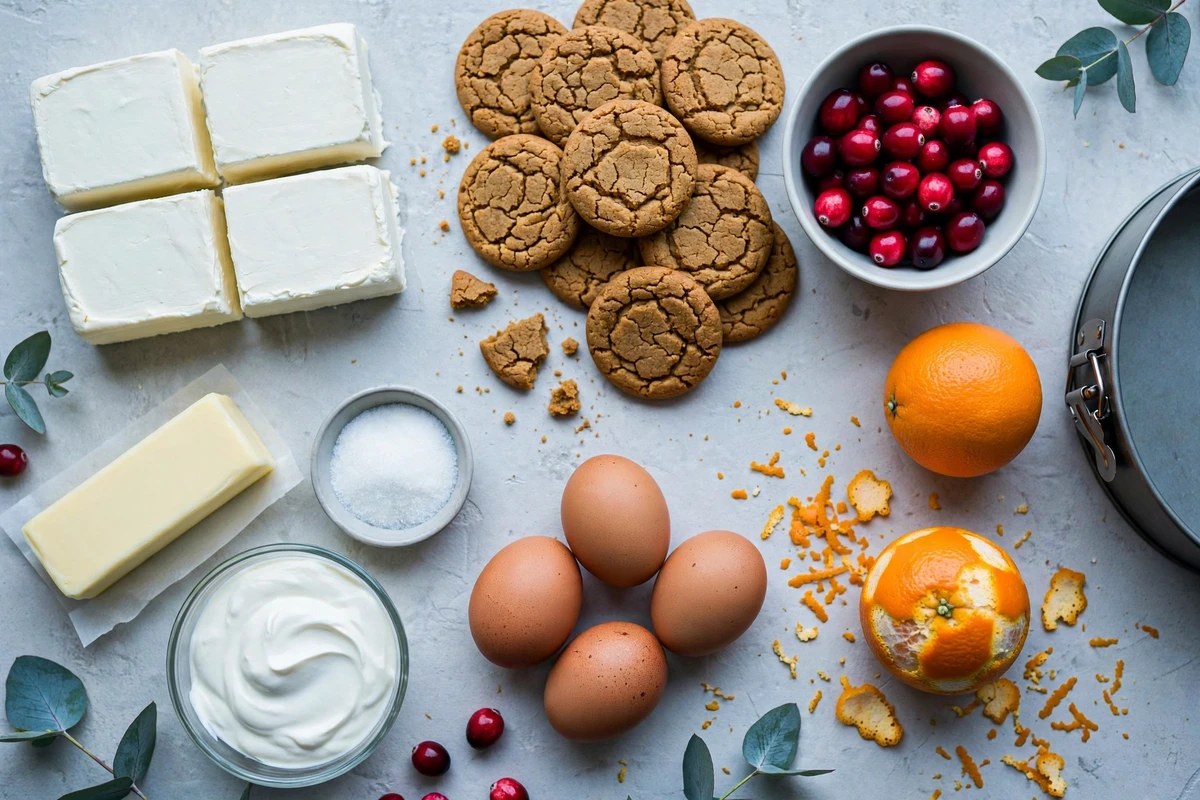
Ingredients for Christmas cheesecake laid out including cream cheese blocks, gingersnap cookies, sour cream, eggs, cranberries, and fresh oranges
Detailed Step-by-Step Cooking Guide
Preparation & Setup
Make and bake the crust
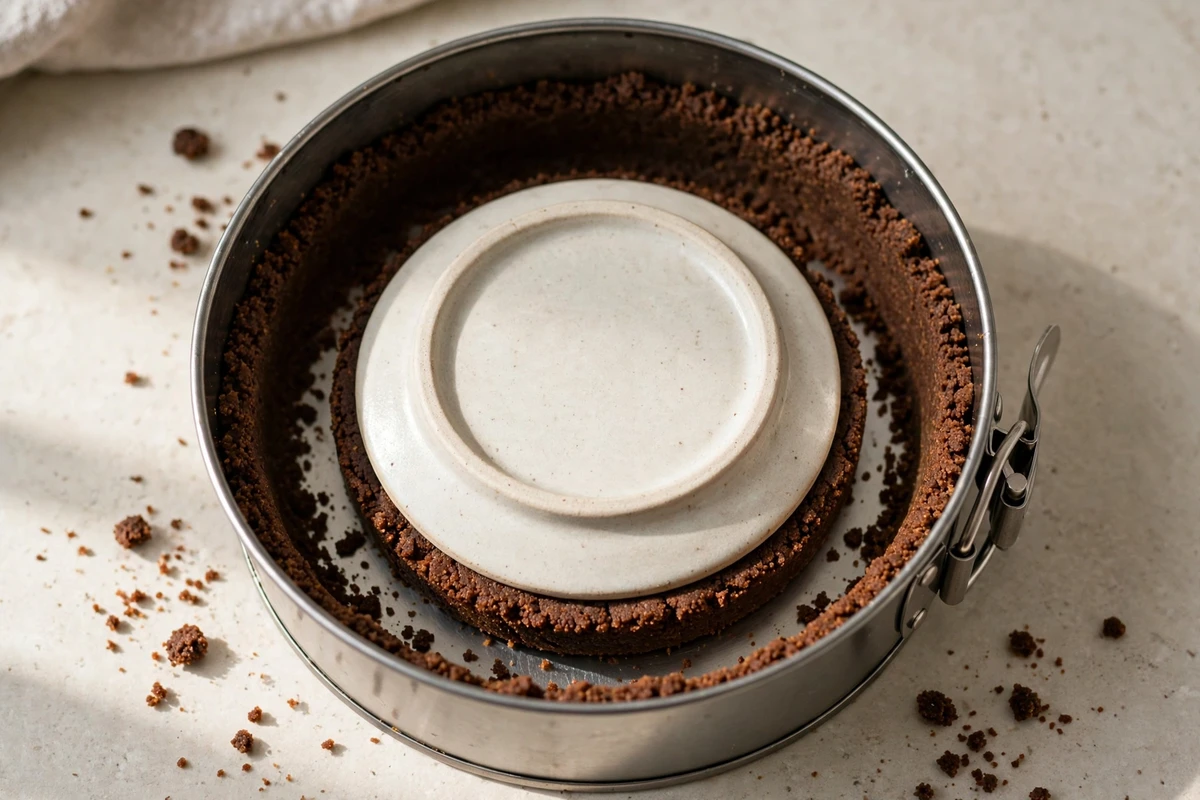
Compacting the spiced gingersnap crust firmly into a springform tin using a small ceramic saucer
Beat the cream cheese alone
Add the sugar and cornstarch
Eggs one at a time, on the lowest speed
Set up the oven and bake at 300°F
The step most people skip
Cool it in three stages
Make the cranberry topping
Top it at the end, not the start
Getting the Texture Right
Usually too much air beaten in, occasionally an oven running hot. The cranberry hides it, so it costs you nothing on the day, but the fix next time is lower speed and less mixing after the eggs go in.
It came out underbaked. The wobble test is easy to misread in a dim oven, which is why the thermometer is worth using. Once chilled, an underbaked cheesecake cannot be rescued by more baking.
Over-baked, most likely. Past about 160°F in the centre the proteins tighten and the custard goes firm and slightly grainy. Pull it while the middle still wobbles.
Either the crust was not pre-baked, or water reached it. This is exactly the failure a foil-wrapped water bath creates and the reason for the tray-below method.
It was not reduced enough, or it went on warm. It needs to mound on the spoon and be fully cold before it touches the cheesecake.
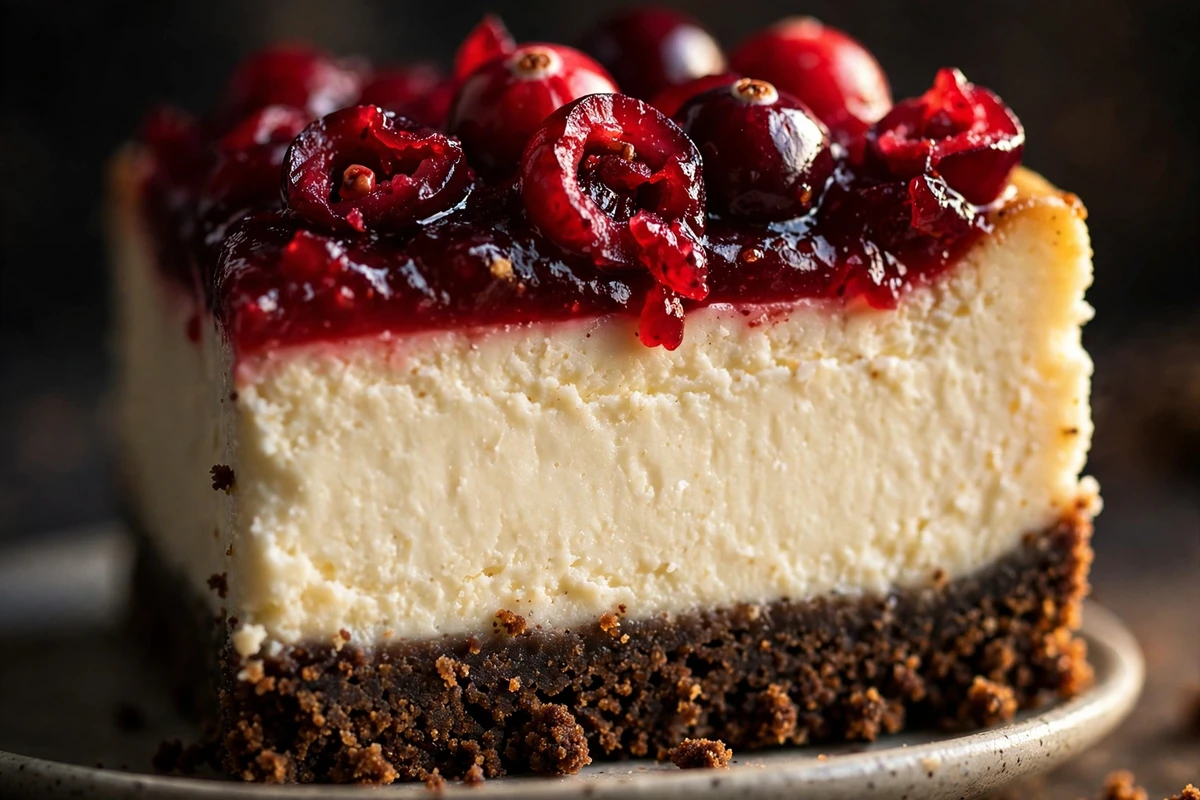
Close-up slice of creamy Christmas cheesecake showing smooth velvety texture, gingersnap crust, and thick cranberry topping
How This Fits the Christmas Table
How to Serve, Store & Reheat
Straight from the fridge, cut with a long thin knife dipped in hot water and wiped dry between every single slice. Twelve slices from a 9 inch tin is the right portion. Sixteen is reasonable after a large dinner.
Christmas cheesecake keeps covered in the fridge for 5 days. Store it uncovered for the first 6 hours of chilling, then cover, otherwise condensation forms on the surface and drips back onto the topping.
Cheesecake is served cold and does not want reheating. If a slice is too cold and firm, 15 minutes on the counter softens it into something noticeably creamier.
Yes, and Christmas cheesecake freezes better than most desserts. Freeze it undecorated, whole or in slices, wrapped tightly, for up to 2 months. Thaw overnight in the fridge and add fresh cranberry topping after. Freezing it with the topping on works but the surface releases water as it thaws.
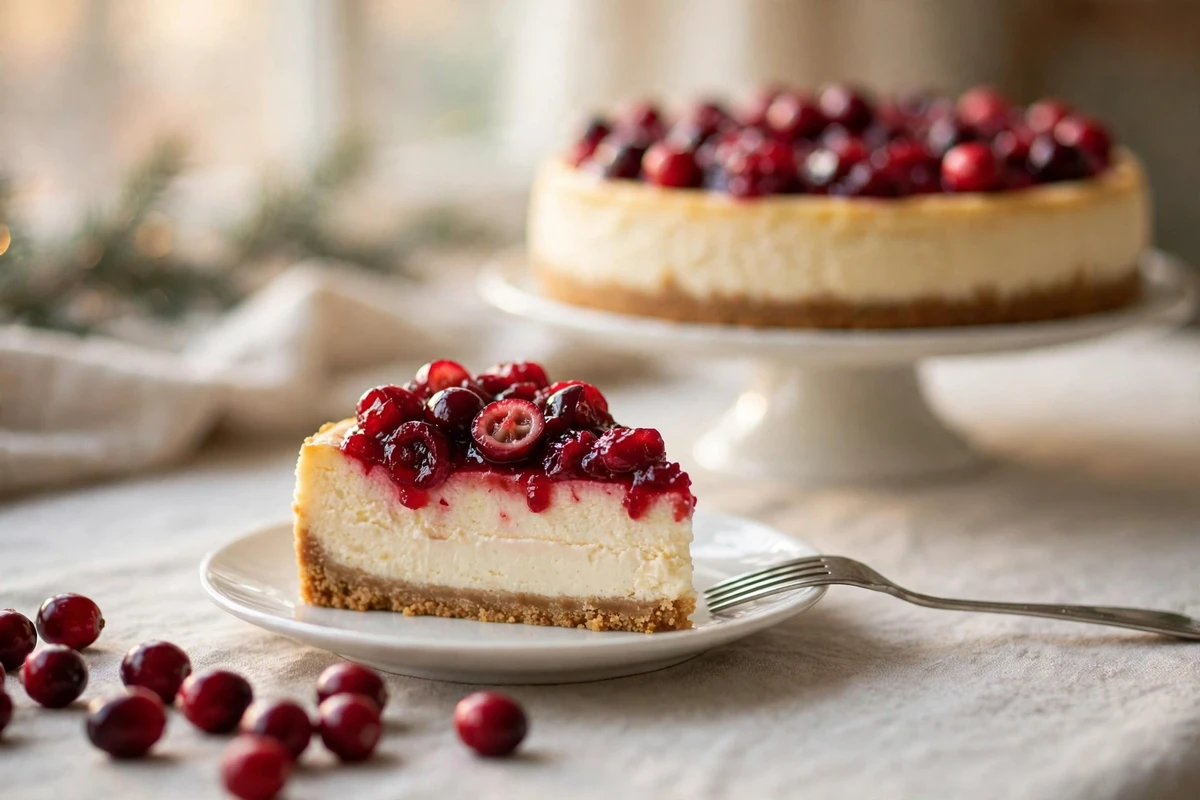
A neat slice of Christmas cheesecake served on a festive holiday table with dessert fork
Dietary Variations
Gluten-free gingersnaps crush and bake into a crust the same way, and the filling contains no flour at all, only cornstarch. This is one of the easier desserts to convert.
Cut the topping sugar to 1/2 cup and add an extra tablespoon of orange juice. Sharper, less jammy, and better against a rich slice than the sweeter version.
Add 1 teaspoon of ground ginger and 1/2 teaspoon of cinnamon to the batter with the sugar. It pushes the whole cake towards the gingersnap crust rather than contrasting with it, which some people prefer.
Cracks are an air problem, not a steam problem. Air beaten into the batter expands in the oven and lifts the cheesecake higher than the custard can hold, and when it cools that structure contracts and tears across the weakest point, which is the middle.
Steam helps by keeping the oven humid and the heat gentle, but it cannot rescue a batter with too much air in it.
That is why the mixing instructions here are stricter than the oven instructions: cream cheese smooth before anything else joins it, lowest speed from the moment the eggs go in, and scrape the bowl instead of mixing longer.
Get those right and you will crack less often with a tray of water than most people do with a full bain-marie.
Allergen Notice: This recipe contains dairy, egg and wheat (in the gingersnap crust). A gluten-free crust swap is above, but the dairy and egg are both structural and cannot be substituted in a baked cheesecake without changing what it is. Gingersnaps are also often produced on shared lines with nuts and soy. Ingredient formulations change without notice, so read current labels rather than treating this list as a guarantee for any specific allergy.
Frequently Asked Questions
Recipe Visual Gallery (5 Full Photos)
Recipe Card & Steps
Ingredients Checklist
Click an item to check it off as you prep
- 200ggingersnap cookies (about 40 small), blitzed to fine crumbs
- 2 Tbsplight brown sugar
- 1/4 tspsalt
- 6 Tbsp(85g) unsalted butter, melted
- 32 oz(900g) full-fat block cream cheese, at room temperature
- 1 1/4 cups(250g) granulated sugar
- 2 Tbspcornstarch
- 1/2 tspsalt
- 4large eggs, at room temperature
- 1 cup(240g) full-fat sour cream, at room temperature
- 2 tspalcohol-free vanilla
- 1 Tbspfinely grated orange zest
- 12 oz(340g) fresh or frozen cranberries
- 3/4 cup(150g) granulated sugar
- 1/3 cuporange juice
- 1 Tbspfinely grated orange zest
- pinchof salt
Step-by-Step Instructions
Follow along and mark each step complete as you cook
Heat the oven to 350°F. Stir the gingersnap crumbs, brown sugar, salt and melted butter until it holds together when squeezed.
Press firmly into the base and 1 inch up the sides of a 9 inch springform tin. Bake 10 minutes and cool. Reduce the oven to 300°F.
Paddle the cream cheese alone for 2 to 3 minutes, scraping twice, until completely smooth with no lumps.
Beat in the sugar, cornstarch and salt on medium-low for 1 minute. Scrape the bowl and paddle.
On the lowest speed, add the eggs one at a time, mixing about 15 seconds each. Mix in the sour cream, vanilla and orange zest just until combined.
Pour into the cooled crust. Put a roasting tin on the lower oven rack, the cheesecake on the middle rack, and fill the roasting tin with boiling water.
Bake 70 to 85 minutes, until the outer 2 inches are set and the middle 3 inches jiggles as one soft unit. The centre should read about 150°F.
Turn the oven off, prop the door open, and leave the cheesecake inside 1 hour.
Cool on the counter 1 hour. Run a thin knife around the inside edge of the tin, then refrigerate uncovered at least 6 hours or overnight.
Simmer the cranberries, sugar, orange juice, zest and salt for 8 to 10 minutes, until the berries burst and the mixture mounds on a spoon. Cool completely, then chill.
Spread the cold topping over the cold cheesecake, release the collar, and serve.
Recipe Card Notes & Tips
- Cream cheese, eggs and sour cream must be at room temperature. Cold cream cheese gives permanent lumps.
- Do not wrap the tin in foil and sit it in water. The tray of boiling water below does the same job without the leak risk.
- The topping must mound on a spoon and be fully cold, or it weeps across the surface.
- Freeze undecorated up to 2 months and add fresh topping after thawing.
Ratings & Reviews
Leave a Review
Made this recipe? Share your thoughts, tweaks, and honest rating with other home cooks!
Community Reviews (0)
You Might Also Enjoy
More delicious recipes in Christmas Recipes.