Pan-Fried Cabbage Dumplings Recipe
Napa cabbage leaves stand in for flour wrappers in these pan-fried cabbage dumplings. A juicy ginger chicken and mushroom filling gets rolled up, seared, steamed and crisped, then served with a soy chili dipping sauce.
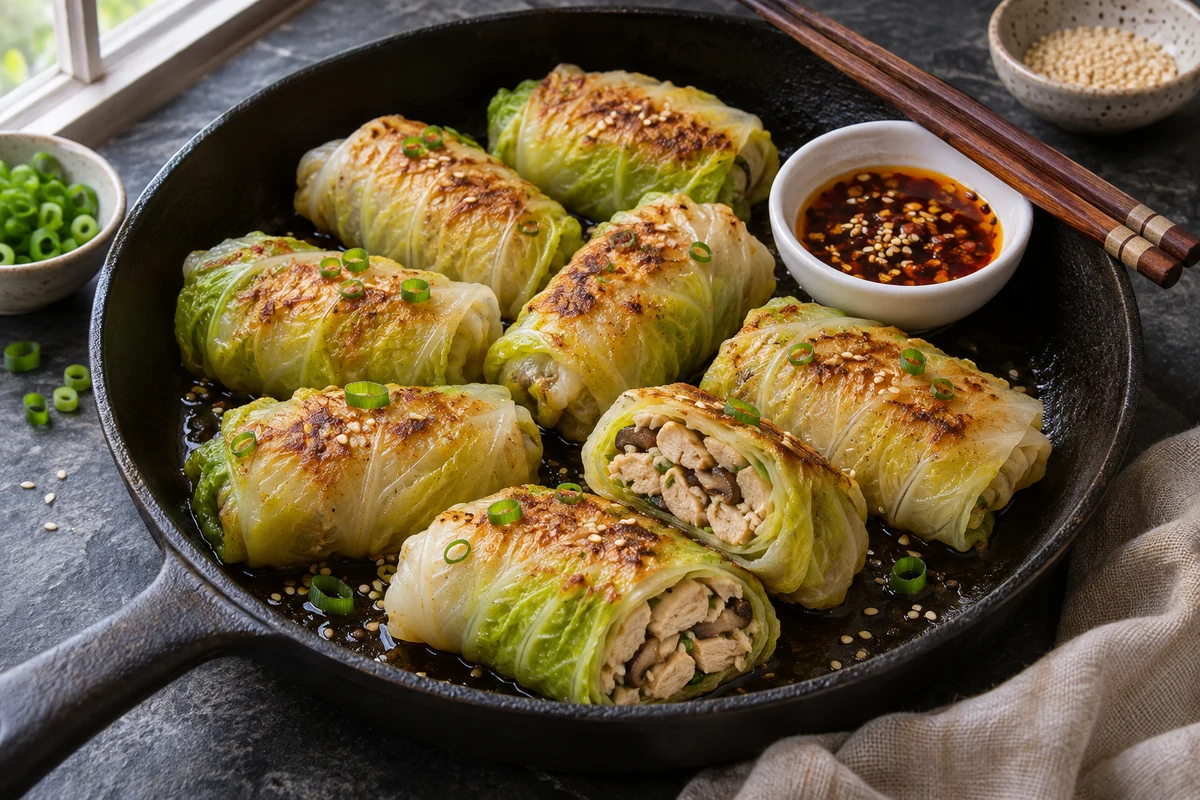
These cabbage dumplings use a blanched napa cabbage leaf where the flour wrapper would normally go, rolled snugly around a ginger, chicken and mushroom filling. They cook like potstickers: seared until golden, steamed under a lid, then crisped again once the water cooks off. Budget about 1 hour 15 minutes, including a short salting rest and two batches in the skillet.
Why You'll Love This Recipe
- No wrappers to buy or pleat. One head of napa cabbage does the job, and rolling a leaf takes far less practice than folding dough.
- Browned edges, juicy middles. The sear, steam, sear method gives you the same contrast as a good potsticker.
- Lower in carbs than flour-wrapped dumplings, simply because the wrapper is a vegetable.
- Nothing goes to waste. The thick ribs you trim off the leaves get chopped into the filling.
Beat liquid into the filling. Ground chicken is lean, and a lean filling tends to cook up dry and crumbly in cabbage dumplings.
The fix comes from Chinese dumpling kitchens: add cold stock to the raw meat a tablespoon at a time and stir hard after each addition until the mixture turns pale and sticky.
Salt from the soy sauce draws proteins out of the meat, and those proteins form a tacky network that holds the liquid in place through cooking. Most recipes insist you stir in one direction only.
The direction matters less than keeping the motion steady for 2 to 3 minutes, so pick one and stay with it.
Read Before You Start
Pick napa cabbage over green. Napa is the standard leaf for cabbage dumplings: long, thin and nearly flat, so a minute in boiling water makes it flexible enough to roll.
Green cabbage leaves are thicker and cupped. They need 2 to 3 minutes of blanching, the ribs resist folding, and the finished rolls come out chewier. Savoy is the better backup: its crinkled leaves bend easily and catch the dipping sauce.
Cook a test bite before you roll. You can't taste raw chicken, so microwave a teaspoon of the filling on a small plate for 20 to 30 seconds, until it's white all the way through, then taste it.
Cabbage is mild and full of water, and it softens the seasoning once everything cooks, so the test bite should taste a little bolder than you'd want on its own.
Ingredient Deep Dive & Notes
Most of what goes into cabbage dumplings is pantry staples. These are the items where your choice changes the result.
Napa cabbage: You need 16 large, intact leaves, so buy a big head, around 2 1/2 to 3 pounds. The small inner leaves are too short to roll; use a couple in the filling and keep the rest for a side dish.
Ground chicken: Thigh meat if your store labels it that way. Ground breast works too, but it leans harder on the beaten-in stock. Most versions of cabbage dumplings use pork, so chicken is my default here, and ground beef is a straight swap (see Dietary Variations).
Mushrooms: Shiitake bring the deepest savory flavor, and cremini are a fine stand-in. Chop them to roughly the size of a grain of rice so they melt into the filling and add moisture instead of chunks.
Cabbage trimmings: These are the ribs and leaf bases you cut off in Step 1, chopped fine, salted and squeezed. The squeeze matters. Unsalted cabbage keeps shedding water as it cooks and leaves a small puddle inside every roll.
Soy sauce: Regular soy sauce contains wheat, so switch to tamari labeled gluten-free if you need to. If you keep halal, read the ingredient list too: some brands add alcohol as a preservative.
Ginger, garlic, scallions and white pepper: White pepper is what makes the filling taste like a dumpling rather than a meatball. Black pepper works, but it gives a sharper, different finish.
Cornstarch: One tablespoon helps the filling hold on to the stock you beat into it.
What I left out: Many Chinese fillings include Shaoxing wine for aroma. I dropped it and let the ginger and white pepper carry that job, the same call I made with my Crispy Orange Chicken. Oyster sauce is out too.
Rice vinegar (for the sauce): Use unseasoned rice vinegar, the same bottle that goes into my Asian Cucumber Salad. Rice wine and mirin often sit right beside it on the shelf, and both contain alcohol, so check before you buy.
Chili crisp or chili oil: Some chili crisps include dried shrimp or pork, and some include peanuts. A plain chili oil avoids those questions.
Don't substitute lettuce or bok choy for the napa. Lettuce collapses into a wet film under steam, and bok choy leaves are too small to wrap around 3 tablespoons of filling.
Equipment Needed
- A 12-inch skillet with a lid that fits: Nonstick or well-seasoned cast iron. The lid is what cooks the filling through.
- A paring knife for shaving down the cabbage ribs.
- An instant-read thermometer: You can't see the filling's color through a rolled leaf, so the number is the reliable check.
- Two clean kitchen towels (or a thick stack of paper towels) for drying the blanched leaves.
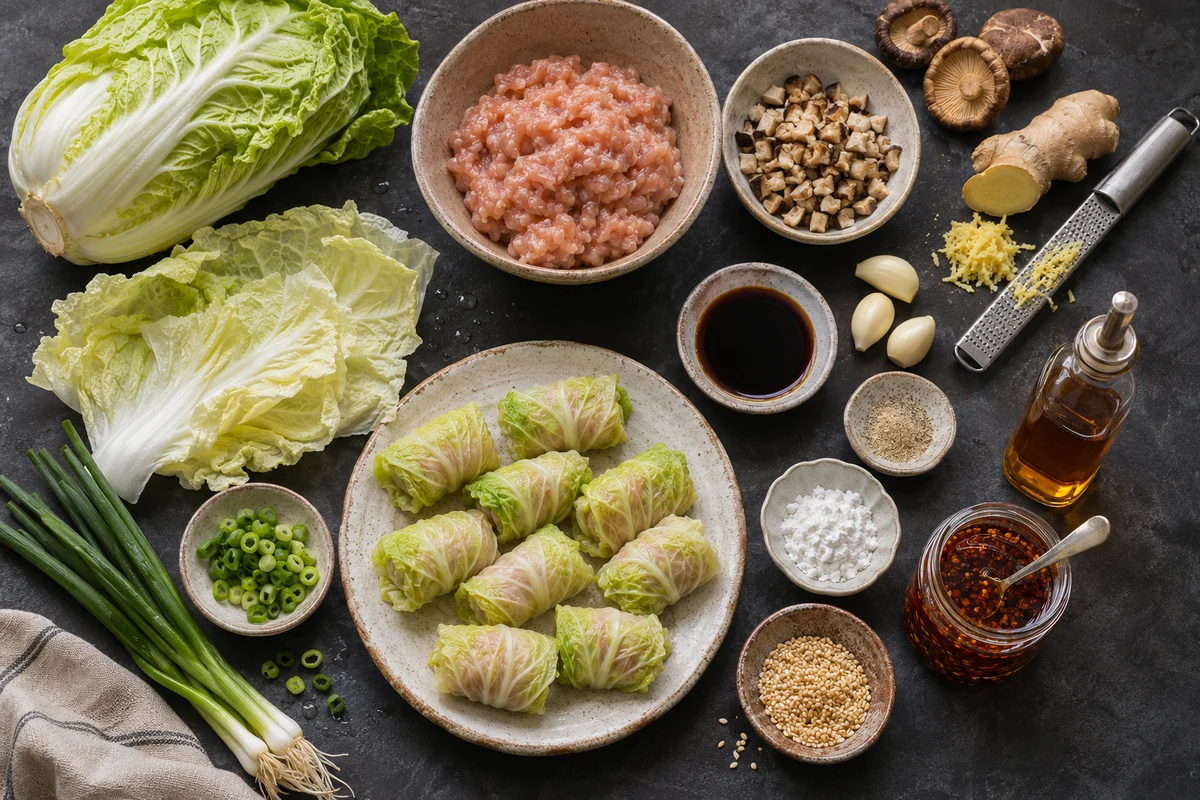
Cabbage dumplings ingredients flatlay with napa cabbage, ground chicken, shiitake mushrooms, ginger, garlic, scallions and soy sauce
Detailed Step-by-Step Cooking Guide
Separate and Trim the Leaves
Before you start: Put a large pot of water on to boil and heat the oven to 200°F for keeping the first batch warm. Both take about 10 minutes, so do Steps 1 and 2 while they heat.
Slice about 1 inch off the root end of the cabbage so the outer leaves loosen, then peel off 16 large leaves, working slowly from the base so they don't split. Cut away the thick white base of each leaf, usually the bottom 2 to 3 inches, which leaves a leaf roughly 6 to 8 inches long. Lay each one flat with the raised side of the rib facing up and shave the rib with your knife held almost parallel to the board, until it's close to the thickness of the leaf around it. Keep every trimming.
Salt and Squeeze the Trimmings
Chop the trimmings finely and measure out 1 cup, adding an inner leaf or two if you come up short. Toss with 1/2 teaspoon of salt and leave it for 10 minutes. Then squeeze it by the handful, or twisted inside a towel, until it stops dripping. Expect a few tablespoons of liquid. Don't rinse it.
Blanch the Leaves and Dry Them Well
Once the water is at a rolling boil, blanch the leaves 3 or 4 at a time for 30 to 60 seconds. They're ready when the thickest part of the rib bends in half without cracking and the leafy edges turn bright green and slightly see-through. Lift them out with tongs and lay them in a single layer on a towel-lined sheet pan. Skip the ice bath: napa leaves are thin enough to stop cooking within a minute once spread out, and cold water only gives you more to dry off.
Now blot the tops. This is the step most people skip, and it decides whether your rolls hold together. A wet leaf won't brown, the seam slides open in the pan, and the extra water ends up under the dumplings where it keeps the bottoms from crisping. Keep blotting both sides until the leaves feel tacky rather than slick.
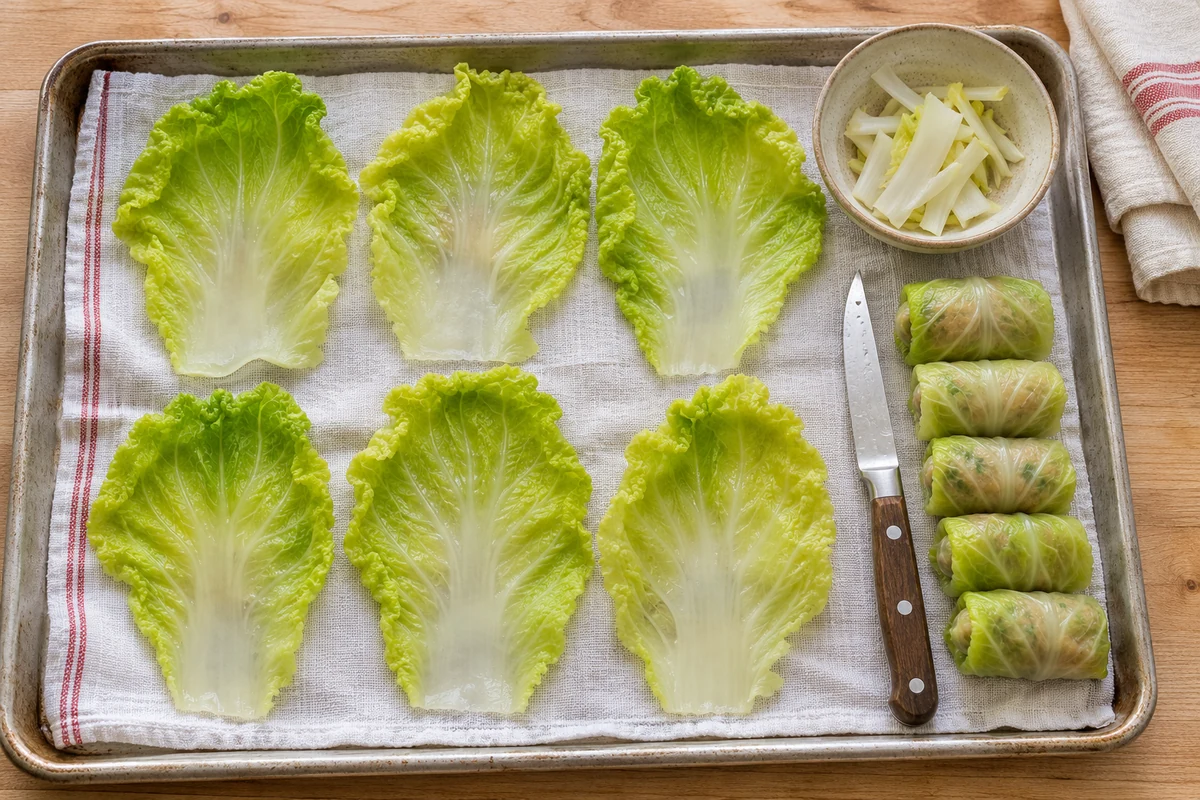
Blanched napa cabbage leaves with shaved ribs drying flat on a kitchen towel before rolling cabbage dumplings
Mix and Beat the Filling
Put the chicken, mushrooms, squeezed cabbage, scallions, ginger, garlic, soy sauce, sesame oil, cornstarch, sugar and white pepper in a large bowl. Stir in one direction with chopsticks or a stiff spatula for about 1 minute.
Then add the cold stock 1 tablespoon at a time, stirring hard after each until it disappears, about 2 to 3 minutes in all. The filling is ready when it looks paler, feels sticky, and pulls away from the bowl in strands. Do the microwave test bite now and adjust the soy sauce or pepper if needed.
Roll the Dumplings
Lay a blanched leaf flat with the inner side facing up and the base toward you. Shape about 3 tablespoons of filling into a 3-inch log near the base.
Fold the base up over the filling, fold in both sides, then roll firmly toward the tip without stretching the leaf. Set it seam-side down on a plate and repeat until you have 16 cabbage dumplings. If a leaf tears, patch it with a scrap from one of the smaller inner leaves.
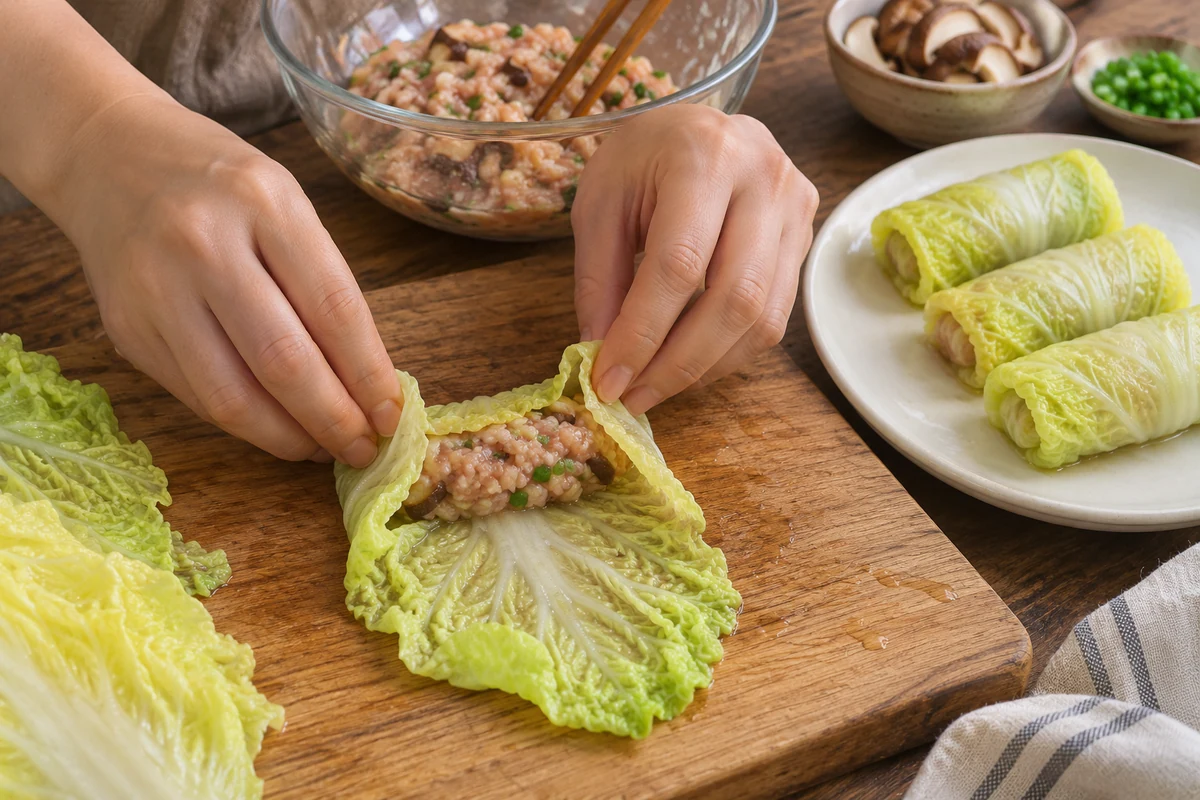
Rolling cabbage dumplings by folding a blanched napa leaf around a log of ginger chicken filling on a wooden cutting board
Sear, Steam, Then Crisp Again
Heat 1 tablespoon of oil in the skillet over medium heat until it shimmers. Add 8 cabbage dumplings seam-side down, leaving a little space between them, and leave them alone for 3 minutes, until the undersides are golden brown with a few darker spots. Flip them and cook 2 minutes more.
Pour in 1/4 cup of water (it will spatter), cover right away, and turn the heat down to medium-low. Steam for 7 minutes. Then take the lid off, bring the heat back to medium, and cook another 1 to 2 minutes, until the water is gone and you can hear the pan sizzling again. That last stretch puts the crisp back on the bottoms. An instant-read thermometer pushed into the center of one dumpling should read 165°F, and the filling should be opaque white and firm when pressed.
Move the batch to a rack set on a sheet pan in the warm oven, then repeat with the remaining oil, water and dumplings.
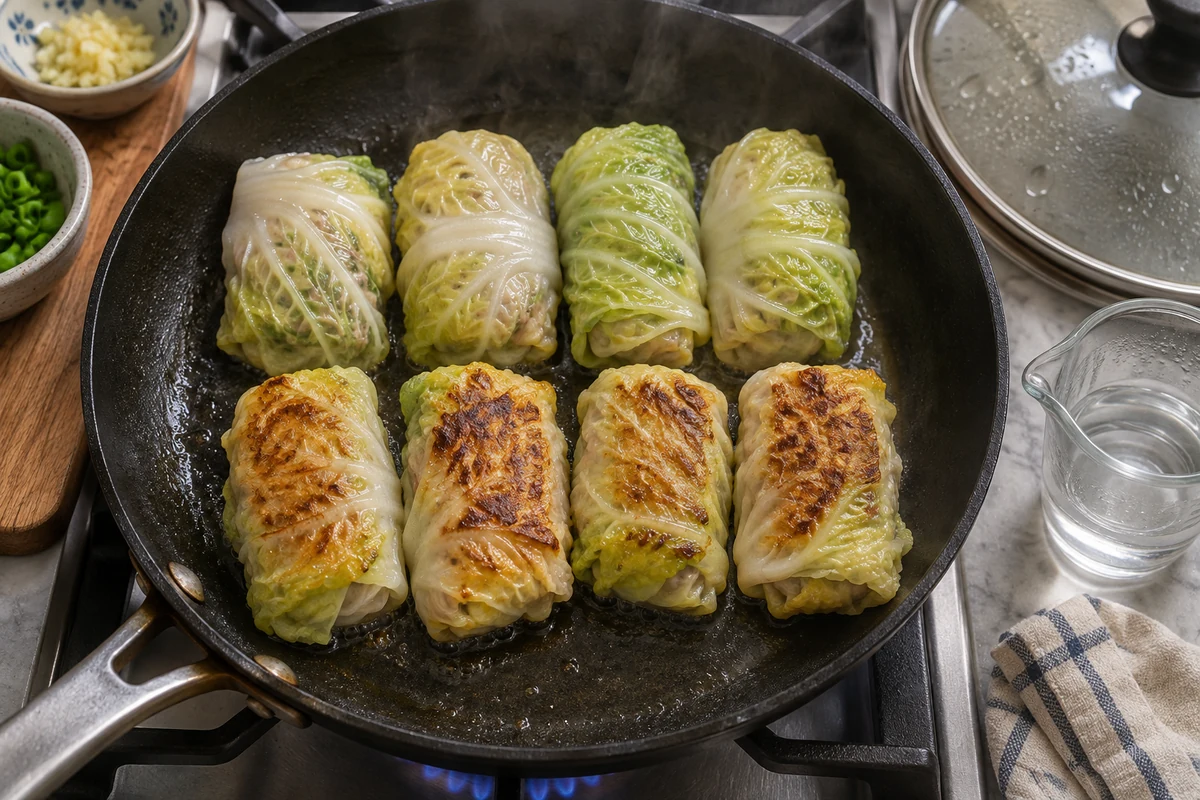
Cabbage dumplings searing seam-side down in a skillet, with flipped rolls showing golden-brown bottoms before steaming
Whisk the Dipping Sauce
While the first batch steams, whisk the soy sauce, rice vinegar, sesame oil, sugar, garlic and chili crisp in a small bowl until the sugar dissolves. Top with the sesame seeds and sliced scallion greens just before serving.
Getting Cabbage Dumplings Right
The failure I'd warn you about first with cabbage dumplings is the roll that unravels in the pan. It almost always comes back to wet leaves or moving the dumplings before the seam has set. Here's how to fix that one and the other common problems.
There are two opposite causes. Underblanched leaves snap at the rib, and overblanched ones go limp and split. Stay in the 30 to 60 second window, test the rib bend on the first leaf, and shave the rib thinner if it still fights you.
Dry the leaves more thoroughly, put the dumplings in seam-side down, and don't touch them for the full 3 minutes.
Measure the 1/4 cup of water per batch instead of pouring freely, and never skip the uncovered finish. Unsqueezed cabbage in the filling will also leak water into the pan.
This is usually lean breast meat with the stock step skipped, or dumplings cooked well past 165°F. Pull them as soon as the thermometer hits that mark.
Trust the test bite. If it tastes merely okay, stir another teaspoon of soy sauce into the filling before you roll. The dipping sauce should add to the flavor, not rescue it.
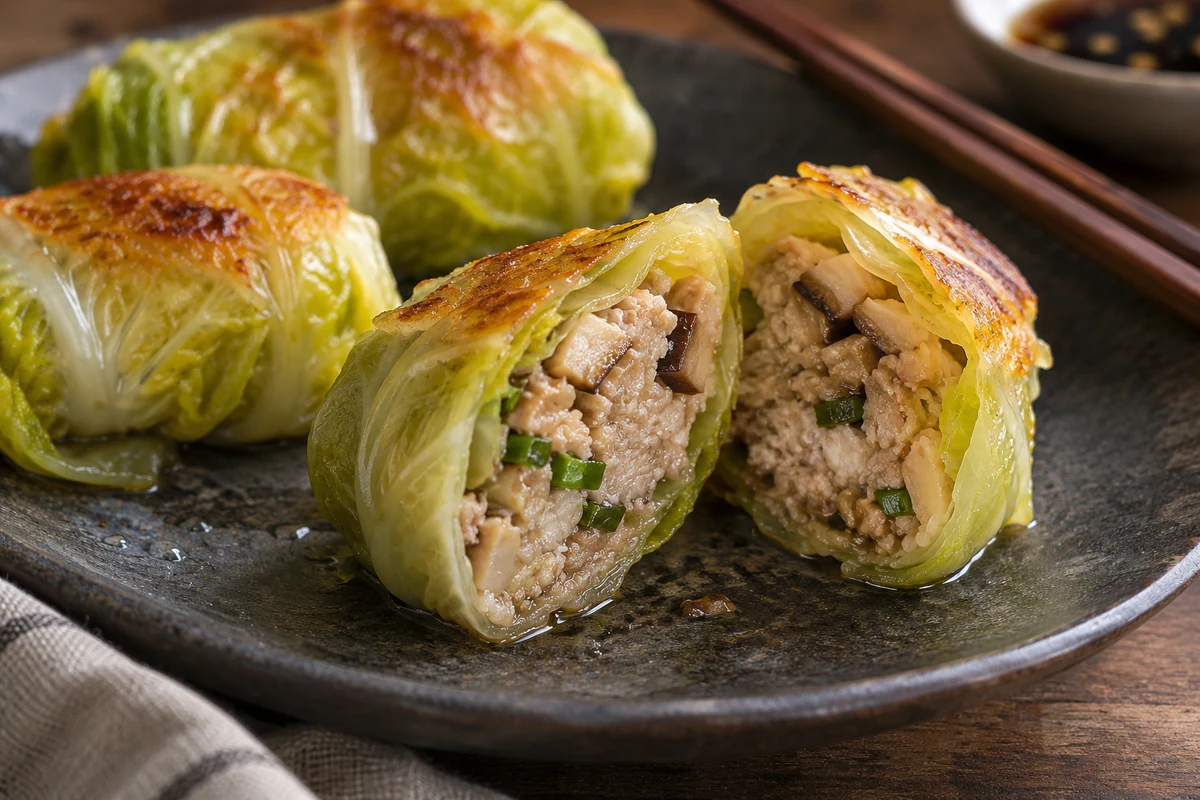
Close-up of a halved cabbage dumpling showing a juicy chicken and mushroom filling inside a tender napa cabbage leaf
How to Steam Cabbage Dumplings Instead
How to Serve, Store & Reheat
Serve cabbage dumplings hot, browned side up, with the dipping sauce on the side. As an appetizer, plan on 3 or 4 per person. As a main, give everyone 4 over steamed rice with something cold and crunchy alongside, like the Asian Cucumber Salad above. For a bigger Lunar New Year spread (the holiday falls on Saturday, February 6, 2027), set them out next to the Crispy Orange Chicken. They aren't traditional pleated dumplings, but they hold their own on that table.
Refrigerate cooked cabbage dumplings in an airtight container within 2 hours of cooking and eat them within 3 days. Keep the dipping sauce in its own jar for the same 3 days; the fresh garlic gets stronger as it sits.
The skillet brings leftover cabbage dumplings back best. Heat 1 teaspoon of oil over medium, add the dumplings and 2 tablespoons of water, cover for 3 to 4 minutes, then uncover until the pan sizzles and the bottoms crisp. The microwave works too (covered, 60 to 90 seconds for 4 dumplings), but the bottoms go soft. Either way, reheat to 165°F in the center.
Yes, but freeze cabbage dumplings uncooked. Set the rolled dumplings on a parchment-lined tray, freeze until solid (about 2 hours), then move them to a freezer bag for up to 2 months. Cook straight from frozen: sear 4 minutes, flip and cook 2 minutes, add 1/4 cup water, then cover for 11 to 13 minutes, adding a splash more water if the pan runs dry, until the center reads 165°F. The leaves come out a little softer than fresh. Freezing them after cooking isn't worth it, because the cabbage turns limp and watery on the second reheat.
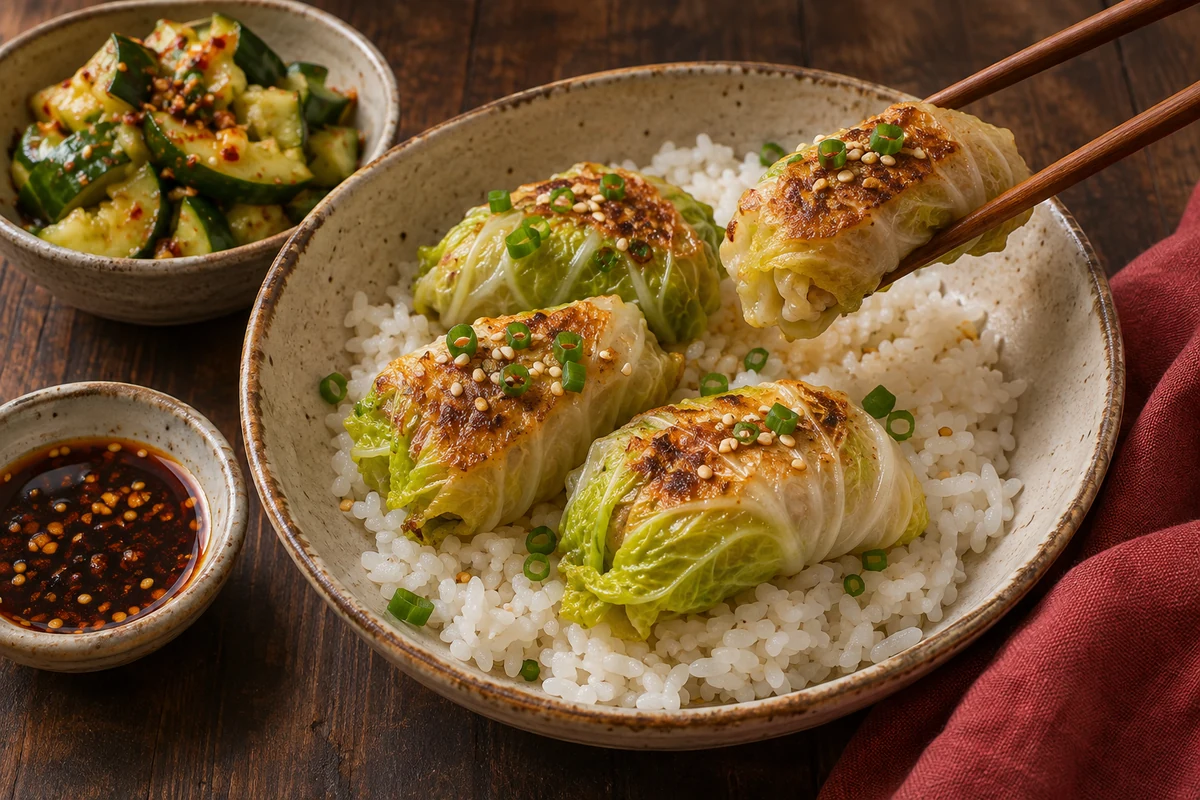
Cabbage dumplings served over steamed rice with soy chili dipping sauce, chopsticks and a side of smashed cucumber salad
How to Use Leftovers
Dietary Variations
Use tamari labeled gluten-free or coconut aminos in both the filling and the sauce. Cornstarch is naturally gluten-free, but check the chili crisp label too.
Swap in 1 pound of 85% lean ground beef and cut the stock to 2 tablespoons, since beef carries more fat. Ground beef is done at 160°F rather than 165°F.
Use 14 ounces of extra-firm tofu, pressed and crumbled, plus another 4 ounces of mushrooms (8 ounces total). Raise the cornstarch to 2 tablespoons and skip the stock, because tofu can't hold it the way meat does. The filling cuts softer, and the steamer treats it more gently than the skillet.
Let the pan set the seam. A flour wrapper seals itself because damp dough sticks to damp dough.
A cabbage leaf has nothing like that, so the only thing keeping cabbage dumplings closed is the filling cooking against the leaf at the seam.
That's why the dumplings go in seam-side down and stay put for the full three minutes. Nudge them at the one-minute mark and the seam lifts before it has set. Wait it out, and they flip as neat, closed rolls.
Allergen Notice: This recipe contains soy (soy sauce), wheat (regular soy sauce) and sesame (sesame oil and seeds). Some chili crisps also contain peanuts or shellfish.
- Soy: Use coconut aminos in place of soy sauce, which also removes the wheat.
- Wheat: Use tamari labeled gluten-free.
- Sesame: Use a neutral oil in the filling and sauce, and leave the seeds off.
Always read labels, since formulas vary by brand and cross-contact can happen during manufacturing. This recipe is not guaranteed to be safe for any specific allergy.
Frequently Asked Questions
Roll your first batch of cabbage dumplings and the second goes noticeably faster, because your hands pick up the fold quickly. Pin this one for Lunar New Year or any weeknight, and come back to tell me whether you went with the skillet or the steamer.
Recipe Visual Gallery (7 Full Photos)
Recipe Card & Steps
Ingredients Checklist
Click an item to check it off as you prep
For the wrappers
- 1 large head napa cabbage (about 2 1/2 to 3 lb), for 16 large leaves
For the filling
- 1 cup finely chopped cabbage trimmings (shaved ribs and leaf bases, plus inner leaves if needed)
- 1/2 tsp kosher salt, for the trimmings
- 1 lb (450 g) ground chicken, thigh preferred
- 4 oz (115 g) shiitake or cremini mushrooms, finely chopped
- 3 scallions, thinly sliced
- 1 Tbsp finely grated fresh ginger
- 2 garlic cloves, finely grated
- 2 Tbsp soy sauce
- 1 Tbsp toasted sesame oil
- 1 Tbsp cornstarch
- 1/2 tsp sugar
- 1/4 tsp ground white pepper
- 3 Tbsp cold unsalted chicken stock or water
To cook
- 2 Tbsp neutral oil, divided
- 1/2 cup water, divided
For the dipping sauce
- 3 Tbsp soy sauce
- 2 Tbsp unseasoned rice vinegar
- 1 tsp toasted sesame oil
- 1 tsp sugar
- 1 small garlic clove, finely grated
- 1 to 2 tsp chili crisp or chili oil
- 1 tsp toasted sesame seeds
- 1 scallion, green part only, thinly sliced
Step-by-Step Instructions
Follow along and mark each step complete as you cook
Heat the oven to 200°F and bring a large pot of water to a boil.
Cut 1 inch off the root end of the cabbage and peel off 16 large, unbroken leaves. Cut away the thick white base of each leaf (usually the bottom 2 to 3 inches), then shave the remaining rib with a paring knife until it is close to the thickness of the leaf. Save all trimmings.
Finely chop the trimmings to make 1 cup, adding an inner leaf or two if needed. Toss with 1/2 tsp salt and let stand 10 minutes. Squeeze firmly by the handful until no more liquid drips. Do not rinse.
Blanch the leaves 3 or 4 at a time for 30 to 60 seconds, until the thickest part of the rib bends in half without cracking. Lay flat in a single layer on a towel-lined sheet pan. Blot both sides until the leaves feel tacky, not wet.
In a large bowl, combine the chicken, mushrooms, squeezed cabbage, scallions, ginger, garlic, soy sauce, sesame oil, cornstarch, sugar and white pepper. Stir in one direction for 1 minute. Add the cold stock 1 Tbsp at a time, stirring hard after each addition, until the filling is pale and sticky, 2 to 3 minutes total.
Microwave 1 tsp of the filling for 20 to 30 seconds until cooked through, taste, and adjust the seasoning.
Lay a leaf flat, inner side up, base toward you. Shape about 3 Tbsp of filling into a 3-inch log near the base. Fold the base over the filling, fold in the sides, and roll firmly toward the tip. Set seam-side down. Repeat to make 16.
Heat 1 Tbsp oil in a 12-inch skillet over medium heat until shimmering. Add 8 dumplings seam-side down and cook, untouched, 3 minutes, until golden brown underneath. Flip and cook 2 minutes more.
Add 1/4 cup water, cover immediately, and reduce the heat to medium-low. Steam 7 minutes. Uncover, raise the heat to medium, and cook 1 to 2 minutes, until the water has evaporated and the bottoms sizzle and crisp. The center should read 165°F. Hold on a rack in the warm oven. Repeat with the remaining oil, water and dumplings.
While the first batch steams, whisk the soy sauce, rice vinegar, sesame oil, sugar, garlic and chili crisp until the sugar dissolves. Top with the sesame seeds and scallion greens. Serve the dumplings hot with the sauce.
Recipe Card Notes & Tips
- Halal: No pork and no alcohol as written. Use halal chicken, and check the labels on your soy sauce (some brands add alcohol) and chili crisp (some contain pork or shrimp).
- Gluten-free: Use tamari labeled gluten-free or coconut aminos in the filling and sauce.
- Steamer method: Steam seam-side down in a lined basket over boiling water, covered, 10 to 12 minutes, to 165°F.
- Make ahead: Roll up to 24 hours ahead and refrigerate, covered. Or freeze uncooked on a tray, then bag for up to 2 months; cook from frozen with 11 to 13 minutes under the lid.
- Ground beef swap: Use 2 Tbsp stock and cook to 160°F.
Ratings & Reviews
Leave a Review
Made this recipe? Share your thoughts, tweaks, and honest rating with other home cooks!
Community Reviews (0)
You Might Also Enjoy
More delicious recipes in Main Dishes.