Chewy Matcha Mochi Breads Recipe
Puffy, crack-topped matcha mochi breads with a crisp shell and a hollow, stretchy middle. Made with tapioca starch and no yeast.
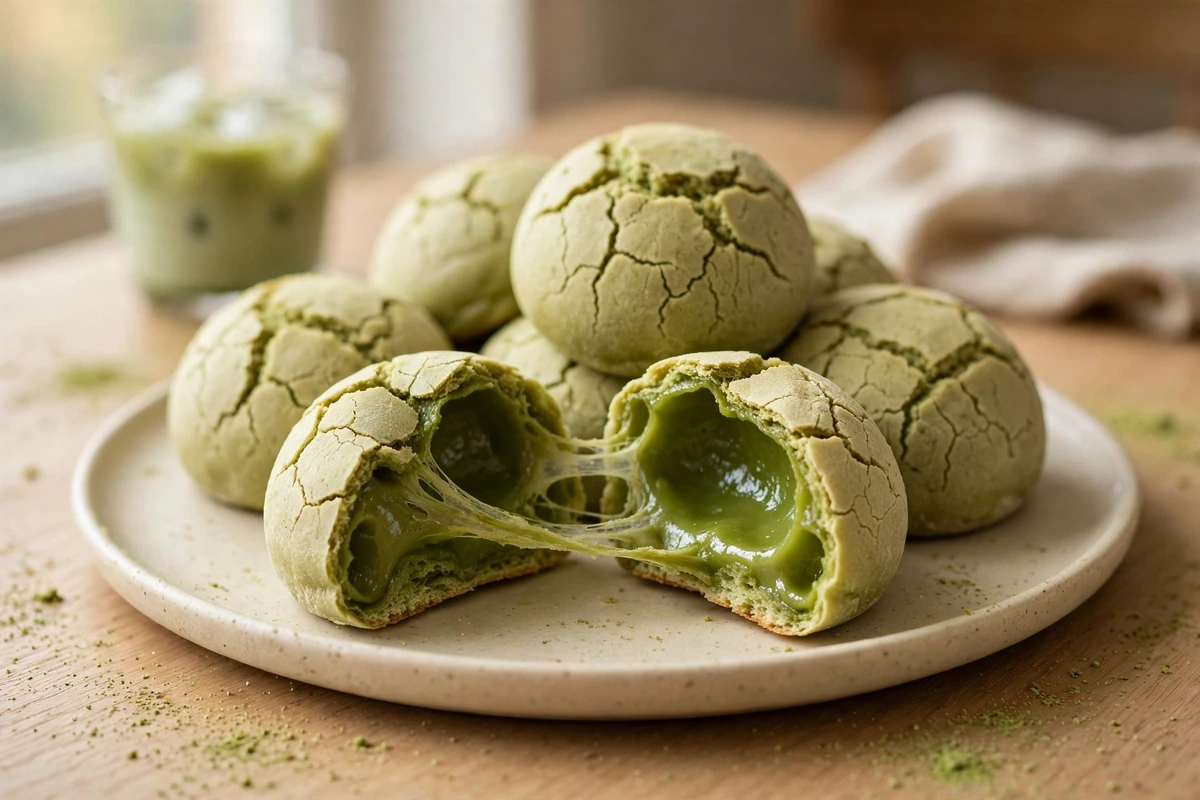
These matcha mochi breads bake into puffy, crack-topped balls with a thin crisp shell and a hollow, stretchy middle that pulls apart like warm mochi. The chew comes from tapioca starch stirred into a hot matcha paste, and the rise comes from steam trapped by the eggs, so there's no yeast and no proofing. Start to finish takes about an hour, and the oven does most of that.
Why You'll Love This Recipe
- No yeast, no rising time. The batter for these matcha mochi breads goes from saucepan to sheet pan in about 15 minutes.
- Eight ingredients. Most are already in your kitchen. Tapioca starch and matcha are the two you may need to buy.
- The texture is the whole point. Crisp and crackled outside, hollow and chewy inside, nothing like a cakey muffin.
- They're only lightly sweet, so the matcha tastes grassy and slightly bitter, the way it should, instead of like green sugar.
Here's the one thing nobody tells you: the tapioca has to go into the paste while the paste is still hot, and it has to go in all at once.
Hot paste partly cooks (gelatinizes) the starch, which is what turns a loose white powder into a stretchy dough that can hold steam and puff.
Let the paste cool first and far less of the starch gelatinizes, so the batter ends up runnier and grittier and tends to bake flat. Have the tapioca weighed and sitting next to the stove before you even warm the milk.
Read Before You Start
Weigh the tapioca starch. A "cup" of tapioca can land anywhere from about 110 to 140 grams depending on how you fill it, and that swing changes how much egg the dough can take. The target is 120 grams. A cheap kitchen scale removes the biggest variable in this recipe.
Let the batter decide how much egg goes in. Two eggs are listed because you'll need more than one, but most batches stop at around one and a half. Add the egg in stages and test after each one. Pour it all in at once and you can lose the batch: a batter that's too loose turns matcha mochi breads into flat green discs in the oven, and nothing brings it back once it's baked.
Ingredient Notes
Whole milk: Milk fat and protein give a softer, richer interior and help the shell color evenly. Skim milk works but bakes up leaner and drier.
Unsalted butter: It adds flavor and keeps the crust tender. Salted butter is fine if you cut the added salt down to a pinch.
Granulated sugar: Only 2 1/2 tablespoons, enough to round off matcha's bitterness and help the outside color. Bakery-style matcha mochi breads are meant to be lightly sweet, and that's the target here.
All-purpose flour: Just 20 grams. It thickens the milk into a smooth paste before the tapioca goes in, which gives the dough a base to hold onto. It's also the only source of gluten in the recipe (see Dietary Variations for the swap).
Culinary-grade matcha: Culinary grade is made for mixing and baking, with a stronger, more astringent flavor that holds up against butter and sugar. Ceremonial grade costs a lot more, and its delicate flavor mostly disappears in a 350°F oven. Look for powder that's actually bright green. Yellowish or dull brown matcha is old or low grade and tastes flat and bitter.
Tapioca starch: Also sold as tapioca flour (in the US they're the same product). It's the main ingredient in matcha mochi breads and the entire source of the chew. Don't substitute cassava flour, even though both come from the same root. Cassava flour is the whole dried root, fiber included, and it bakes into something dense and bready with none of the stretch. Regular rice flour won't work either.
Large eggs: Use them at room temperature. Cold eggs chill the warm dough, stiffen the butter in it, and make the batter look curdled and harder to bring together.
If chewy, bouncy textures are your thing, the Sweet Potato Mochi Pancakes are a good next bake. For another recipe built around a bright Asian flavor, try the Fudgy Yuzu Brownies.
Equipment Needed
- Digital kitchen scale: mainly for the tapioca starch.
- Medium heavy-bottomed saucepan: a thin pan can scorch the paste in the minute it cooks.
- Fine-mesh sieve: matcha clumps easily and needs sifting.
- Stand mixer or hand mixer: makes beating in the eggs easy. A sturdy silicone spatula and some arm work also does it for a batch this size.
- 1 1/2-tablespoon cookie scoop: keeps all 12 matcha mochi breads the same size so they bake evenly. A piping bag with a 1/2-inch round tip works too.
- Half sheet pan and parchment paper: a silicone mat works, though the bottoms brown a little less.
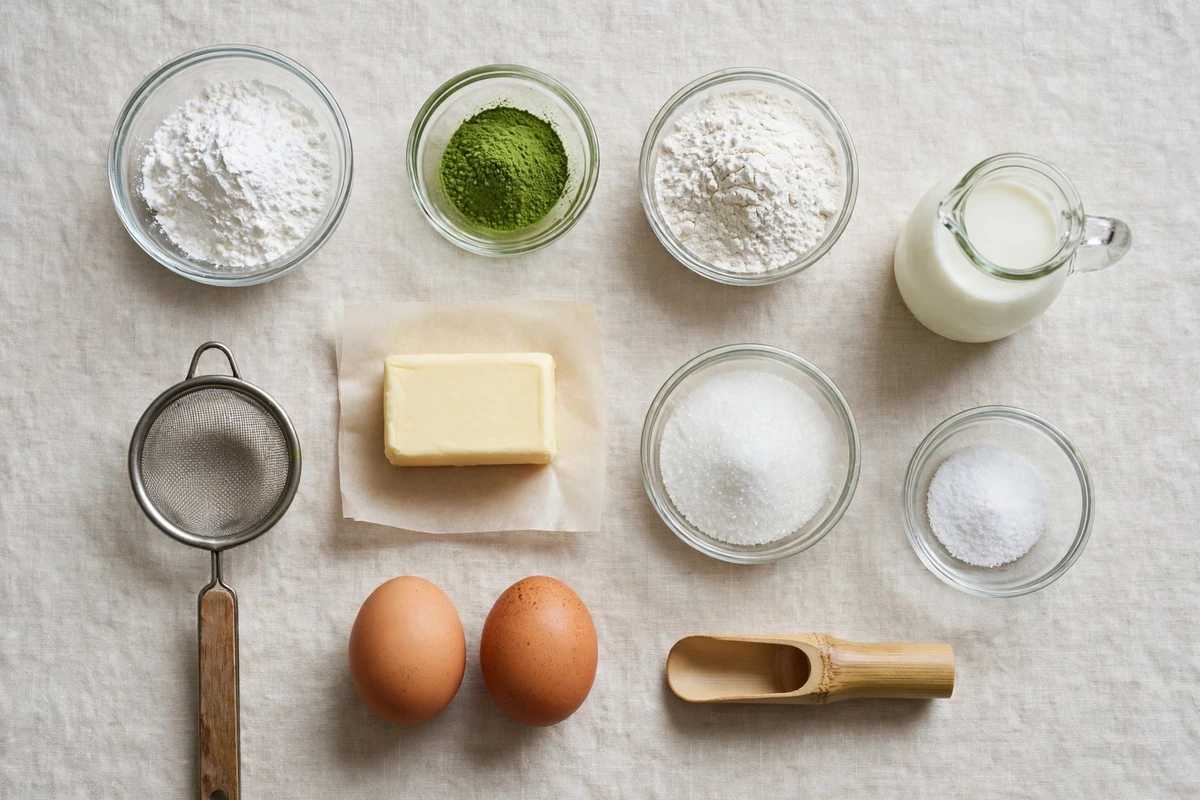
Ingredients for matcha mochi breads: tapioca starch, matcha, flour, milk, butter, sugar, salt and eggs
How to Make Matcha Mochi Breads Step by Step
Sift the Flour and Matcha Together
Before you start: Heat the oven to 350°F (175°C) with a rack in the center and line the pan with parchment. Weigh everything, and beat the eggs together in a measuring cup with a spout. If the eggs are cold, set them in a bowl of warm water for 5 minutes first. The stovetop part moves fast, so keep everything within reach.
Sift the flour and matcha into a small bowl and whisk them together. This is the one step most people skip, and it's why so many batches of matcha mochi breads end up with dark green specks and pockets of bitter powder. Matcha's very fine particles clump easily, and spreading them through the flour first means they hydrate evenly when they hit the hot milk.
Heat the Milk, Butter, Sugar, and Salt
Put the milk, butter, sugar, and salt in the saucepan over medium heat. Warm it until the butter has melted completely, the surface is steaming, and small bubbles form around the edge, about 3 minutes. Don't let it reach a rolling boil, since that evaporates liquid the dough needs.
Cook the Matcha Paste
Turn the heat down to medium-low and add the flour and matcha all at once. Stir constantly with a spatula for 45 to 60 seconds. The thin green milk will turn into a smooth paste about as thick as pudding, with no dry spots left. The flour needs this full minute for its starch to swell, and an undercooked paste makes a weaker dough.
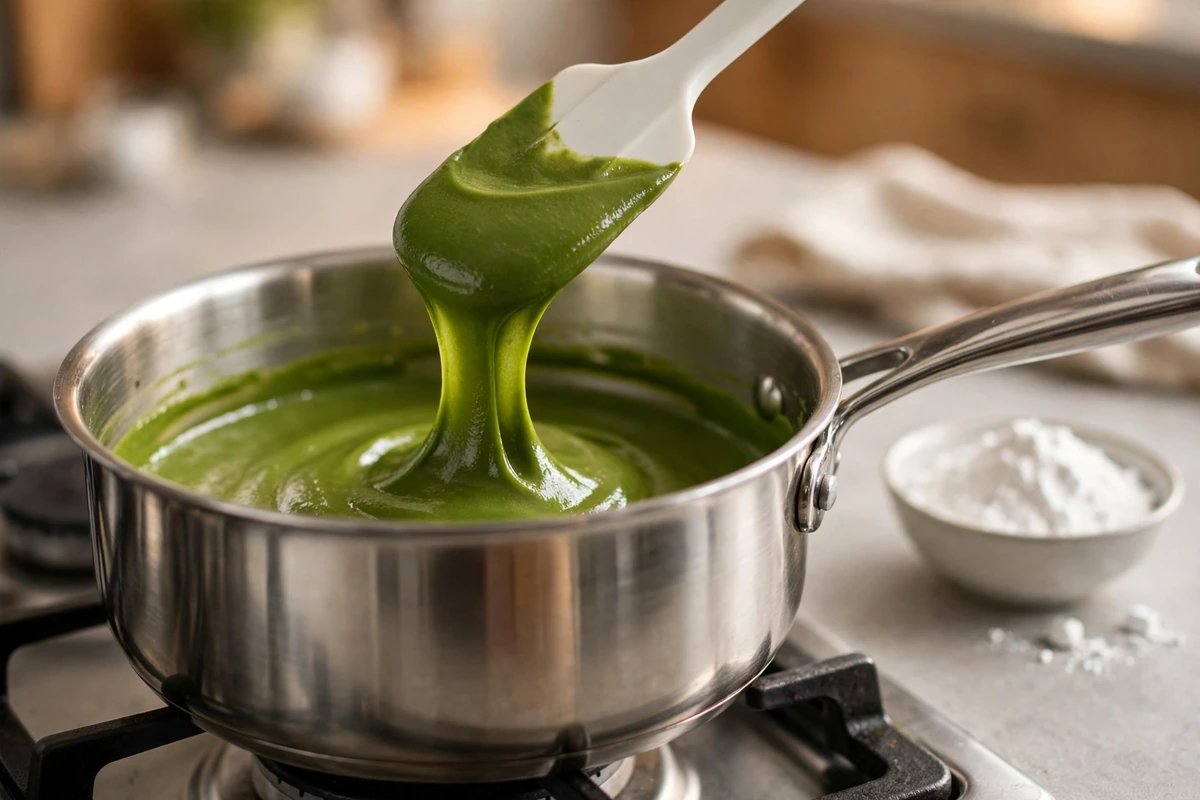
Smooth bright green matcha paste being stirred with a spatula in a saucepan for mochi bread dough
Add the Tapioca Off the Heat
Take the pan off the heat, tip in all the tapioca starch, and stir hard. It looks lumpy and shaggy at first. Within about a minute it comes together into a stiff, sticky, slightly translucent dough that pulls away from the sides of the pan. Press any white streaks against the side of the pan until they disappear.
Move the dough to a mixing bowl and let it sit for 5 minutes, until it feels warm but no longer hot (below 140°F/60°C). Any hotter and the eggs start to cook on contact.
Beat in the Eggs a Little at a Time
Pour in about a quarter of the beaten egg and beat on medium speed (or by hand) until it's absorbed. After each addition the dough looks broken and slippery, then smooths out again. Keep adding egg in 4 or 5 small additions in total.
Once you've added roughly one and a half eggs, start testing. Lift the beater or spatula: ready batter is glossy and thick, falls off in a slow, heavy ribbon, and leaves a thick V-shaped flap hanging from the spatula for a few seconds. If it still clings in a stiff clump, add another teaspoon of egg and test again.
The usual mistake here is adding all of the second egg because the ingredient list says two. If your batter runs off the spatula quickly, it's gone too far, and the fix is in the troubleshooting section below.
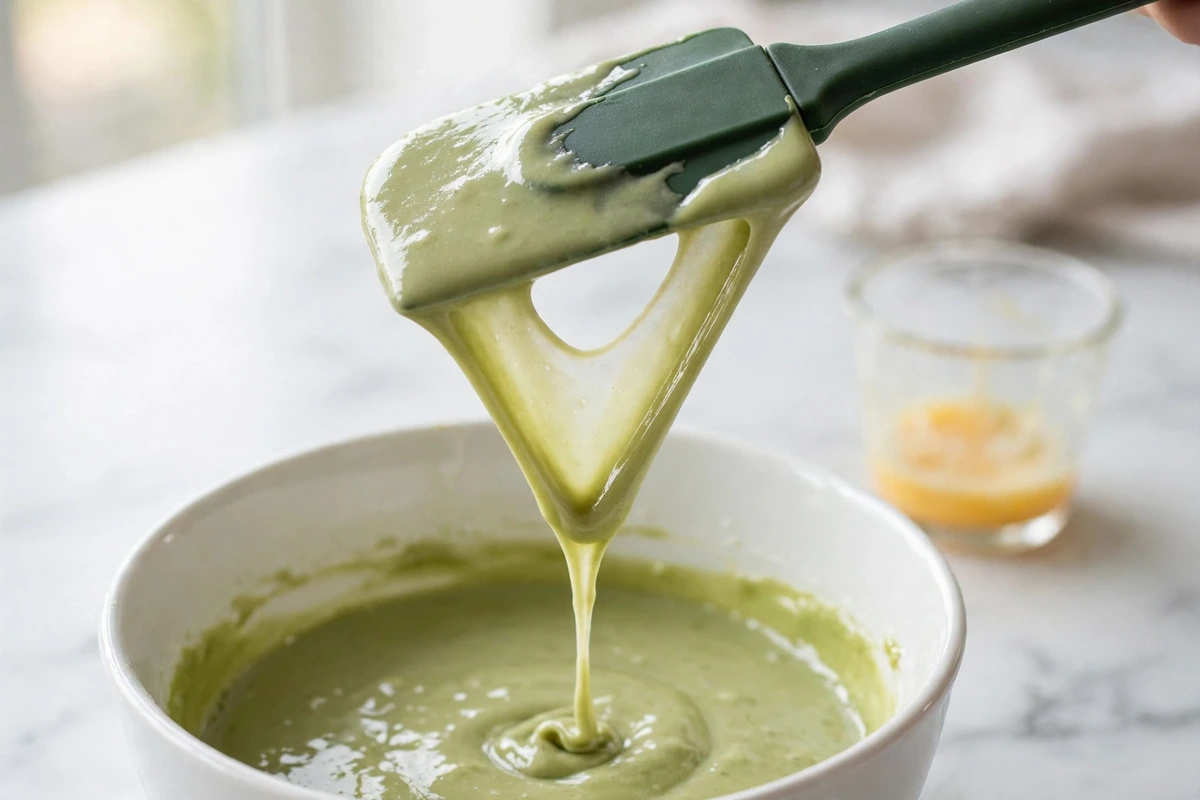
Glossy matcha mochi bread batter hanging from a spatula in a thick V shape over a mixing bowl
Scoop and Shape
Scoop 12 level 1 1/2-tablespoon mounds onto the lined pan, about 2 inches apart (a 3 by 4 grid fits a half sheet pan). Dip a fingertip in water and smooth down any peaks, since points brown before the rest of the ball. If you like, sprinkle a few toasted black sesame seeds over the tops.
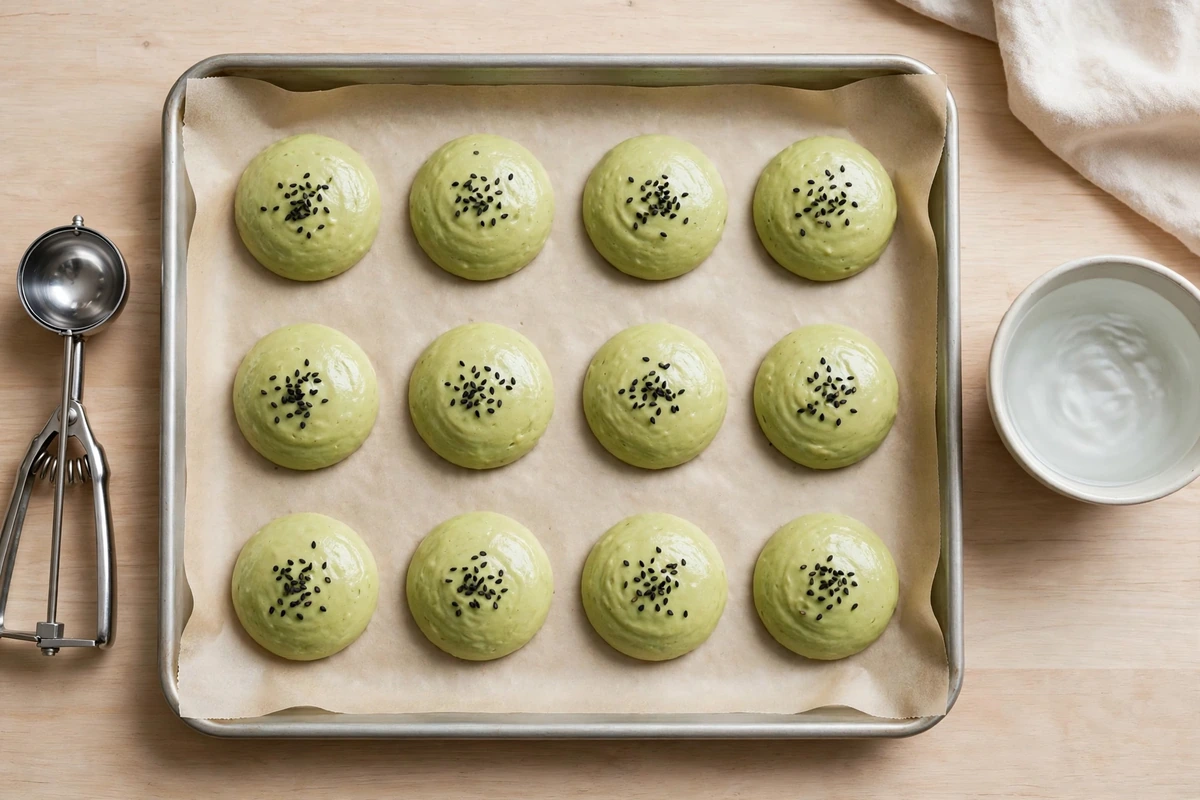
Twelve unbaked matcha mochi bread mounds spaced on a parchment-lined baking sheet, topped with black sesame
Bake Without Opening the Door
Bake for 25 to 27 minutes, and keep the oven door shut for the first 18. Matcha mochi breads rise on steam, and a rush of cool air before the crust sets makes them sink. Once that happens, they won't rise again.
They're done when they've puffed to about double their size, the cracks on top look dry and matte rather than wet, the bottoms are pale golden, and one feels light and firm when you lift it. Let them cool on the pan for 10 minutes so the shell firms up and holds its shape, then eat them warm.
Getting the Hollow, Chewy Texture Right
A good batch of matcha mochi breads has a thin, crackled shell that's crisp for the first hour or two. Tear one open and you should see an irregular hollow in the middle, surrounded by moist, stretchy walls that pull into strands before they separate. It should feel chewy, never cakey or bready.
The batter was too loose (too much egg), or the tapioca went into a paste that had already cooled. If a batch is too loose before baking, make a quick rescue dough: warm 2 tablespoons milk with 1 teaspoon butter until steaming, stir in 2 tablespoons tapioca starch off the heat, then beat that into the loose batter until it holds a V again.
The batter was too stiff, usually from too little egg, so there wasn't enough moisture to make steam. An oven running cool causes the same thing. An inexpensive oven thermometer will tell you which one it was.
They were underbaked and the inside hadn't set. A slight wrinkle as they cool is normal, but a real collapse means they needed 2 or 3 more minutes. A heavy-feeling bread isn't done.
The oven ran hot or they baked too long. Heat breaks down the chlorophyll in matcha, which turns it olive, and heavy browning covers the tea flavor. If the tops darken early, tent the pan loosely with foil for the last 8 minutes.
The tapioca didn't gelatinize enough, either because the paste had cooled or because lumps of dry starch never got worked in during step 4.
That's normal. Starch firms up as it sits, which is why matcha mochi breads are best the day they're baked. The reheating section below brings them back.
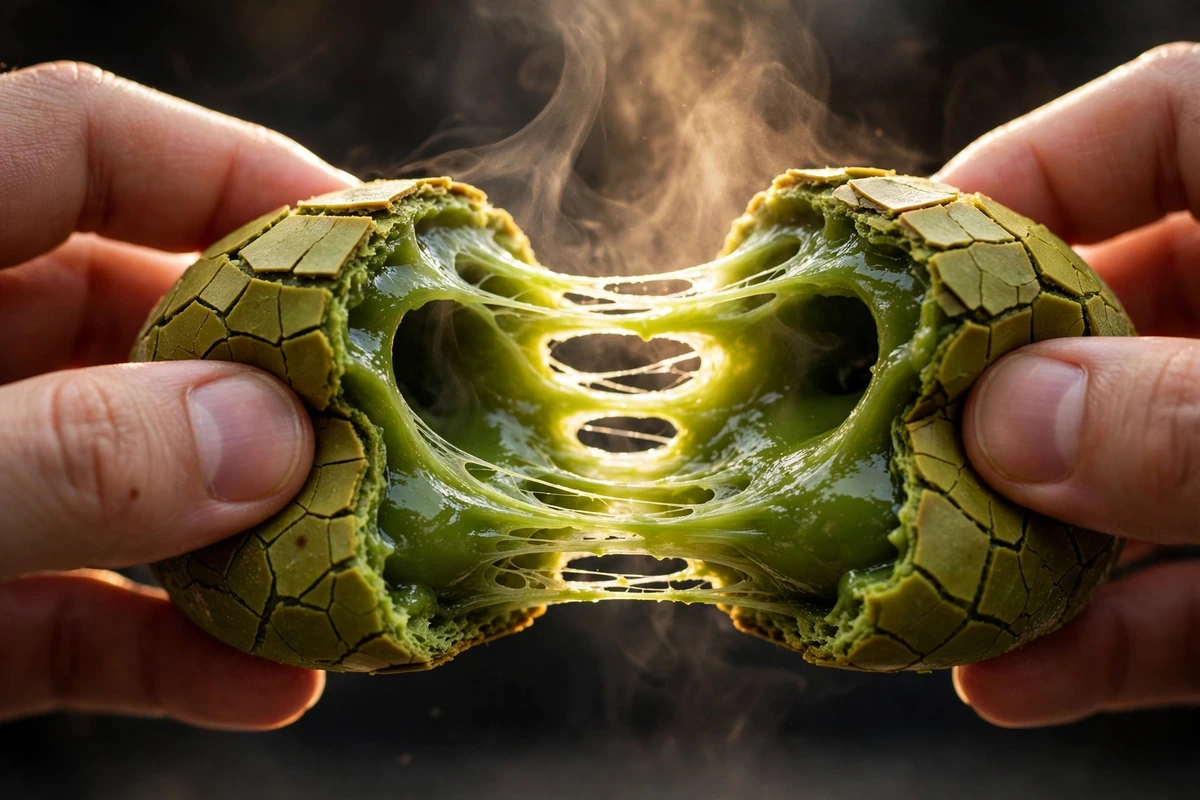
Macro of a matcha mochi bread pulled apart, showing a hollow center and stretchy, chewy green interior
How to Fill and Flavor Matcha Mochi Breads
How to Serve, Store, and Reheat
Serve matcha mochi breads warm, ideally within 2 hours of baking, while the shell is still crisp and the inside stretches. Pile them on a plate or in a small basket lined with a napkin and let people tear them open at the table.
Keep unfilled matcha mochi breads in an airtight container at room temperature for up to 2 days. Don't refrigerate them: starch firms up fastest at fridge temperatures, so the fridge turns them hard and dry quicker than the counter does. Breads filled with whipped cream or ganache are the exception. Those need to go in the fridge within 2 hours, so fill only what you'll eat.
Warm leftover matcha mochi breads in a 300°F (150°C) oven or air fryer for 4 to 5 minutes. That brings back both the crisp shell and the soft, stretchy middle. A microwave works for 10 to 15 seconds and softens the inside, but the shell goes soft too, and they firm up again quickly as they cool, so eat them right away.
Yes, and matcha mochi breads freeze best unbaked. Scoop the mounds onto a parchment-lined tray, freeze until solid (about 2 hours), then move them to a freezer bag for up to 1 month. Bake straight from frozen at 350°F without thawing, adding 3 to 5 minutes. Baked breads also freeze for up to 1 month; reheat them from frozen at 300°F for 8 to 10 minutes.
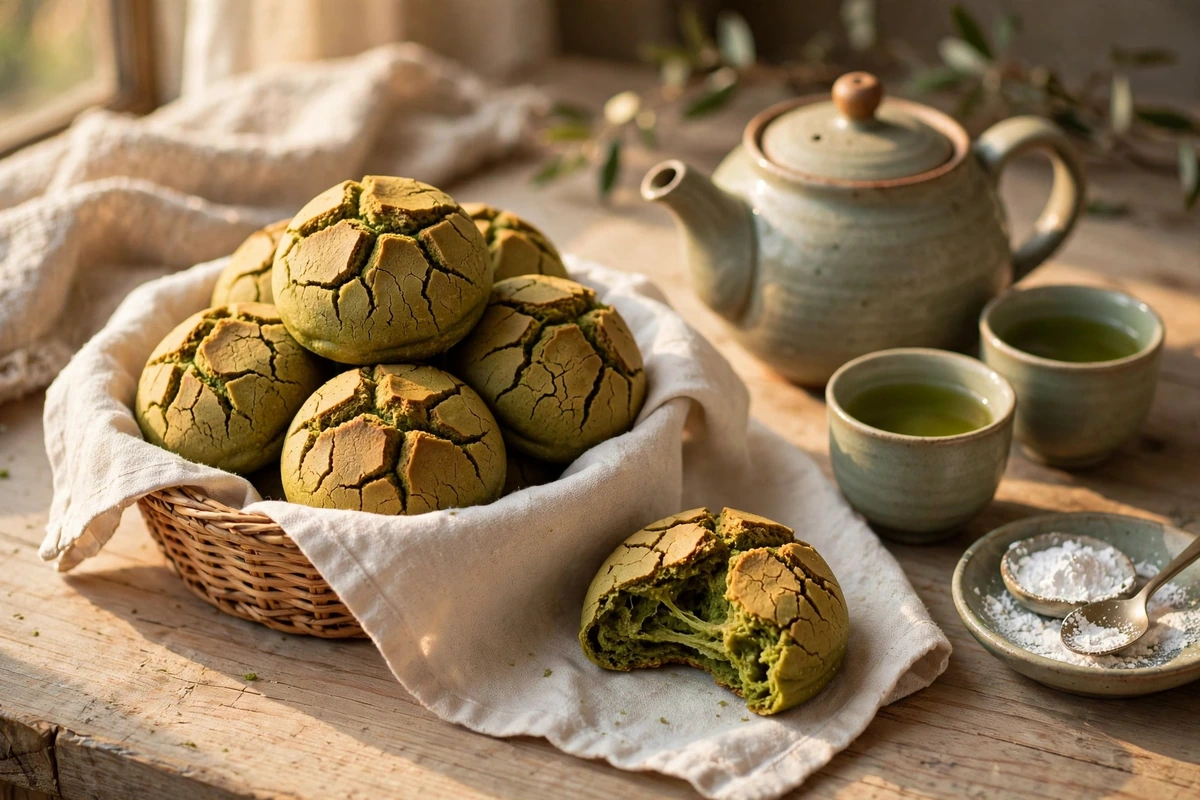
Warm matcha mochi breads served in a napkin-lined basket with green tea for an afternoon snack
Dietary Variations
Replace the 20 grams of all-purpose flour with 20 grams of glutinous rice flour (also called sweet rice flour), which contains no gluten despite its name. It thickens faster and stickier, so stir the paste for 30 to 45 seconds instead of a full minute. Gluten-free matcha mochi breads tend to be a little denser and stickier with slightly less rise, since glutinous rice paste is heavier than a wheat paste. Check that your tapioca starch and matcha are labeled gluten-free if that matters for you.
Use unsweetened soy milk in place of the milk, since its protein content is closest to dairy milk and it helps the shell brown. Swap the butter for a firm plant-based butter block, not a soft tub spread, which holds more water. Soy milk catches on the bottom of the pan more easily, so stir while it heats.
Cut the sugar to 1 1/2 tablespoons. Sugar helps browning and keeps the crust tender, so expect paler, slightly firmer shells, and the matcha will taste more bitter. Bake to the low end of the time range and judge doneness by feel.
Judge these by weight and feel, not color. Matcha hides browning: as matcha mochi breads bake, the outside shifts from bright green to a dull olive-khaki because heat breaks down chlorophyll, so a perfectly baked batch never looks golden the way a plain one would.
Waiting for golden is how you overbake them and lose the tea flavor. Instead, lift one off the pan at 25 minutes. If it feels light for its size and the cracks look dry, they're done.
If it feels heavy and the cracks still look damp, give them 2 more minutes. The brighter green is on the inside.
Allergen Notice: This recipe contains milk (whole milk, butter), eggs, and wheat/gluten (all-purpose flour). The optional topping adds sesame, so leave it off for a sesame-free batch.
- Milk: use unsweetened soy milk and a plant-based butter block, as described above. Soy is itself a common allergen.
- Eggs: there isn't a reliable substitute in this recipe. Eggs provide the structure and much of the moisture that turns to steam and makes the breads rise, and egg replacers won't give the same puff or hollow.
Always check the label on every ingredient, since processing and cross-contact vary by brand. These substitutions are not a guarantee that the finished breads are safe for anyone with a food allergy.
Matcha Mochi Breads FAQs
Once you've seen the batter hang from the spatula in that thick V, these matcha mochi breads stop feeling tricky and become a 15-minute job before the oven takes over. Pull one apart while it's still warm and the hollow, stretchy middle makes the attention at the egg step worth it. If you try a filling or one of the swaps, leave a rating and tell me how it went.
Recipe Visual Gallery (7 Full Photos)
Recipe Card & Steps
Ingredients Checklist
Click an item to check it off as you prep
- 1/2 cupwhole milk (125 g)
- 2 tablespoonsunsalted butter (30 g)
- 2 1/2 tablespoonsgranulated sugar (30 g)
- 1/4 teaspoonfine salt
- 2 1/2 tablespoonsall-purpose flour (20 g)
- 1 tablespoonculinary-grade matcha powder (6 g)
- 1 cuptapioca starch (120 g)
- 2 largeeggsroom temperature, beaten (you'll use about 1 1/2)
- 1 teaspoontoasted black sesame seedsfor topping (optional)
Step-by-Step Instructions
Follow along and mark each step complete as you cook
Heat the oven to 350°F (175°C) with a rack in the center. Line a half sheet pan with parchment paper.
Sift the flour and matcha together into a small bowl and whisk to combine.
In a medium heavy-bottomed saucepan over medium heat, warm the milk, butter, sugar, and salt until the butter melts and the milk steams with small bubbles at the edge, about 3 minutes.
Reduce the heat to medium-low. Add the flour and matcha all at once and stir constantly for 45 to 60 seconds, until a smooth paste as thick as pudding forms.
Remove the pan from the heat. Add the tapioca starch all at once and stir hard for about 1 minute, until a stiff, sticky dough forms with no white streaks.
Transfer the dough to a mixing bowl and let it cool for 5 minutes, until warm but below 140°F (60°C).
Add the beaten egg in 4 or 5 additions, beating until smooth after each one.
Stop adding egg when the batter is glossy and hangs from the spatula in a thick V that holds for a few seconds. You may have egg left over.
Scoop 12 level 1 1/2-tablespoon mounds onto the pan, about 2 inches apart.
Smooth the tops with a wet fingertip and sprinkle with sesame seeds, if using.
Bake for 25 to 27 minutes without opening the oven door for the first 18 minutes, until doubled in size, the cracks look dry, and the breads feel light when lifted.
Cool on the pan for 10 minutes. Serve warm.
Recipe Card Notes & Tips
- Rest Time: 15 minutes (5 minutes cooling the dough before the eggs, 10 minutes cooling on the pan).
- Weigh the tapioca starch if you can. The batter's consistency depends on it.
- To make ahead, freeze the unbaked mounds on the tray, bag them, and bake from frozen within 1 month, adding 3 to 5 minutes to the bake time.
Ratings & Reviews
Leave a Review
Made this recipe? Share your thoughts, tweaks, and honest rating with other home cooks!
Community Reviews (0)
You Might Also Enjoy
More delicious recipes in Desserts.
Chewy Cranberry Chocolate Oatmeal Cookies Recipe
Fudgy Yuzu Brownies Recipe with Tart Yuzu Glaze