Bun Thit Nuong Recipe with Lemongrass Chicken
Bun thit nuong, the Vietnamese rice vermicelli bowl, made with charred lemongrass chicken thighs, quick-pickled carrot and daikon, lettuce, cucumber, fresh herbs, scallion oil and crushed peanuts, finished with a sweet, sour and salty nuoc cham.
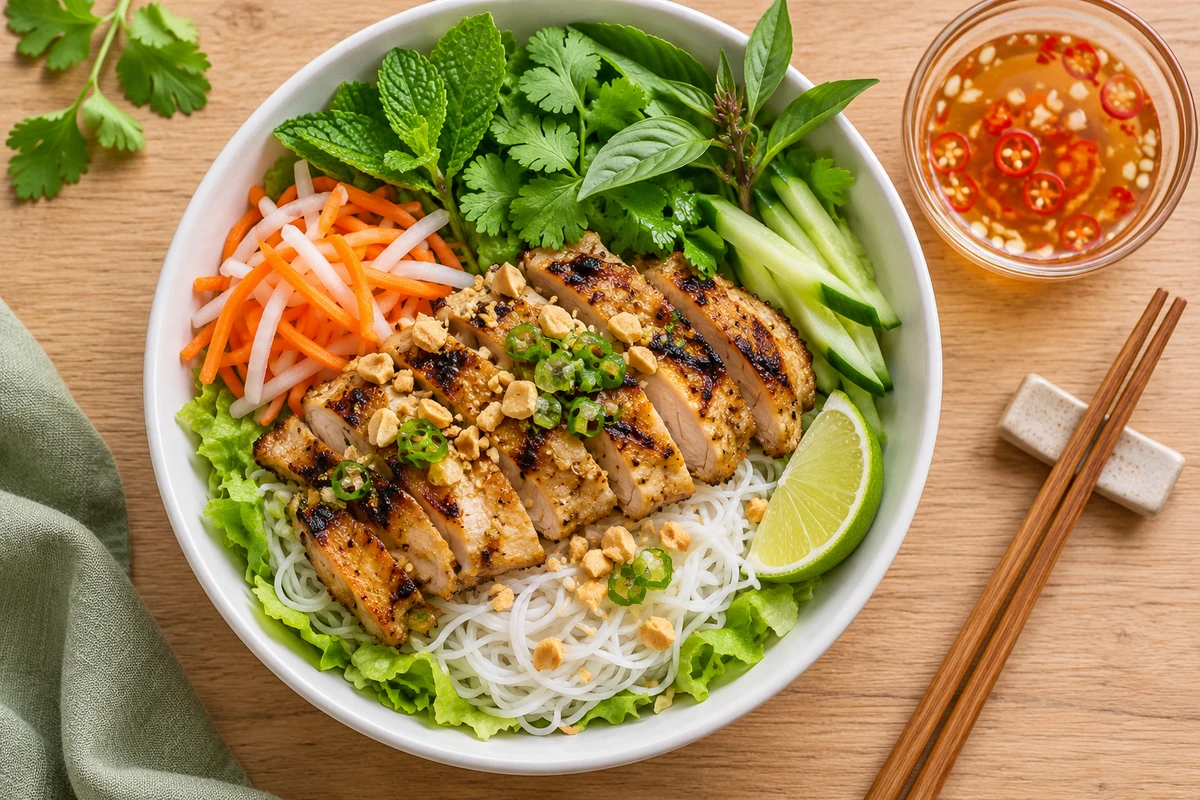
Bun thit nuong is the Vietnamese noodle bowl where cool rice vermicelli, crisp lettuce, mint and tangy pickled carrots sit under warm, charred lemongrass meat, and a sweet-sour fish sauce dressing goes over everything. In Vietnam the meat in bun thit nuong is almost always pork shoulder. I use boneless chicken thighs, which take the same marinade and char just as well. Plan on just over 2 hours, an hour of it with the chicken marinating in the fridge.
Why You'll Love This Recipe
- Warm, cool, crunchy and soft in one bowl. The hot chicken meets room-temperature noodles, and the lettuce, cucumber and peanuts stay crisp underneath.
- The marinade turns into the crust. Blended lemongrass, shallot and garlic flavor the meat, then caramelize into dark, sticky edges on the grill.
- Mostly make-ahead. The pickles, the sauce and the marinated chicken all hold in the fridge, so the night you serve bun thit nuong there's about 25 minutes of cooking.
- Everyone builds their own. Set the parts out and let people pick their herbs and pour as much sauce as they want.
Blend the lemongrass, don't mince it. Minced lemongrass stays fibrous, which is a problem for bun thit nuong.
On a hot grill the loose shards burn black long before the chicken is cooked, and the ones that survive are woody to chew.
Blending the lemongrass with the shallot, garlic, sugar and fish sauce turns it into a smooth paste that coats the chicken in a thin, even layer, so the sugar caramelizes along with the meat instead of scorching in clumps.
Slice the stalks thin across the grain before they go in. Short pieces break down quickly, while long fibers tend to wrap around the blade of a small blender.
Read Before You Start
Use only the bottom of the lemongrass. The lemongrass flavor in bun thit nuong comes from the bottom 4 to 5 inches of each stalk, which is also the only tender part. Cut off the dry green top and the root end, then peel away two or three papery outer layers until you reach a pale core with tight rings that slices easily. If your knife catches on something woody, peel one more layer.
Start the chicken and the pickles first. These are the two parts of bun thit nuong that need at least an hour in the fridge, so get them going back to back before you touch anything else. Everything after that is quick.
Ingredient Deep Dive & Notes
Most of what goes into bun thit nuong is at a regular grocery store. Lemongrass, daikon and Thai basil may mean a trip to an Asian market.
Chicken thighs: Boneless, skinless thighs stay juicy at the high heat this marinade needs, and an extra minute on the grill won't ruin them, which is the same reason thighs are the default in my Baked Lemon Chicken. Bun thit nuong is traditionally made with thinly sliced pork shoulder, so chicken is my swap here; a Vietnamese menu would list this version as bún gà nướng. Breasts work if you pound them thin and pull them right at 165°F, but they dry out quickly.
Lemongrass: Fresh stalks give the cleanest aroma. Frozen minced lemongrass from an Asian grocery works with no change. For lemongrass paste in a tube, use about 1 tablespoon per stalk and read the label, since some brands add salt, sugar or oil that shifts the seasoning.
Shallots: They melt into the paste and add sweetness. Half a small yellow onion is the closest stand-in.
Fish sauce: It seasons both the marinade and the nuoc cham, and it's the same bottle that goes into my Thai Cucumber Salad. Look for a short ingredient list: anchovies, salt and maybe sugar. The smell is strong straight from the bottle but turns savory once it's cooked or mixed with lime and sugar.
Brown sugar and honey: Together they give the chicken its dark, sticky char. Honey is high in fructose, which browns at a lower temperature than plain sugar, so the color comes on before the chicken overcooks.
Rice vermicelli: Buy thin dried rice noodles labeled "rice vermicelli" or "bún," made from rice and water. The flat rice sticks sold for pad thai are a different noodle and turn heavy in a room-temperature bowl.
Carrot and daikon: These become đồ chua, the sweet-sour pickle that shows up in every bowl. If you can't find daikon, use all carrot, or add a few thinly sliced red radishes, which pickle faster.
Herbs: Mint is the one I wouldn't skip, because it's what makes the bowl taste Vietnamese rather than like a generic noodle salad. Add cilantro and Thai basil if you can get them, and perilla (tía tô) if your Asian grocery carries it.
Lettuce, cucumber and bean sprouts: Green leaf or butter lettuce, an English or Persian cucumber, and sprouts for crunch. Raw sprouts carry a higher food-safety risk than most produce, so blanch them for 30 seconds, or leave them out if anyone eating is pregnant, very young, older or immunocompromised.
Peanuts: Roasted and unsalted, crushed coarse. If yours are raw, toast them first (Step 5).
What I left out: Some thịt nướng recipes add rice wine, sake or Shaoxing wine to the marinade, and some use oyster sauce or soy sauce for color. None of them are here. The honey handles the color, the fish sauce handles the savory depth, and the recipe stays free of alcohol and of the wheat that most soy sauce contains. The scallion oil uses neutral oil instead of pork fat.
Don't substitute bottled lime juice in the nuoc cham. The sauce is mostly lime, sugar and fish sauce, so the flat, slightly bitter taste of bottled juice has nowhere to hide.
Equipment Needed
- A blender or mini food processor: For the marinade paste. A mortar and pestle works if you have the patience.
- A meat mallet or rolling pin: To flatten the thighs to an even thickness.
- A julienne peeler or mandoline: For thin, even carrot and daikon strips. A sharp knife works, just slower.
- An instant-read thermometer: A dark, sugary marinade can look done on the outside well before the middle is.
- A grill or grill pan: No grill at all? You can still make bun thit nuong under the broiler; that method is further down.
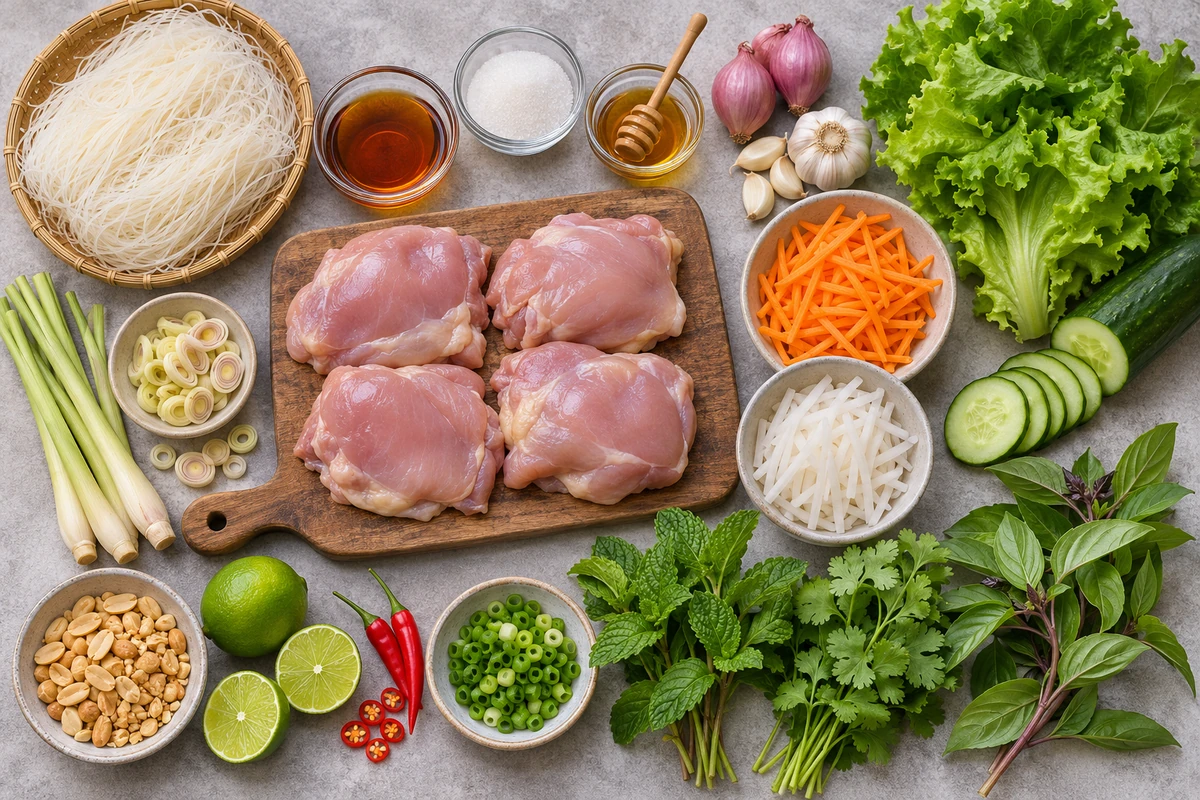
Bun thit nuong ingredients flatlay with chicken thighs, lemongrass, shallots, rice vermicelli, daikon, carrot, herbs and fish sauce
Detailed Step-by-Step Cooking Guide
Blend the Paste and Marinate the Chicken
Before you start: Bun thit nuong comes together in two stages. Do Steps 1 and 2 first, back to back. Everything else happens once the chicken and pickles are in the fridge.
Slice the trimmed lemongrass thinly across the grain. Put it in a blender or mini food processor with the shallots, 4 garlic cloves, 2 tablespoons fish sauce, brown sugar, honey, 2 tablespoons oil and black pepper. Blend, scraping down the sides once or twice, until you have a thick, fairly smooth paste with no visible strands, about 3/4 cup.
Now flatten the thighs. This is the step most people skip. Lay them between two sheets of plastic wrap or parchment and pound the thick end of each one until the whole piece is an even 1/2 inch. Thighs are naturally lopsided, and a sugary coating makes that matter more than usual: the thin edge burns while the thick end is still raw. With an even thickness, the char and the cooking finish at the same moment.
Toss the chicken with the paste until every surface is coated, cover, and refrigerate for at least 1 hour and up to 24 hours.
Quick-Pickle the Carrot and Daikon
Cut the carrot and daikon into thin matchsticks 2 to 3 inches long. Toss them in a bowl with the salt and 1 teaspoon of the sugar and massage for 2 to 3 minutes, until they soften and a strip bends in half without snapping. Rinse under cold water and squeeze dry.
Stir the warm water, vinegar and remaining 3 tablespoons of sugar until the sugar dissolves. Pack the vegetables into a jar, pour the brine over, close the lid, and refrigerate for at least 1 hour. Daikon gives off a strong smell as it pickles, so keep that lid tight. The pickles give bun thit nuong its sour crunch, and they're ready when they taste tangy all the way through rather than only on the surface.
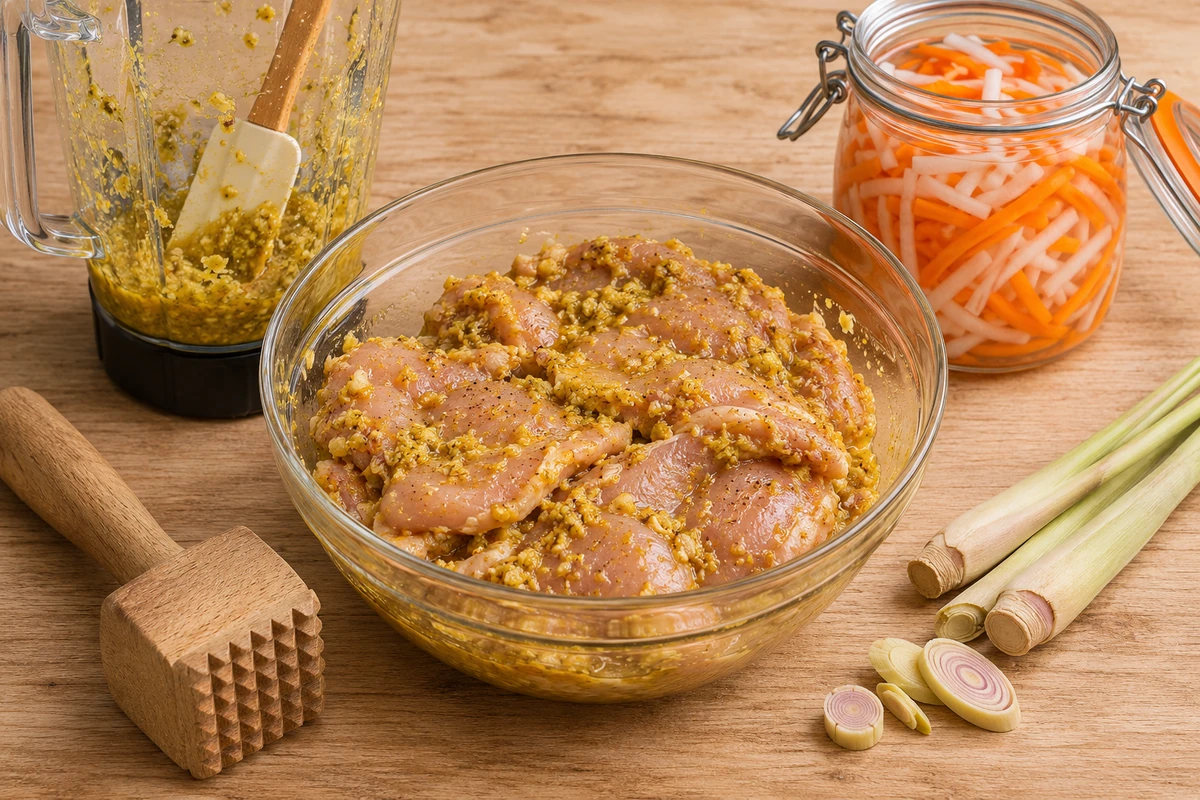
Lemongrass paste in a blender jar beside flattened chicken thighs coated in marinade and a jar of quick-pickled carrot and daikon
Mix the Nuoc Cham
This sauce dresses the whole bowl of bun thit nuong, so take a minute over it. Stir the 1/4 cup sugar into the warm water until it dissolves completely, then add the lime juice and 1/4 cup fish sauce. Taste it. Sweet, sour and salty should come through at roughly equal strength, with none of them jumping out. Add a little more lime or sugar if one side seems weak, then stir in the 2 minced garlic cloves and the chilies. Leave it at room temperature. You'll taste it once more against the noodles in Step 7.
Cook and Rinse the Noodles
Bring a large pot of water to a boil. If you're blanching the bean sprouts, dip them in for 30 seconds first, lift them out, and rinse them under cold water. Add the rice vermicelli and stir right away so the strands don't stick together. Cook for 3 to 5 minutes, or the time on your package, and start testing early. Bite a strand: it's done when it's soft and springy with no white, chalky core.
Drain into a colander and rinse under cold running water, lifting and tossing the noodles with your hands, until they're cool and the water runs clear. That washes off the surface starch that would otherwise glue vermicelli into a solid block as it cools. Let them drain for 10 minutes, shaking the colander now and then. Bun thit nuong is served with room-temperature noodles, so there's no need to keep them warm.
While they drain, shred the lettuce, cut the cucumber into thin matchsticks, and pick the herb leaves off their stems.
Make the Scallion Oil and Toast the Peanuts
Put the sliced scallions in a small heatproof bowl with a pinch each of salt and sugar. Heat the 1/4 cup oil in a small saucepan over medium heat until a slice of scallion dropped in sizzles right away, about 2 minutes. Pour the hot oil over the scallions. They should hiss, turn bright green and soften without browning.
If your peanuts are raw, toast them in a dry skillet over medium heat for 3 to 4 minutes, shaking often, until they smell nutty and turn a shade darker. Let them cool, then crush them coarsely in a zip-top bag with a rolling pin.
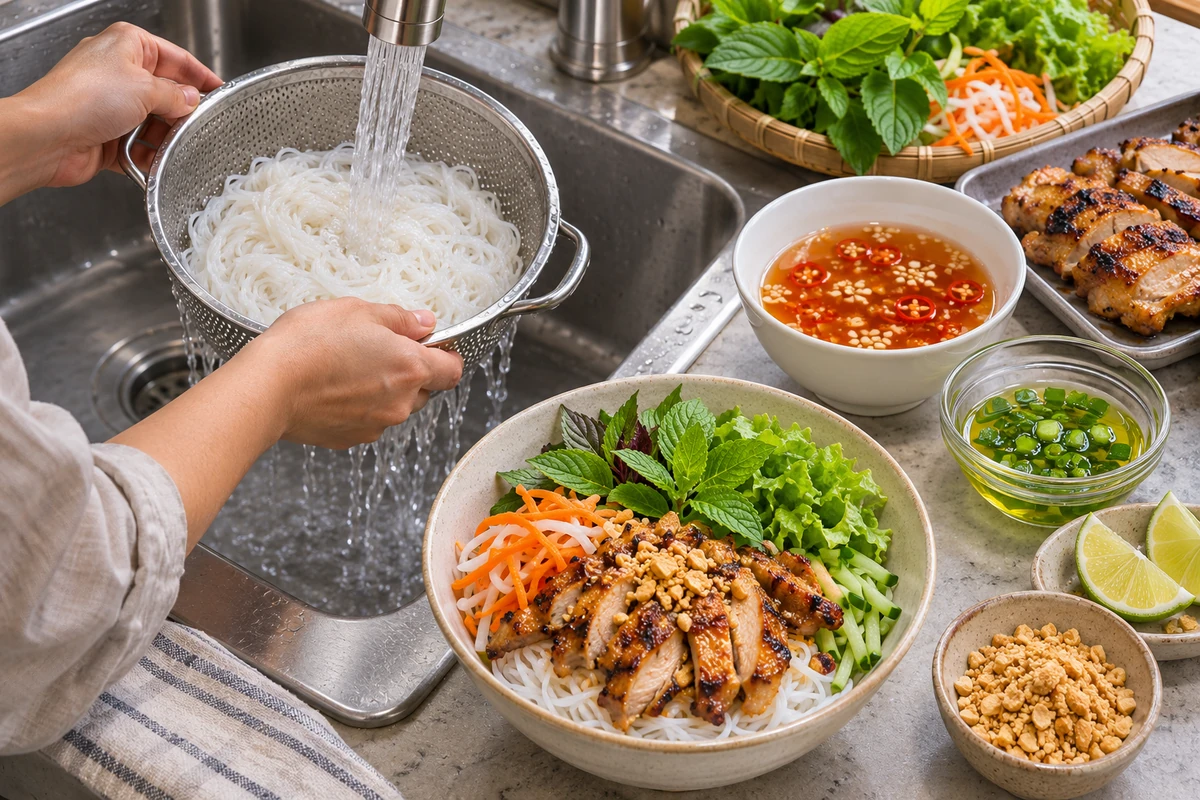
Rinsing cooked rice vermicelli under cold water for bun thit nuong, with nuoc cham and fresh scallion oil on the counter
Grill and Rest the Chicken
Heat a grill to medium-high, about 400 to 450°F, and set up a cooler zone by leaving one burner on low or banking the coals to one side. Clean the grates, then wipe them with an oiled paper towel held in tongs. Lift the chicken out of the bowl, letting the excess paste drip back, and throw the leftover marinade away.
Grill the thighs over the hot side for 4 to 5 minutes without moving them, until the undersides are charred in spots and they release from the grates without tearing. Flip and grill 3 to 4 minutes more. If the outside darkens past a deep mahogany before the middle is done, slide those pieces to the cooler side and close the lid. Chicken is safe at 165°F in the thickest part, and thighs are at their juiciest between 170°F and 175°F.
Rest the chicken on a cutting board for 5 minutes, then slice it across the grain into strips about 1/2 inch wide, so each piece has a charred edge.
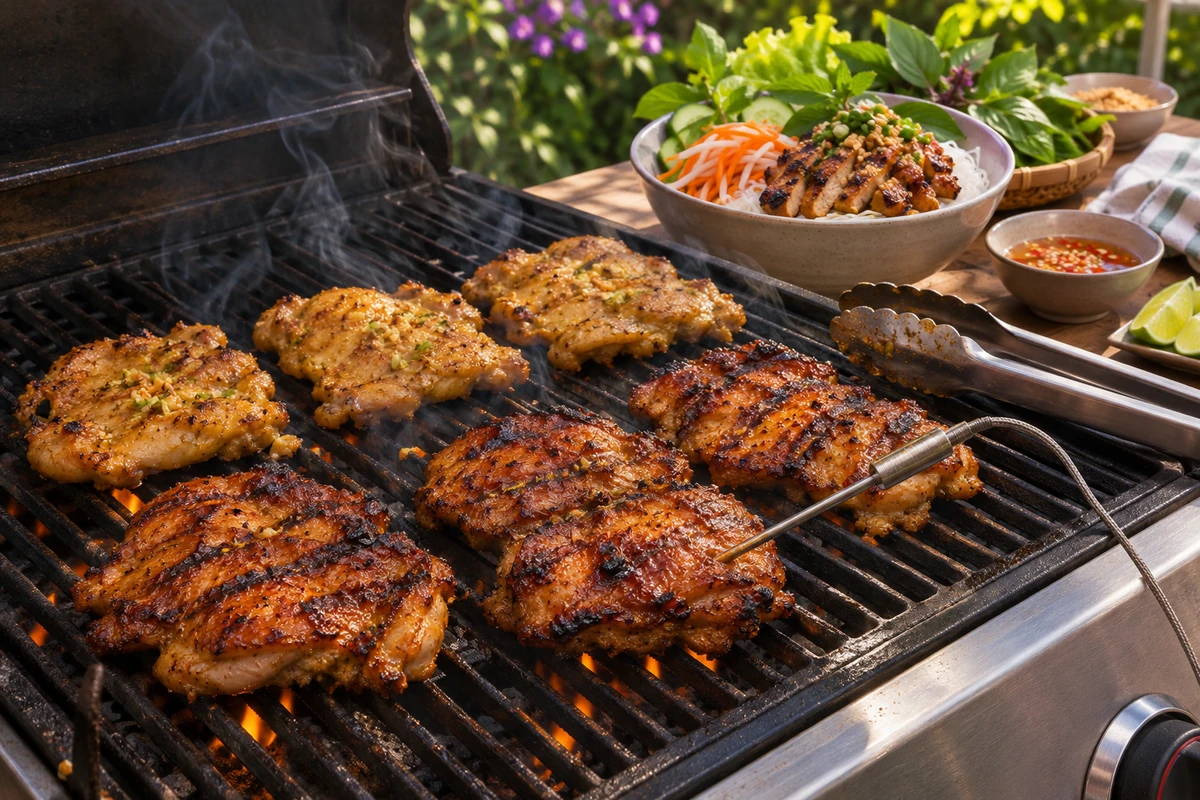
Lemongrass chicken thighs on a hot grill with dark caramelized char marks for bun thit nuong, with tongs and a thermometer
Build the Bowls
Taste the nuoc cham on a few strands of plain noodle and adjust it with more lime, sugar or a splash of water. Build each bowl of bun thit nuong from the bottom up: divide the lettuce and herbs among four wide bowls, then add the noodles, cucumber, bean sprouts and a handful of drained pickles. Lay the warm chicken on top, spoon over the scallion oil, and scatter the peanuts. Serve with the nuoc cham and lime wedges on the side, about 1/4 to 1/3 cup of sauce per bowl, so everyone can pour their own and toss before eating.
Getting Bun Thit Nuong Right
When a bowl of bun thit nuong disappoints, it's usually one of two things: chicken that burned before it cooked through, or noodles that set into a brick. Both are easy to prevent once you know the cause.
The grill is too hot, the thighs weren't flattened, or the paste went on too thick. Pound to an even 1/2 inch, let the extra paste drip off, and finish thicker pieces on the cooler side with the lid closed. A few blackened spots on the edges belong in this dish. A crust that's black all over means the heat was too high.
Grates that aren't hot, clean and oiled will grab a sugary marinade. Give the first side its full 4 minutes. Once the chicken has seared, it lets go on its own.
They were rinsed too briefly or cooked a minute too long. Run warm tap water over the clump in the colander, loosen the strands with your fingers, then drain well. Next time, keep rinsing until the water runs completely clear.
Dry chicken in bun thit nuong is usually breast meat, or thighs taken well past 175°F. Start checking with the thermometer at the 7-minute mark.
They need more time. After 1 hour they're crunchy and bright, and by the next day they mellow. If they're still too sour for you, drain them and toss with a teaspoon of sugar before serving.
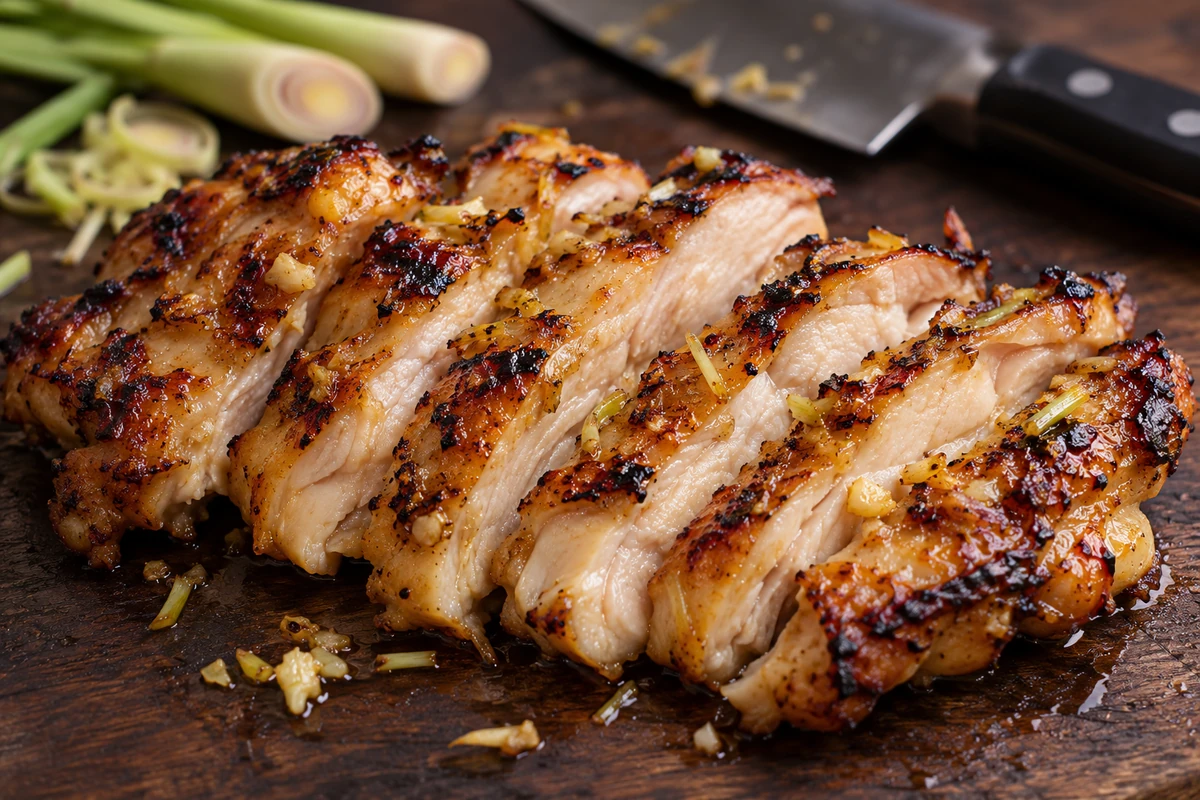
Close-up of sliced grilled lemongrass chicken for bun thit nuong, showing caramelized charred edges and a juicy interior
No Grill? Broiler and Grill Pan Methods
How to Serve, Store & Reheat
Bun thit nuong mixes temperatures on purpose: warm chicken, room-temperature noodles, cold vegetables. Build the bowls just before eating so the lettuce doesn't wilt under the hot meat. To eat, pour the nuoc cham over everything and toss with chopsticks until every noodle is coated. For a crowd, bun thit nuong works well as a build-your-own spread: set each component out in its own dish and let people build their bowls. In Vietnam, a bowl topped with sliced fried spring rolls is called bún thịt nướng chả giò. Those rolls are usually filled with pork, so if you add them, look for chicken or vegetable ones.
Keep the components of bun thit nuong separate. Refrigerate the cooked chicken in an airtight container within 2 hours of cooking and use it within 3 to 4 days. The pickles keep up to 2 weeks in a closed jar, the nuoc cham up to 1 week, and herbs and lettuce 2 to 3 days wrapped in a damp paper towel. Keep the scallion oil refrigerated and use it within 4 days, the same guidance that applies to garlic in oil. Cooked noodles firm up in the fridge. They keep for 2 days but are best the day you make them.
When reheating leftover bun thit nuong, warm only the chicken. Warm it in a skillet over medium heat for 2 to 3 minutes, or in the microwave, covered, for 45 to 60 seconds, until it reaches 165°F. To loosen chilled noodles, pour hot water over them in a colander for 10 to 20 seconds and drain well. Serve the vegetables, herbs and pickles cold.
Yes for the chicken, no for everything else. Freeze the chicken raw in its marinade, laid flat in a freezer bag, for up to 3 months, then thaw it overnight in the fridge; it finishes marinating as it thaws. Cooked chicken also freezes for up to 3 months, though it comes out a little drier. The noodles, pickles, sauce, herbs and vegetables turn mushy or watery in the freezer, so make those fresh.
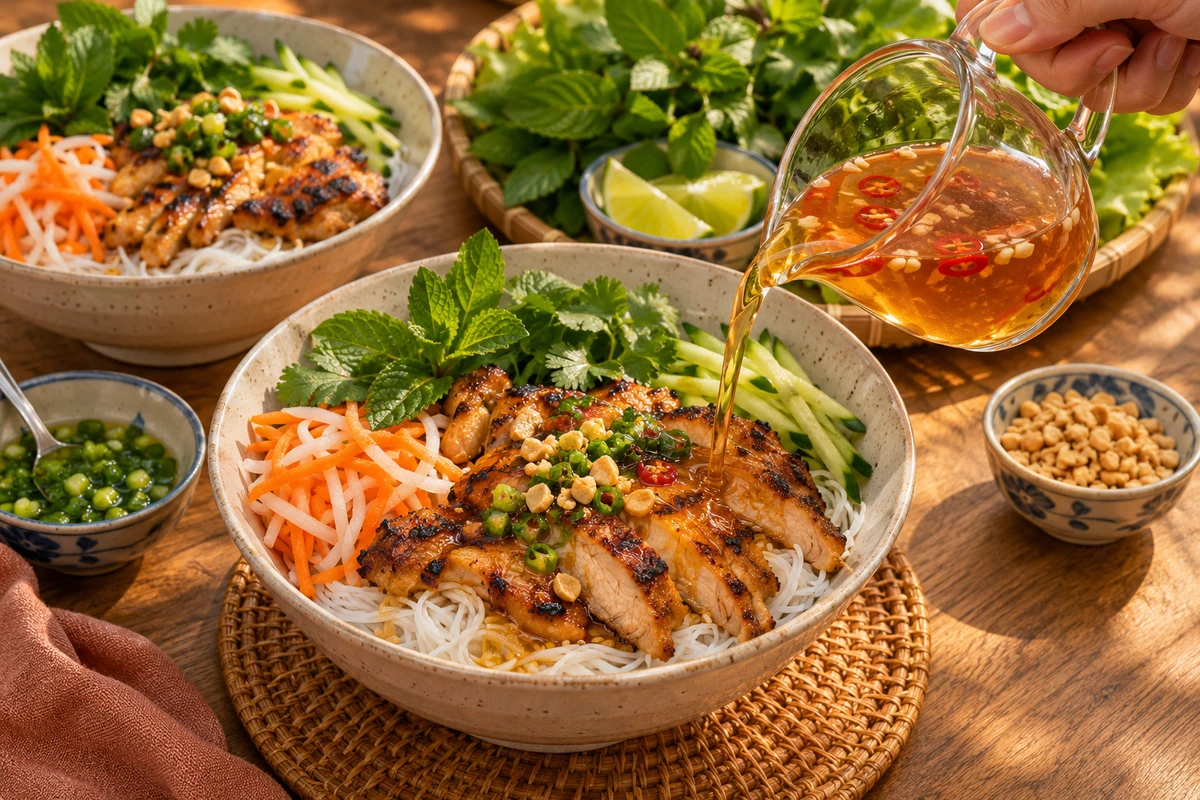
Pouring nuoc cham over a bun thit nuong bowl with grilled chicken, noodles, pickles and herbs, set for a family-style dinner
How to Use Leftovers
Dietary Variations
Use 1 1/2 pounds of flank steak and marinate it whole, with no pounding. Grill over high heat for 5 to 6 minutes per side to 145°F, rest 10 minutes, and slice it thinly across the grain.
Press a 14-ounce block of extra-firm tofu for 20 minutes and cut it into 1/2-inch slabs. Use soy sauce or a vegetarian fish sauce in place of the fish sauce in both the marinade and the nuoc cham, marinate for 30 minutes, and cook on a well-oiled grill pan 3 to 4 minutes per side. If you keep halal, check the soy sauce label, since some brands add alcohol.
As written, the recipe is gluten-free as long as the fish sauce and the noodles are. Most fish sauce is just anchovies and salt and most rice vermicelli is just rice and water, but check both labels.
Swap the peanuts for toasted pumpkin seeds, which give the same crunch.
Season the nuoc cham for the bowl, not the spoon. Plain rice noodles and lettuce make up most of a bowl of bun thit nuong, and neither carries any seasoning of its own.
The nuoc cham is the only thing salting and sweetening them, so on its own it should taste a little too strong, sharper and saltier than you'd want to sip.
If it tastes perfectly balanced straight from a spoon, the finished bowl will taste watery. That's why the last check happens on a few strands of plain noodle, right before the bowls go out.
Allergen Notice: This bun thit nuong recipe contains fish (fish sauce) and peanuts.
- Fish: Use coconut aminos with a pinch of salt in the marinade and the sauce. Soy sauce also works but adds soy and, in most brands, wheat. Either way, the flavor will be less savory.
- Peanuts: Use toasted pumpkin seeds, or leave them off.
Always read labels, since formulas vary by brand and rice noodles are sometimes made in facilities that also process wheat. This recipe is not guaranteed to be safe for any specific allergy.
Frequently Asked Questions
Once the pickles and sauce are sitting in your fridge, bun thit nuong becomes one of the quicker dinners you can put together, because all that's left is boiling noodles and a few minutes on the grill. Pin it for your next warm evening, and come back to tell me which herbs made it into your bowl.
Recipe Visual Gallery (7 Full Photos)
Recipe Card & Steps
Ingredients Checklist
Click an item to check it off as you prep
For the lemongrass chicken
- 1 1/2 lb (680 g) boneless, skinless chicken thighs (about 6)
- 2 stalks lemongrass, trimmed to the tender bottom 4 to 5 inches and thinly sliced (about 1/4 cup)
- 2 small shallots, roughly chopped (about 1/3 cup)
- 4 garlic cloves
- 2 Tbsp fish sauce
- 2 Tbsp light brown sugar
- 1 Tbsp honey
- 2 Tbsp neutral oil, plus more for the grates
- 1/2 tsp ground black pepper
For the quick pickles (đồ chua)
- 1 medium carrot (about 4 oz), cut into thin matchsticks
- 4 oz daikon radish, cut into thin matchsticks
- 1 tsp kosher salt
- 3 Tbsp plus 1 tsp sugar, divided
- 1/2 cup warm water
- 1/2 cup distilled white vinegar
For the nuoc cham
- 1/4 cup sugar
- 2/3 cup warm water
- 1/4 cup fresh lime juice (about 2 limes)
- 1/4 cup fish sauce
- 2 garlic cloves, minced
- 1 to 2 Thai bird's eye chilies, thinly sliced (optional)
For the scallion oil
- 4 scallions, thinly sliced
- 1/4 cup neutral oil
- Pinch each of kosher salt and sugar
For the bowls
- 8 oz (225 g) dried thin rice vermicelli
- 4 cups shredded green leaf or butter lettuce
- 1 English cucumber (or 3 Persian), cut into thin matchsticks
- 2 cups bean sprouts (optional, see Notes)
- 1 cup loosely packed mixed herbs: mint, cilantro and Thai basil
- 1/2 cup roasted unsalted peanuts (or raw, toasted in step 6)
- 1 lime, cut into wedges
Step-by-Step Instructions
Follow along and mark each step complete as you cook
Blend the lemongrass, shallots, 4 garlic cloves, 2 Tbsp fish sauce, brown sugar, honey, 2 Tbsp oil and pepper in a blender or mini food processor, scraping down once or twice, until it forms a thick, smooth paste with no visible strands.
Place the chicken thighs between sheets of plastic wrap or parchment and pound to an even 1/2-inch thickness. Toss with the paste to coat, cover, and refrigerate at least 1 hour or up to 24 hours.
Toss the carrot and daikon with the salt and 1 tsp sugar and massage 2 to 3 minutes, until a strip bends without snapping. Rinse and squeeze dry. Stir the warm water, vinegar and remaining 3 Tbsp sugar until dissolved. Pack the vegetables into a jar, pour the brine over, close tightly, and refrigerate at least 1 hour.
For the nuoc cham, stir the sugar into the warm water until dissolved. Add the lime juice and 1/4 cup fish sauce, taste and balance, then stir in the minced garlic and chilies. Set aside at room temperature.
Bring a large pot of water to a boil. If blanching the bean sprouts, dip them in for 30 seconds, then rinse under cold water. Cook the vermicelli 3 to 5 minutes (or per package), stirring at first, until soft and springy with no chalky core. Drain, rinse under cold running water while tossing until cool and the water runs clear, and drain 10 minutes, shaking occasionally. Meanwhile, shred the lettuce, cut the cucumber, and pick the herb leaves.
Place the scallions in a heatproof bowl with a pinch of salt and sugar. Heat 1/4 cup oil in a small saucepan over medium heat until a scallion slice sizzles immediately, about 2 minutes, and pour it over the scallions. If using raw peanuts, toast them in a dry skillet over medium heat 3 to 4 minutes, until fragrant. Cool and crush the peanuts coarsely.
Heat a grill to medium-high (400 to 450°F) with a cooler zone. Clean and oil the grates. Let excess marinade drip off the chicken and discard the leftover marinade. Grill 4 to 5 minutes without moving, until charred in spots and the chicken releases easily, then flip and grill 3 to 4 minutes more, until the thickest part reads at least 165°F (170 to 175°F is best for thighs). Move any pieces that darken too fast to the cooler zone and close the lid.
Rest the chicken 5 minutes, then slice across the grain into 1/2-inch strips.
Taste the nuoc cham on a few strands of plain noodle and adjust with lime, sugar or a splash of water. Divide the lettuce and herbs among 4 bowls, then add the noodles, cucumber, bean sprouts and drained pickles. Top with the chicken, scallion oil and peanuts. Serve with the nuoc cham (1/4 to 1/3 cup per bowl) and lime wedges; pour over and toss before eating.
Recipe Card Notes & Tips
- Halal: No pork and no alcohol as written. Use halal chicken, and check that the fish sauce label lists only anchovies, salt and sugar.
- No grill: Broil on high, about 4 inches from the element, on a foil-lined pan with an oiled rack: 5 to 6 minutes, flip, then 4 to 5 minutes more, to 165°F. Or cook in a grill pan over medium-high heat, 4 to 5 minutes per side.
- Lemongrass swaps: Use 1 Tbsp frozen minced lemongrass or tube lemongrass paste per stalk.
- Bean sprouts: Raw sprouts carry a higher food-safety risk than most produce. Blanch them for 30 seconds, or leave them out for anyone pregnant, very young, older or immunocompromised.
- Make ahead: Chicken in its marinade up to 24 hours; pickles up to 2 weeks; nuoc cham up to 1 week; scallion oil refrigerated up to 4 days.
- Gluten-free: Gluten-free when the fish sauce and rice vermicelli labels confirm it.
Ratings & Reviews
Leave a Review
Made this recipe? Share your thoughts, tweaks, and honest rating with other home cooks!
Community Reviews (0)
You Might Also Enjoy
More delicious recipes in Main Dishes.