Make-Ahead Breakfast Casserole Recipe
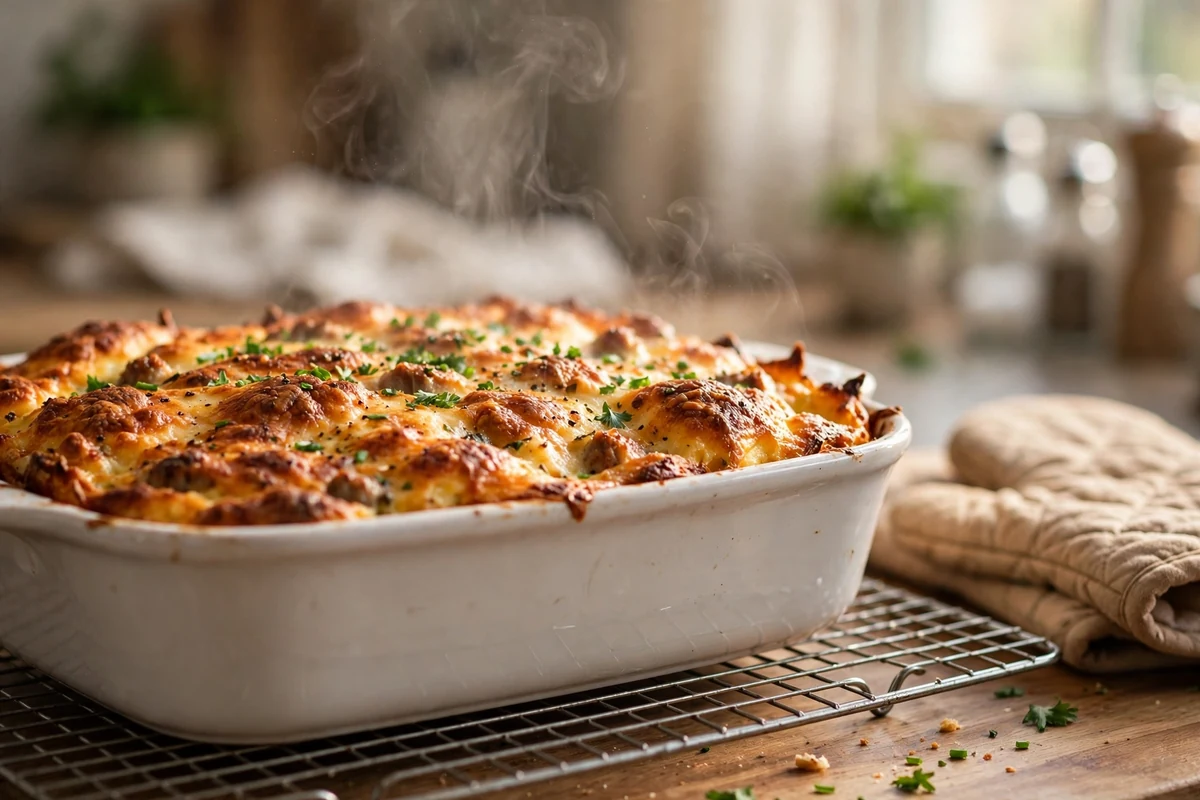
Bread cubes toasted dry before they ever meet the custard, an overnight soak, and a 350°F bake that finishes uncovered. That combination is why this one slices into clean squares instead of collapsing into wet bread pudding. It comes out of the oven puffed and deeply browned at the edges, soft in the middle, with sharp cheddar pulling in strings when you cut it.
Why You'll Love This Recipe
- All the work happens the night before. Morning-of, you preheat an oven and pull a dish out of the fridge.
- Feeds twelve from one pan. No batches, no standing at a stove flipping eggs while everyone eats in shifts.
- Cheap ingredients, and it likes stale bread. The end of a sourdough loaf is an asset here, not a problem.
- It reheats genuinely well, which most egg dishes do not. Leftovers on day three still taste right.
Here's the one thing nobody tells you: toast the bread cubes before you build the casserole.
Every recipe says "use day-old bread." Day-old bread is drier than fresh bread, but it is nowhere near dry enough. Spread the cubes on a sheet pan and bake them at 300°F for 12 to 15 minutes, until they feel dry and light and the edges are just starting to color. You want them to sound faintly hollow when you shake the pan.
Dry bread absorbs custard and holds its shape. Merely stale bread absorbs custard and dissolves. This single step does more for the final texture than the bread type, the cheese, the soaking time or the bake temperature. It is also the step almost everyone skips.
Read Before You Start
Shred your own cheese. Bagged shredded cheddar is coated in potato starch or cellulose to stop it clumping in the bag. In a wet custard that coating turns grainy and squeezes oil out as it melts. A block of sharp cheddar takes two minutes on a box grater and melts smooth.
Drain the sausage properly, then season lighter than instinct says. Rendered fat that stays in the pan pools at the bottom of the dish and makes the base greasy rather than set. And between the sausage, the cheese and the salt already in the bread, this dish arrives salty on its own. The custard only needs 1½ teaspoons of kosher salt for twelve eggs, which will look like too little in the bowl and taste correct on the plate.
Ingredient Deep Dive & Notes
Sturdy bread, 10 cups cubed. Sourdough, a French loaf or a rustic white boule. What matters is a firm, open crumb that holds up after twelve hours in liquid. Don't substitute soft sandwich bread here. It has almost no structure once wet, and it turns the bottom third of the pan into paste no matter how carefully you do everything else. Brioche and challah work, but they're sweet and eggy already, which pushes the dish toward French toast bake territory.
Chicken or beef breakfast sausage, 1 pound. Standard breakfast casseroles use pork sausage. I use chicken or beef breakfast sausage instead, and the dish loses nothing: the sage, black pepper and fennel in the seasoning blend are doing most of the flavor work, not the meat. Look for a bulk roll rather than links so it crumbles. If you only find links, slit the casings and squeeze the meat out.
12 large eggs and 3 cups whole milk. This ratio is deliberate and I'll come back to it in the Chef's Note. Whole milk, not skim. Fat is what keeps the set tender instead of rubbery. Half-and-half in place of one cup of the milk gives a richer, denser result if you want that.
Sharp cheddar (8 oz) and Gruyère or Monterey Jack (4 oz). Sharp cheddar carries the flavor. The second cheese is there for melt: aged cheddar alone can go slightly oily and separate. Gruyère is the better version, Monterey Jack is the cheaper one, both work.
One onion and one red bell pepper, cooked first. Raw vegetables release water directly into the custard while it bakes, and there is nowhere for that water to go. Sweating them in the sausage fat first drives the moisture off and builds flavor at the same time. This applies to anything you add: mushrooms and spinach especially need to be cooked and squeezed dry.
1 teaspoon Dijon mustard. Not enough to taste as mustard. It sharpens the cheese and cuts the richness slightly, the same way it does in a cheese sauce.
Equipment Needed
- 9x13 inch baking dish, glass or ceramic, at least 3 quarts. Metal works but browns the edges faster, so start checking 10 minutes early.
- Rimmed sheet pan for drying the bread.
- Box grater. See above.
- Instant-read thermometer. The single most useful tool for this dish, because visual doneness cues on a custard this thick are unreliable.
- Foil for the covered portion of the bake.
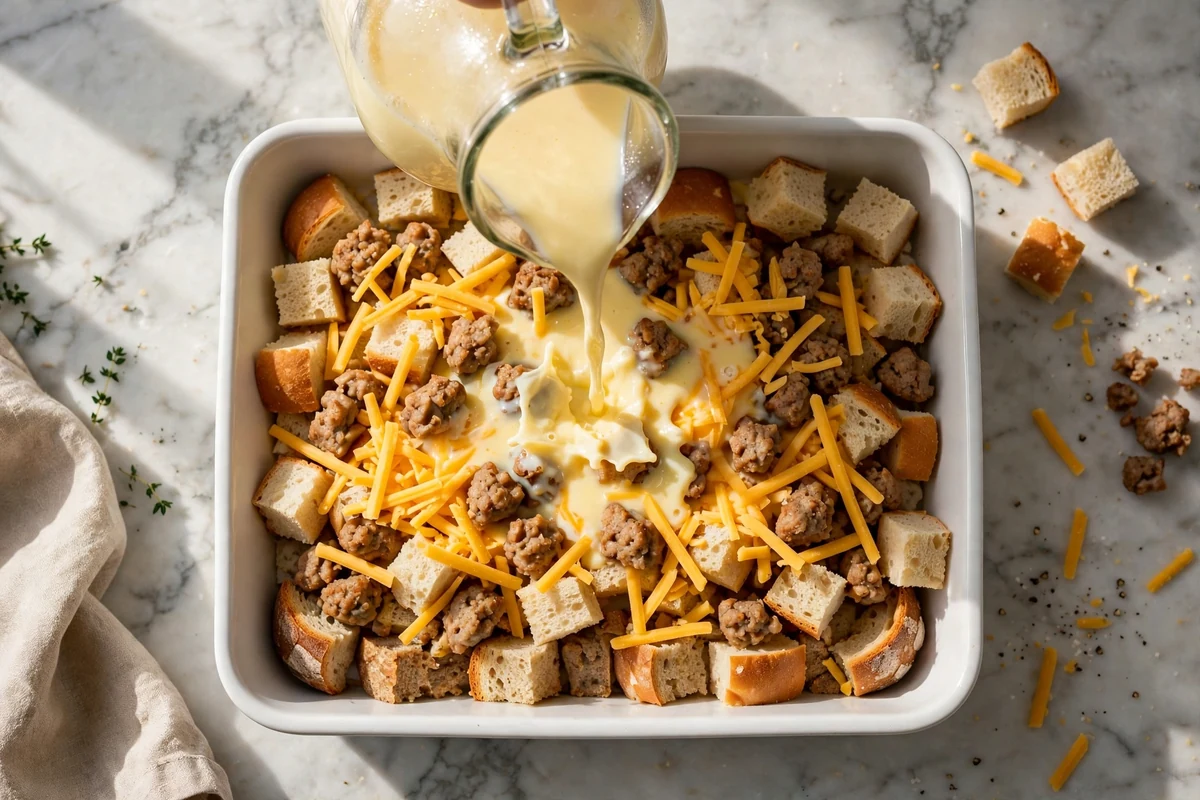
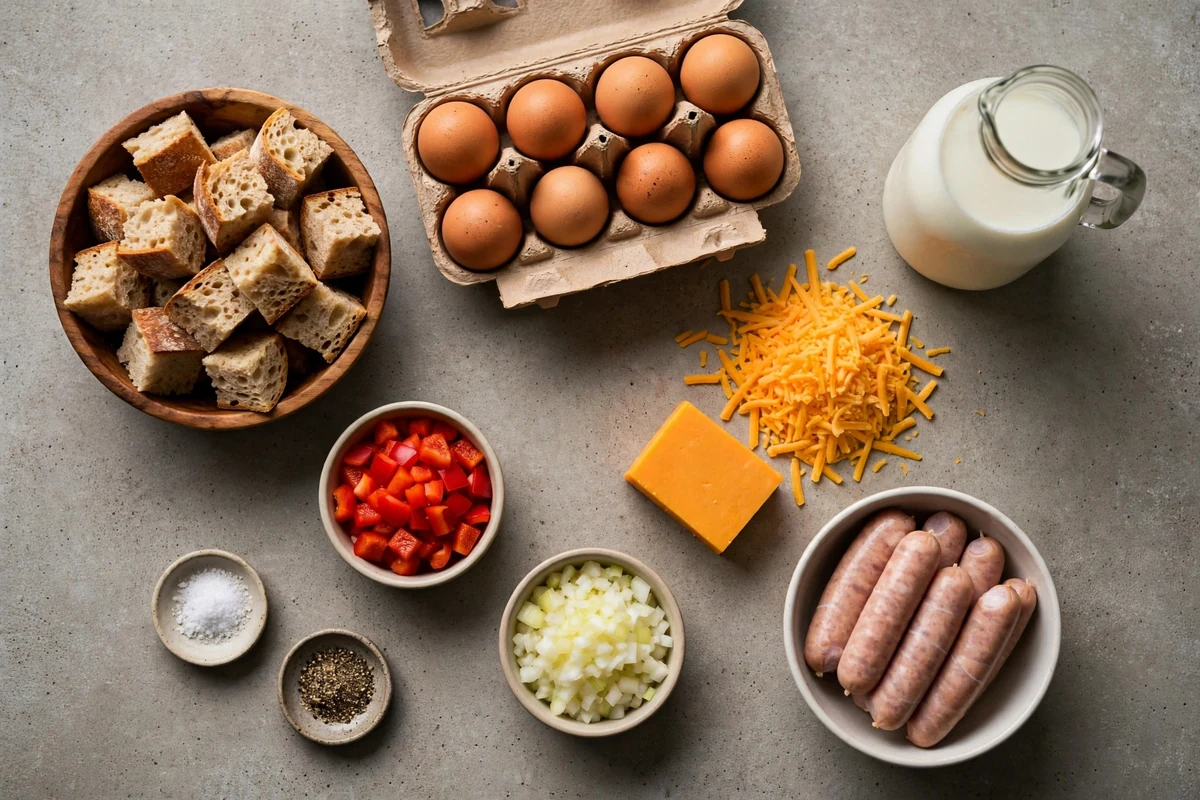
Make-ahead breakfast casserole ingredients including bread, eggs, milk, sausage and cheese
Detailed Step-by-Step Cooking Guide
1. Cube and dry the bread
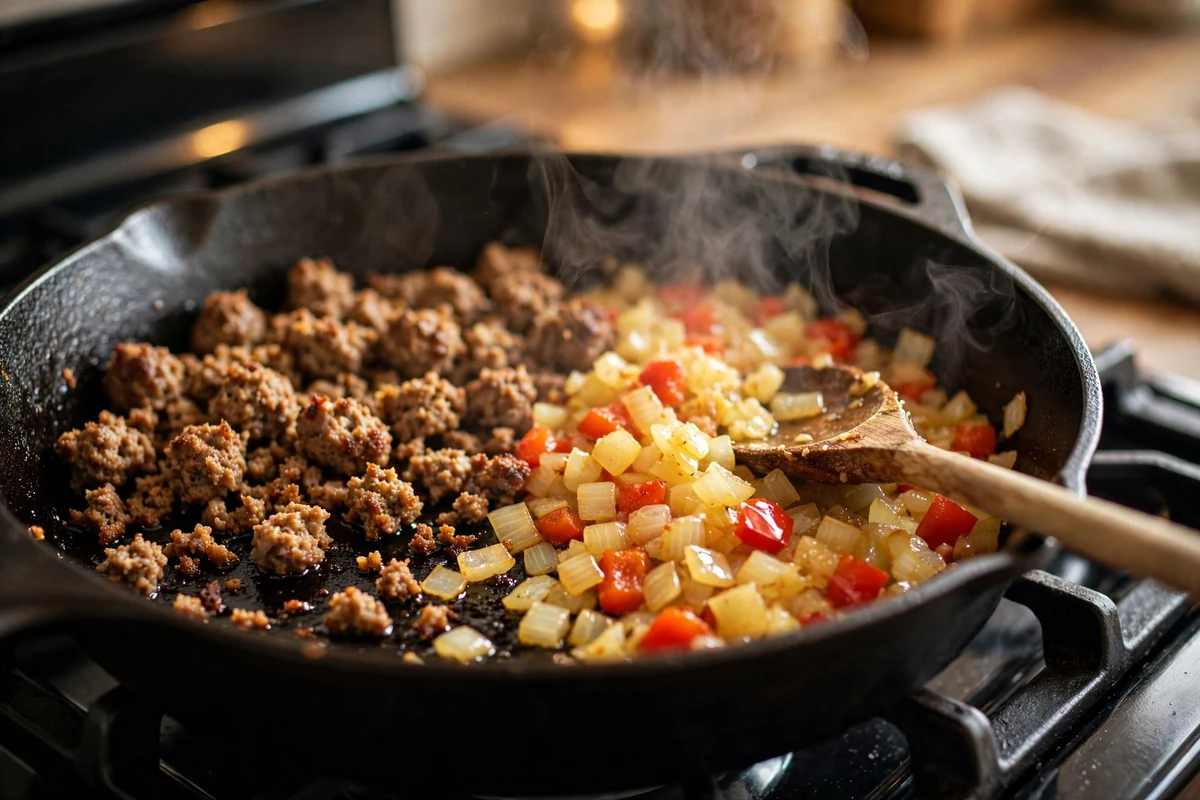
2. Brown the sausage and cook the vegetables
Sausage browning in a skillet with vegetables cooking alongside
3. Whisk the custard
4. Layer the dish
Layered breakfast casserole in a 9x13 dish with custard being pressed into the bread
5. Chill overnight
6. Bake covered, then uncovered
7. Rest before cutting
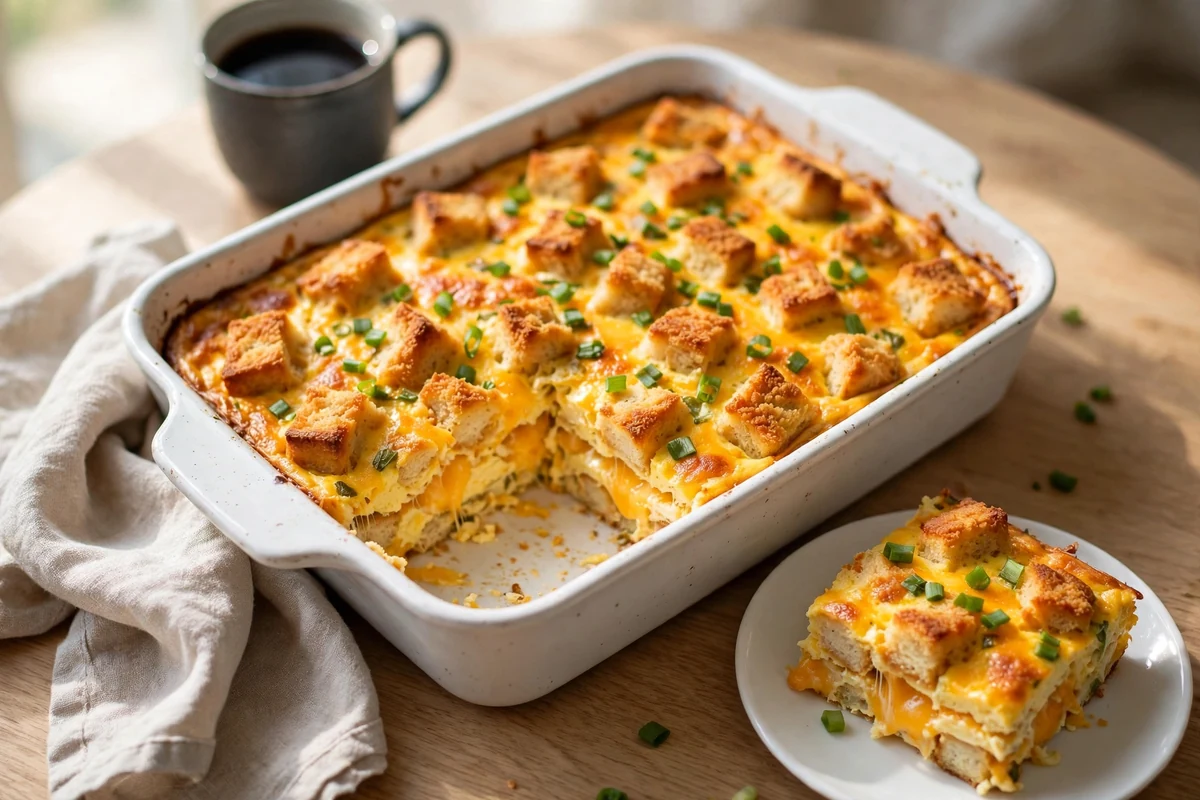
Make-ahead breakfast casserole resting after baking before being sliced
Getting the Custard Set Right
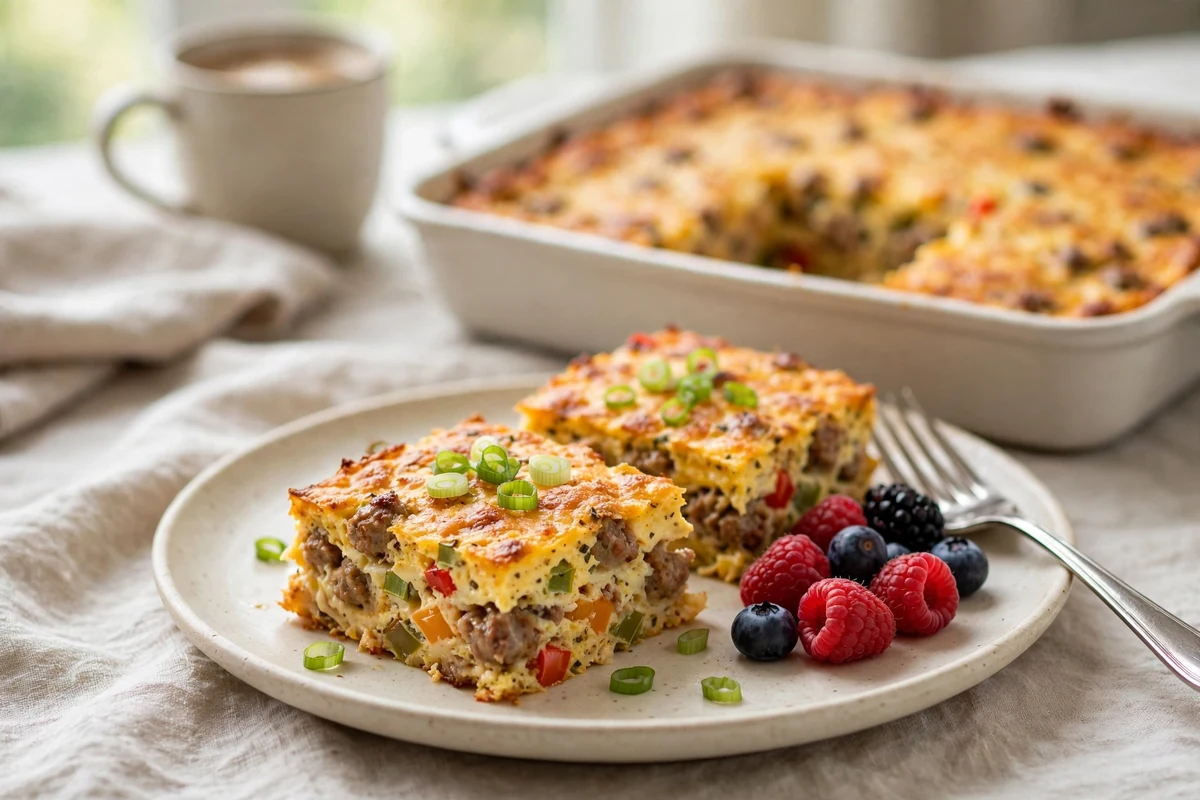
What it should look like: The surface is puffed and evenly browned with darker edges. When you nudge the dish, the center moves as a single soft unit rather than rippling like liquid. A knife inserted in the middle comes out with moist crumbs, not wet custard. Cut squares hold their shape with a soft, sliceable interior somewhere between quiche and bread pudding.
Cover it back up with foil and keep going in 10 minute increments. This happens when the dish went in fridge-cold or when the vegetables released water. Foil prevents the top burning while the middle catches up.
Almost always undried bread, soft sandwich bread, or raw vegetables. Nothing rescues it in the oven at that point. Fixes go into the next attempt: dry the cubes properly, use a sturdy loaf, cook the vegetables first.
The custard broke. Egg proteins overcooked, tightened and squeezed out the milk they were holding. Cause is heat, not time, so this is what happens when someone raises the oven to 400°F to speed things up. 350°F, all the way through, every time.
Overbaked, or the milk was too lean. Pull it at 160°F rather than waiting for a completely firm center, and use whole milk.
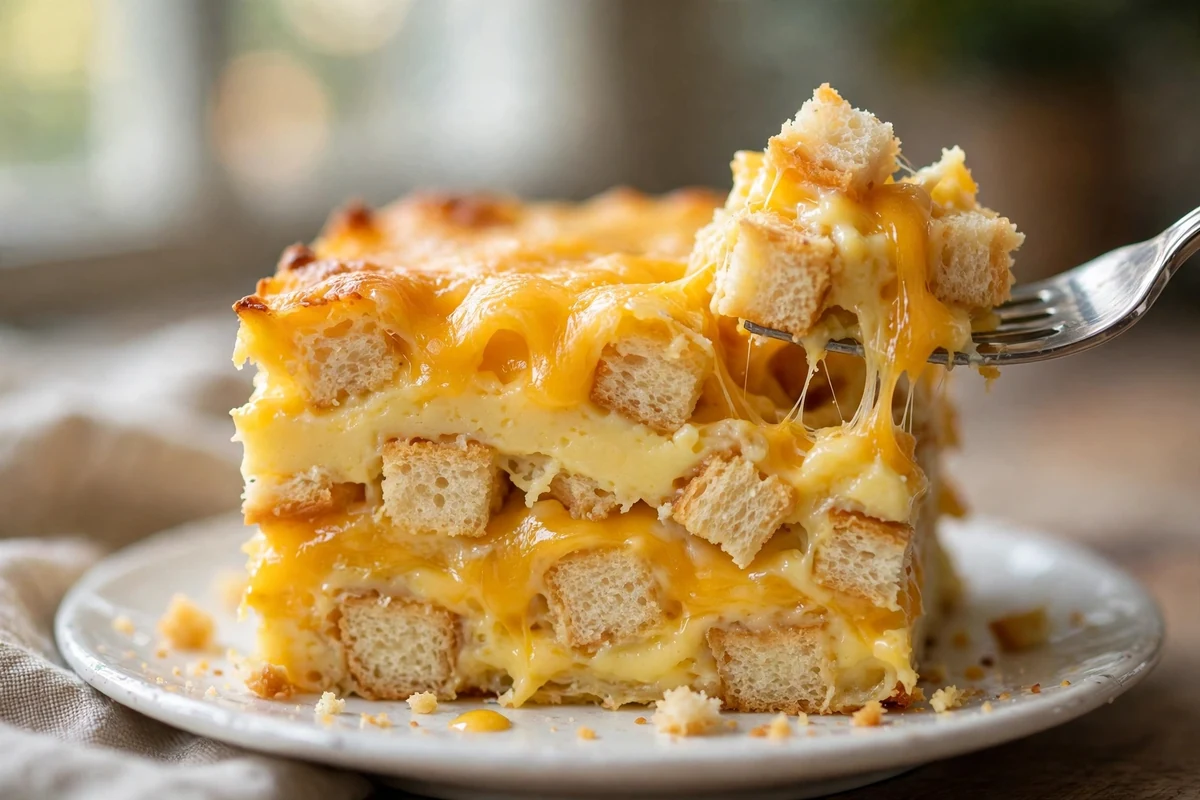
Baked breakfast casserole cut into squares showing the golden top and set custardy interior
How to Use Leftovers
How to Serve, Store & Reheat
Cut into 12 squares straight in the pan after the 15 minute rest. Scatter sliced green onions or chopped chives over the top for color and a bit of bite against the richness. Hot sauce, salsa or a spoonful of sour cream all work on the side. Chilled glasses of Strawberry Banana Smoothie and warm slices of Moist Banana Bread complete a generous holiday breakfast spread.
Cool to room temperature within two hours, then cover tightly or transfer squares to an airtight container. Refrigerate up to 4 days. Egg dishes shouldn't sit out at room temperature longer than two hours, and one hour if the room is above 90°F.
Single squares: microwave 60 to 90 seconds from cold, covered loosely with a damp paper towel so the top doesn't go leathery. Whole pan: cover with foil and warm at 325°F for 20 to 25 minutes, until the center reaches 165°F.
Yes, both ways. Baked: Cool completely, wrap individual squares in plastic then foil, freeze up to 3 months. Unbaked: Assemble fully, wrap tightly and freeze up to 1 month. Thaw a full 24 hours in the refrigerator before baking. If you are looking for a potato-crusted variation, our Hashbrown Breakfast Casserole offers another reliable brunch staple.
Make-ahead breakfast casserole squares served at the table with green onions, hot sauce and sour cream
Dietary Variations
Swap the bread for a sturdy gluten-free loaf and dry the cubes at 300°F for 18 to 20 minutes rather than 12 to 15. Gluten-free bread holds more moisture and needs the longer drying time, but it also breaks down faster once wet, so cut the fridge time to 4 hours maximum.
Unsweetened oat milk sets closest to dairy, and full-fat canned coconut milk cut 50/50 with unsweetened almond milk also works. Use a dairy-free cheddar-style shred and add it only in the top layer, since most plant-based cheeses seize rather than melt when fully submerged in custard.
Drop the sausage and use 10 oz of mushrooms plus 5 oz of spinach, both cooked down hard and squeezed dry in a clean towel. Add ½ teaspoon of ground sage and an extra ¼ teaspoon of salt to replace the seasoning the sausage was carrying.
Replace the bread with 6 cups of cauliflower florets, roasted at 425°F for 20 minutes until dry and lightly charred. Reduce the milk to 2 cups, because there's no bread absorbing liquid, and skip the overnight chill entirely. Bake 40 to 45 minutes uncovered.
The ratio to memorize is one large egg per ¼ cup of dairy. That's what 12 eggs to 3 cups of milk works out to, and it's the point where a baked custard sets firm enough to slice but stays tender.
Push it toward more milk and you get a looser, spoonable result. Push it toward more egg and it firms up toward a frittata, denser and more prone to going rubbery if you overshoot the temperature. Neither is wrong, but knowing where the line sits means you can scale this to any pan you own instead of hunting for a recipe that happens to match your dish.
An 8x8 pan is roughly half a 9x13, so 6 eggs and 1½ cups milk. Same bake temperature, start checking around 40 minutes.
Allergen Notice: This recipe contains eggs, dairy (milk, butter, cheese) and wheat (bread). Substitutions above cover dairy and wheat. For eggs, there is no substitute that works here: eggs are the structural element of the dish, and a plant-based egg replacer produces something different enough that it needs its own recipe rather than a swap. Ingredient formulations vary between brands, so check labels on the sausage, bread and cheese for cross-contact warnings. I can't tell you this recipe is safe for any specific allergy. Anyone cooking for a diagnosed allergy should verify every product themselves.
Frequently Asked Questions
Recipe Visual Gallery (6 Full Photos)
Recipe Card & Steps
Ingredients Checklist
Click an item to check it off as you prep
- 12 ozsturdy sourdough or French bread (about 10 cups cubed, ¾ inch cubes)
- 1 lbbulk chicken or beef breakfast sausage
- 1medium yellow onion, diced
- 1red bell pepper, diced
- 8 ozsharp cheddar, shredded from a block (about 2 cups)
- 4 ozGruyère or Monterey Jack, shredded (about 1 cup)
- 1 tbspunsalted butter, for the dish
- 12large eggs
- 3 cupswhole milk
- 1 tspDijon mustard
- 1½ tspkosher salt
- ½ tspblack pepper
- ½ tspgarlic powder
- 2green onions, thinly sliced
Step-by-Step Instructions
Follow along and mark each step complete as you cook
Heat the oven to 300°F. Spread the bread cubes on a rimmed sheet pan and bake 12 to 15 minutes, tossing once, until dry and light with barely golden edges. Cool completely.
Cook the sausage in a large skillet over medium heat, breaking it into crumbles, until browned and cooked through (165°F for poultry sausage). Transfer to a paper-towel-lined plate. Pour off all but 1 tablespoon of fat.
Cook the onion and bell pepper in the reserved fat over medium heat for 6 to 8 minutes, until the onion is translucent and no liquid pools in the pan. Cool slightly.
Whisk the eggs in a large bowl until completely uniform. Add the milk, Dijon, salt, pepper and garlic powder. Whisk until frothy on top.
Butter a 9x13 baking dish. Layer half the bread, half the sausage, half the vegetables and half of both cheeses. Repeat with the remaining bread, sausage, vegetables and cheese.
Pour the custard slowly and evenly over the surface. Press the bread down firmly with your palms or a spatula. Rest 15 minutes on the counter, then press again.
Cover tightly and refrigerate at least 8 hours or overnight, up to 24 hours maximum.
Remove from the fridge and heat the oven to 350°F, letting the dish sit on the counter about 20 minutes while it preheats.
Bake covered with foil for 45 minutes. Uncover and bake 15 to 20 minutes more, until the top is deeply golden, the center is puffed rather than liquid, and an instant-read thermometer in the middle reads 160°F.
Rest 15 minutes. Top with sliced green onions and cut into 12 squares.
Recipe Card Notes & Tips
- Short on time? One hour of refrigeration is the minimum for a properly set casserole. Do not skip the chill entirely, the bread needs time to absorb the custard.
- Adding vegetables? Cook and drain anything watery first, especially mushrooms and spinach. Raw vegetables are the main cause of a soggy result.
Ratings & Reviews
Leave a Review
Made this recipe? Share your thoughts, tweaks, and honest rating with other home cooks!
Community Reviews (0)
You Might Also Enjoy
More delicious recipes in Breakfast.