Zucchini Lasagna Recipe That Isn't Watery
This zucchini lasagna recipe salts and roasts the planks first, so the layers set instead of flooding the pan. Low-carb, gluten-free, with beef ragu.
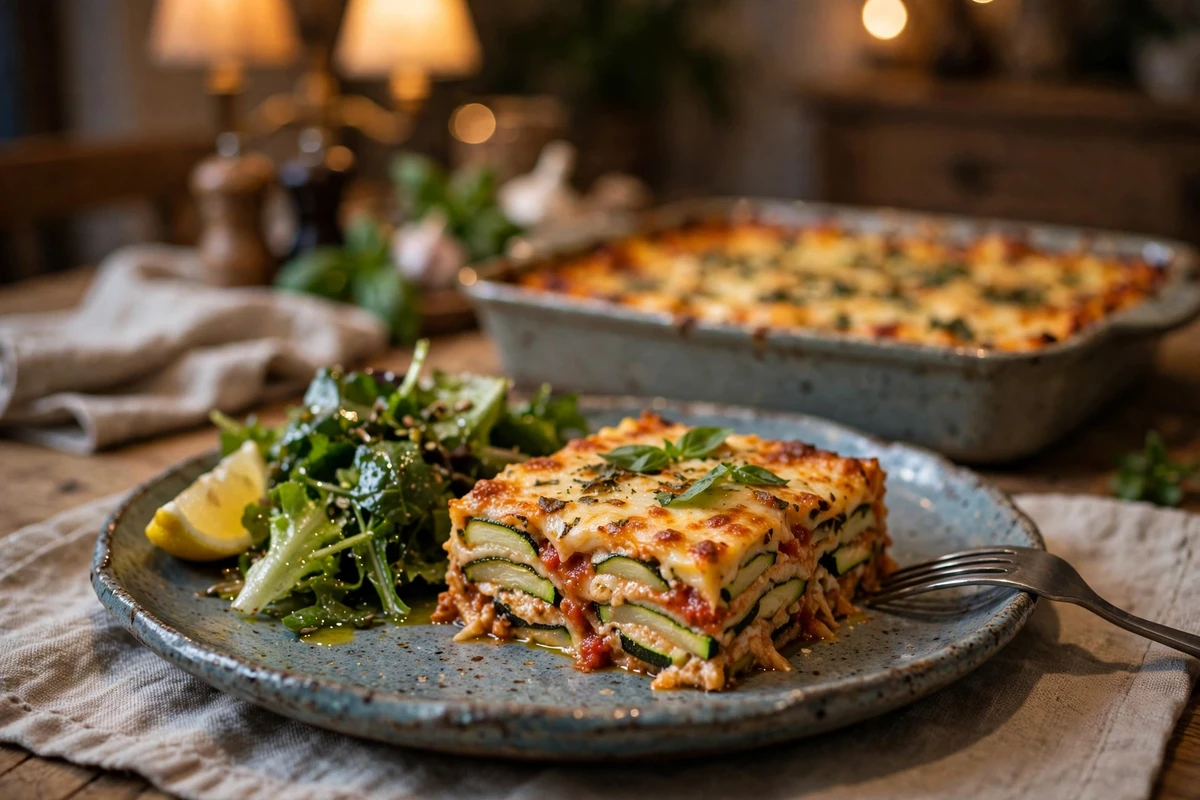
This zucchini lasagna recipe uses two stages instead of one: salt the planks, then roast them dry before they ever go in the pan. The result cuts into squares that hold, with a thick beef ragù and a ricotta layer that sets. No noodles, no soggy bottom, no puddle in the dish.
Why You'll Love This Recipe
- The two-stage water removal actually works, so you get squares instead of a scoop.
- It is naturally low-carb and gluten-free without any specialty ingredients.
- Peak-season zucchini is cheap and this uses four pounds of it.
- It reheats well for lunches, which is unusual for a vegetable-based bake.
Here's the one thing nobody tells you: salting is only half the job. You have to roast the planks too. Salt works by osmosis on the surface, drawing out the free water sitting near the cut face.
That is why 30 minutes of salting produces a visible puddle and feels like you have solved the problem. You have not. The water bound inside the cell walls is still there, and oven heat is what releases it.
Fifteen minutes on a sheet pan at 400°F drives that out before assembly, where it can evaporate freely, instead of during the bake, where it has nowhere to go but the bottom of your dish.
Skip this step and you will do everything else right and still end up spooning liquid off the pan.
Read Before You Start
Slice lengthwise into planks, not into rounds. Long planks span most of the dish and act like pasta sheets, giving each layer structural continuity. Rounds create seams in every direction, and a slice built on seams falls apart the moment the server goes in.
Buy medium zucchini, 6 to 8 inches long. The oversized ones are tempting because they yield more planks per vegetable, but they are mostly water and developed seeds. Medium zucchini have denser flesh and hold their shape through roasting and baking.
Ingredient Deep Dive & Notes
Zucchini, about 4 pounds. That sounds like a lot, and it is deliberate. The planks shrink by roughly a third during roasting. Buy more than feels necessary.
Ground beef, 85/15. Leaner beef makes a flat sauce, and there is no pasta here to carry richness. Fattier than 85/15 and you will be pouring grease off.
Crushed tomatoes only, no second can of tomato sauce. A standard lasagna sauce would use both. Here the sauce needs to be thicker than usual, because the zucchini will still contribute some moisture no matter how well you prep it.
Beef broth, not wine. Half a cup, only enough to lift the browned bits off the pan. Many ragù recipes deglaze with red wine; broth does the same job and the sauce simmers long enough that it does not matter.
Whole-milk ricotta. Do not substitute part-skim. In a dish whose entire problem is excess water, part-skim ricotta is the last thing you want. It holds more water, less fat, and it breaks down and leaks under oven heat. Whole-milk ricotta with an egg beaten in sets into a soft custard.
Low-moisture mozzarella, in a block. Shred it yourself. Fresh mozzarella packed in water is completely wrong for this dish for obvious reasons, and pre-shredded is coated in starch that stops it melting cleanly.
If you want the traditional pasta version, that is Easy Lasagna. For a creamy white-sauce take, see Creamy Chicken Lasagna.
Equipment Needed
- A mandoline, if you have one. Even ¼-inch planks matter more here than in most recipes, since uneven thickness means some layers turn to mush while others stay crunchy. A sharp chef's knife and patience also works.
- Two rimmed baking sheets for roasting the planks in a single layer. Crowding them steams the zucchini instead of drying it, which defeats the whole point.
- A wire rack for the salting stage, so the drawn-out water drains away instead of pooling back underneath.
- A 9x13-inch baking dish, at least 3 inches deep.
- An instant-read thermometer.
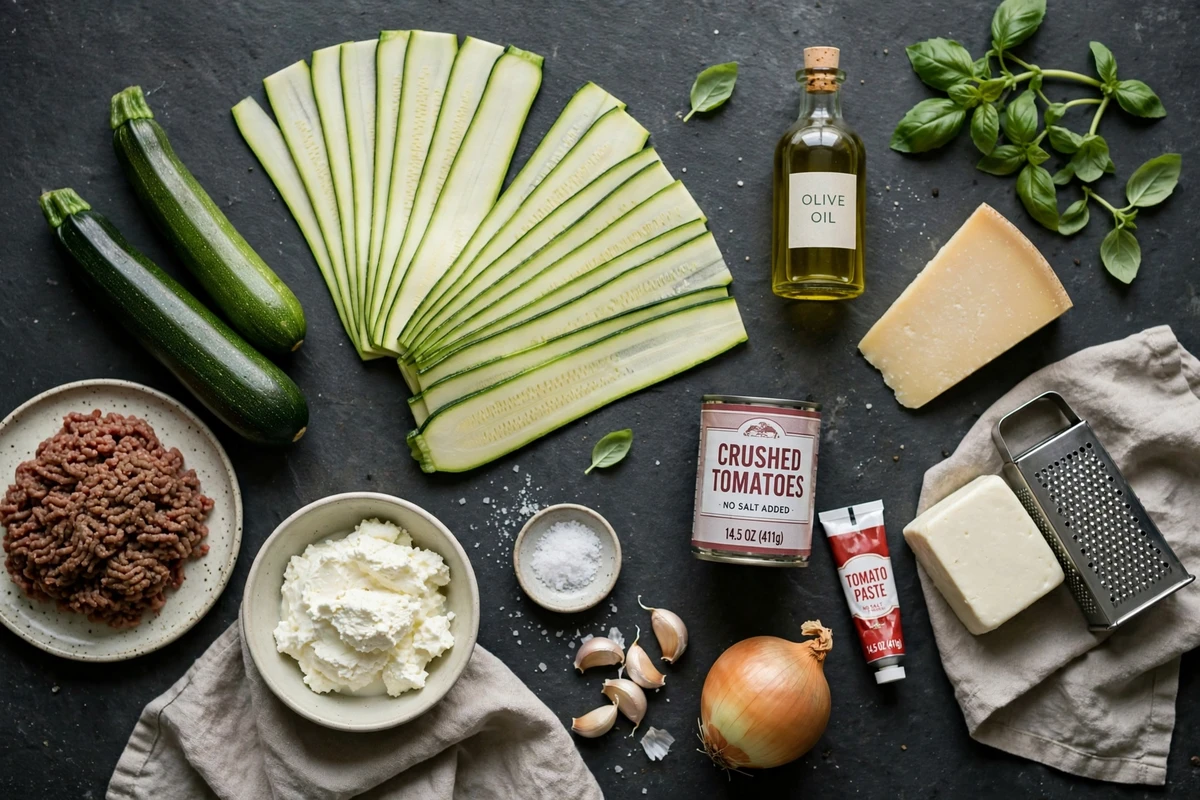
Ingredients for zucchini lasagna including sliced zucchini planks, ground beef, ricotta, crushed tomatoes, and mozzarella
Detailed Step-by-Step Cooking Guide
Preparation & Setup
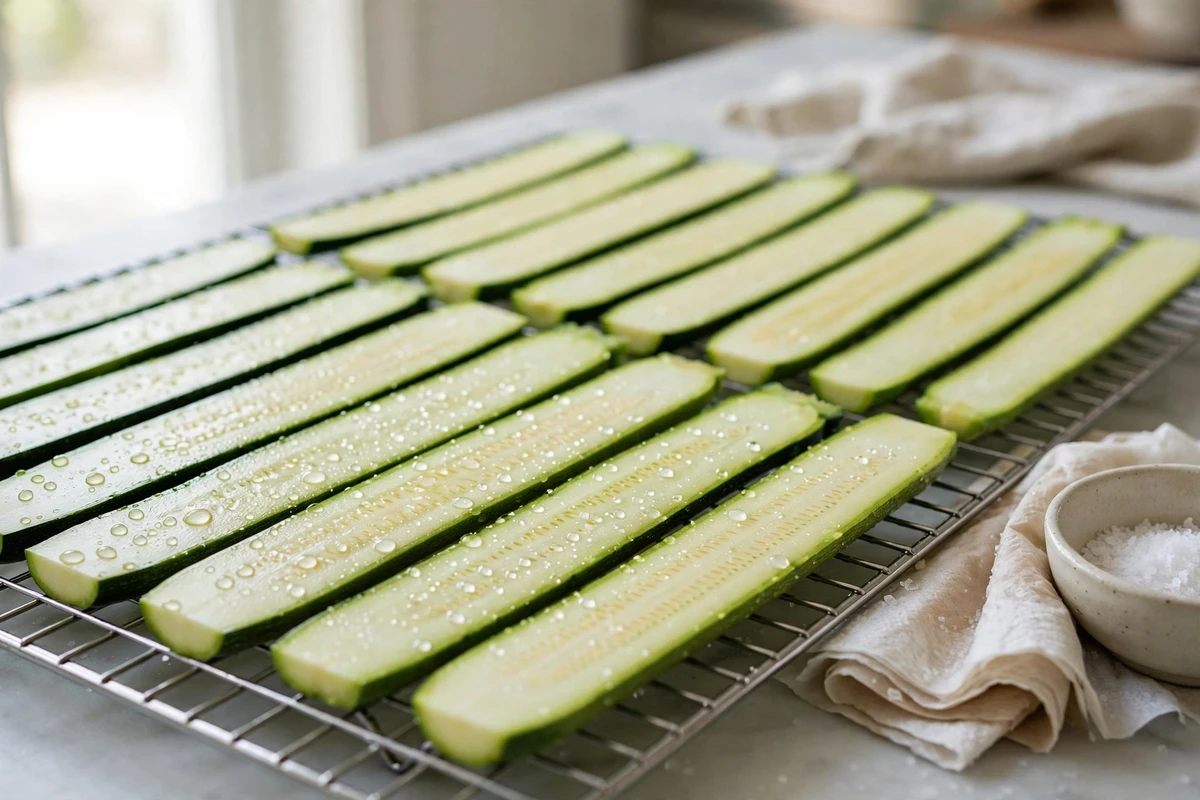
Sliced zucchini planks sweating water droplets on a wire rack with salt
Slice and salt the zucchini
Start the meat sauce while they drain
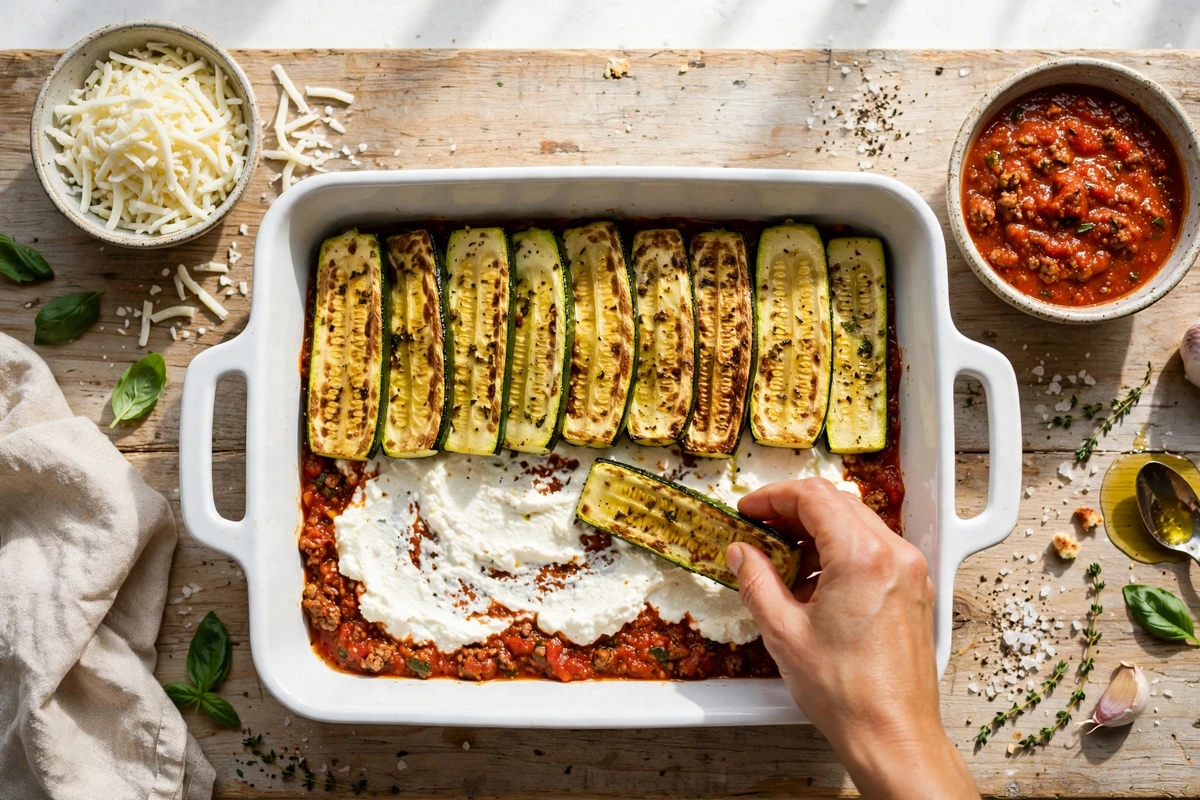
Placing roasted zucchini planks over meat sauce and ricotta in a white baking dish
Simmer the sauce thick
Simmering thick tomato beef ragù and roasted zucchini planks on parchment-lined sheet pans
Roast the planks
Mix the ricotta
Layer it
Layering roasted zucchini planks with meat sauce and ricotta in a baking dish
Bake covered, then uncovered
Rest 20 minutes
Getting the Texture Right
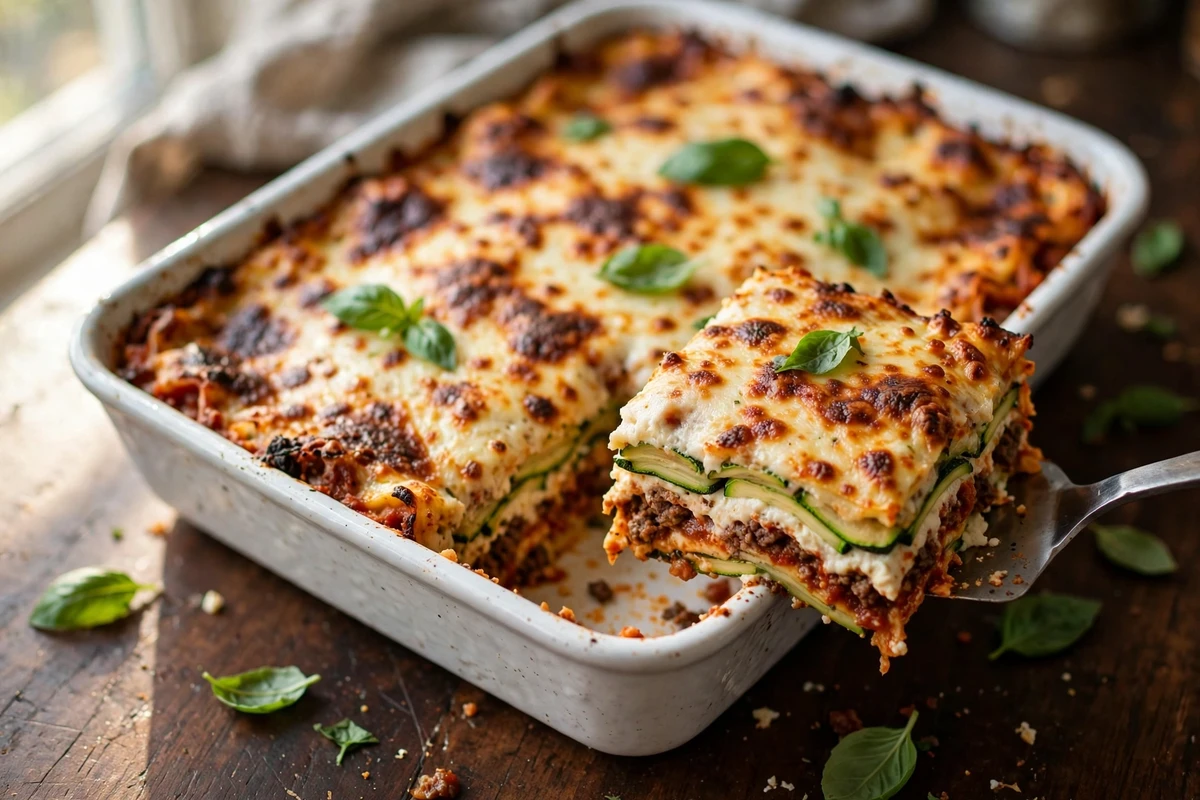
A finished slice should stand on its own with visible stripes: green-edged zucchini, a pale set cheese layer, dark sauce. The cut face looks glossy, not wet, and the gap where you removed the slice should stay dry.
A stage got skipped or shortened. Salting without roasting is the most common version of this. Tilt the dish, spoon the liquid off, and give it another 10 minutes of rest.
Planks sliced too thin, or all laid in the same direction. Quarter-inch is the target, and rotating each layer 90 degrees genuinely helps.
The salting stage pulls seasoning out along with the water, and zucchini brings nothing of its own. Fix it in the sauce, which should taste slightly too strong on its own spoon.
The planks were not blotted after salting, so all that drawn-out salt went back in. Blot firmly next time and hold back the salt in the sauce.
Planks cut thicker than ¼ inch, or the roast was cut short. Cover and bake another 10 minutes.
Spatula lifting a clean square slice of zucchini lasagna with golden melted cheese
How to Use This Zucchini Lasagna Recipe Beyond One Dinner
How to Serve, Store & Reheat
Cut into 10 squares with a thin sharp knife, wiping the blade between cuts. Lift each square with a wide spatula rather than a narrow server, since there is no pasta holding it together. A sharp green salad and a squeeze of lemon over the top suit it well.
Cool to room temperature within two hours, then cover tightly or move squares to airtight containers. Refrigerate up to 4 days. It firms up overnight and cuts more cleanly on day two than day one.
Individual squares: microwave covered at 50% power for 2 to 3 minutes. A whole pan: cover with foil and bake at 350°F (175°C) for 25 to 35 minutes. Either way, heat until the center reaches 165°F (74°C). If it looks wet after reheating, uncover it for the last 5 minutes.
Not recommended, and here is the honest reason. Freezing ruptures zucchini's cell walls, so it releases the water you worked to remove as soon as it thaws. A frozen and reheated pan comes out soft and wet no matter how careful the prep was. If you want to get ahead, freeze the meat sauce instead, which freezes perfectly for 3 months, then salt and roast fresh zucchini on the day.
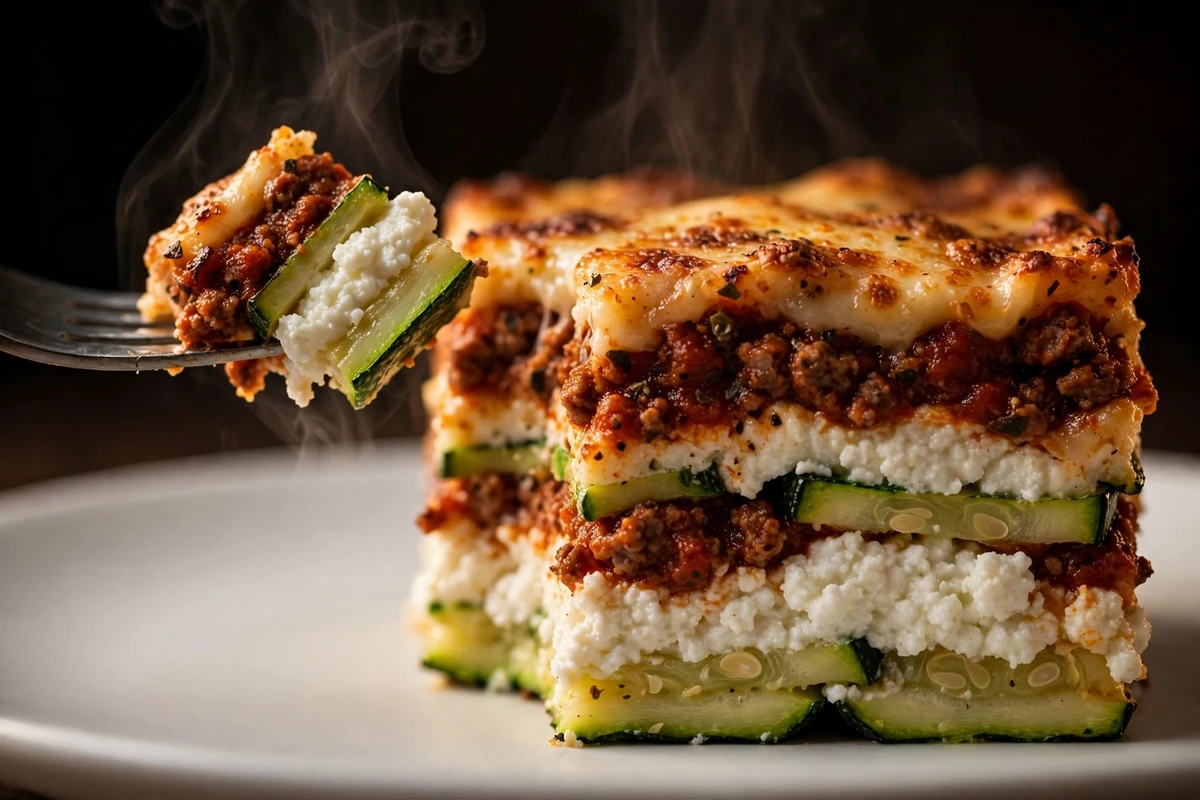
Fork lifting a bite of zucchini lasagna showing clean layers with no watery liquid pooling
Dietary Variations
Replace the beef with 1 pound of cremini mushrooms pulsed in a food processor and browned hard in two batches until they squeak and stop giving off water, plus a cup of cooked brown lentils. Browning them properly matters double here, since undercooked mushrooms add water to a dish that cannot take any.
Swap the ricotta for a puréed white bean, garlic, and olive oil spread, and use a dairy-free mozzarella. The bean purée actually binds better than most dairy-free ricottas and holds up to the bake without adding moisture.
The recipe is already around 14 grams of carbohydrate per serving. To go lower, cut the crushed tomatoes to half a can and add ½ cup more broth reduced down, or swap one layer of zucchini for thinly sliced eggplant, which is drier once salted and roasted the same way.
Thickness is the variable people get wrong most often, and it goes both ways. Under ¼ inch and the planks disintegrate into the sauce during the bake, leaving you with a casserole rather than a lasagna.
Much over ¼ inch and the middle stays crunchy no matter how long it bakes, because zucchini softens from the outside in.
If you are cutting by hand, slice one plank, measure it against a ruler once, and use it as your reference for the rest. Eyeballing it after that is fine.
Consistency between planks matters more than hitting exactly a quarter inch.
Allergen Notice: This recipe contains dairy (ricotta, mozzarella, Parmesan) and eggs (in the ricotta filling). It contains no wheat or gluten as written, but check your dried Italian seasoning blend, since some contain wheat-based anti-caking agents. Reasonable substitutions: the white bean purée and dairy-free mozzarella above for the dairy; 3 tablespoons of aquafaba whisked into the ricotta in place of the egg, which binds less firmly and needs a longer rest. I cannot verify any brand or production line for you, so read labels and treat this as a starting point rather than a guarantee. Anyone cooking for a serious allergy should confirm every product independently.
Frequently Asked Questions
Recipe Visual Gallery (6 Full Photos)
Recipe Card & Steps
Ingredients Checklist
Click an item to check it off as you prep
- 4 lb (1.8 kg)zucchini, about 5 to 6 medium
- 2 tspkosher salt, for drawing out water
- 2 tbspolive oil
- 1½ lb (680 g)ground beef, 85/15
- 1 mediumyellow onion, diced
- 4 clovesgarlic, minced
- 3 tbsptomato paste
- ½ cupbeef broth
- 1 (28 oz / 794 g) cancrushed tomatoes
- 1 tbspdried Italian seasoning
- 1 tspkosher salt
- ½ tspblack pepper
- ¼ tspcrushed red pepper flakes (optional)
- 16 oz (450 g)whole-milk ricotta
- 1 largeegg
- ¾ cup (65 g)finely grated Parmesan
- ¼ cupchopped fresh basil
- ½ tspkosher salt (for ricotta filling)
- ¼ tspblack pepper (for ricotta filling)
- 12 oz (340 g)low-moisture whole-milk mozzarella, shredded (about 3 cups)
- ½ cup (40 g)finely grated Parmesan, for the top
Step-by-Step Instructions
Follow along and mark each step complete as you cook
Slice the zucchini lengthwise into planks about ¼ inch thick. Lay in a single layer on wire racks, sprinkle both sides lightly with the 2 tsp salt, and leave 30 minutes. Blot both sides firmly dry. Do not rinse.
Meanwhile, heat the olive oil in a large skillet over medium-high. Add the ground beef, break into large chunks, and leave undisturbed 4 to 5 minutes until deeply browned. Break up and cook until no pink remains, about 8 minutes total.
Push the meat aside, add the onion, and cook 4 minutes. Add the garlic and cook 30 seconds. Stir in the tomato paste and cook 1 minute until it darkens, then add the beef broth and scrape the pan clean.
Add the crushed tomatoes, Italian seasoning, 1 tsp salt, ½ tsp pepper, and red pepper flakes. Simmer uncovered on low 30 minutes, until a spoon dragged across the pan leaves a lane that stays open about 3 seconds. Season assertively.
Heat the oven to 400°F (200°C). Arrange the blotted zucchini in a single layer on two parchment-lined sheet pans and roast 12 to 15 minutes, until shrunken and pliable with lightly browned edges and no wet sheen. Cool a few minutes.
Stir together the ricotta, egg, ¾ cup Parmesan, basil, ½ tsp salt, and ¼ tsp pepper until smooth.
Drop the oven to 375°F (190°C). Spread ¾ cup sauce over the bottom of a 9x13-inch baking dish.
Layer: zucchini planks overlapping slightly and all facing the same direction, one third of the ricotta spread to the edges, about 1 cup sauce, ¾ cup mozzarella. Repeat twice, rotating the planks 90 degrees on each new layer.
Finish with the remaining sauce, the last 1 cup mozzarella, and the ½ cup Parmesan.
Tent with foil so it does not touch the cheese. Set on a rimmed baking sheet and bake 35 minutes. Uncover and bake 15 minutes more, until browned in patches and thickly bubbling at the edges, with the center at 165°F (74°C). If liquid is still moving at the edges, give it 5 to 10 minutes more uncovered.
Rest 20 minutes before cutting into 10 squares. Lift with a wide spatula.
Recipe Card Notes & Tips
- Salting alone will not stop this from going watery. The 400°F roast is what removes the water bound inside the zucchini, and skipping it is the single most common reason this dish fails.
- To assemble ahead: build it, cover, and refrigerate up to 1 day. Bake from cold and add 10 to 15 minutes to the covered stage. Do not go beyond a day, since the zucchini keeps releasing liquid in the fridge.
Ratings & Reviews
Leave a Review
Made this recipe? Share your thoughts, tweaks, and honest rating with other home cooks!
Community Reviews (0)
You Might Also Enjoy
More delicious recipes in Main Dishes.